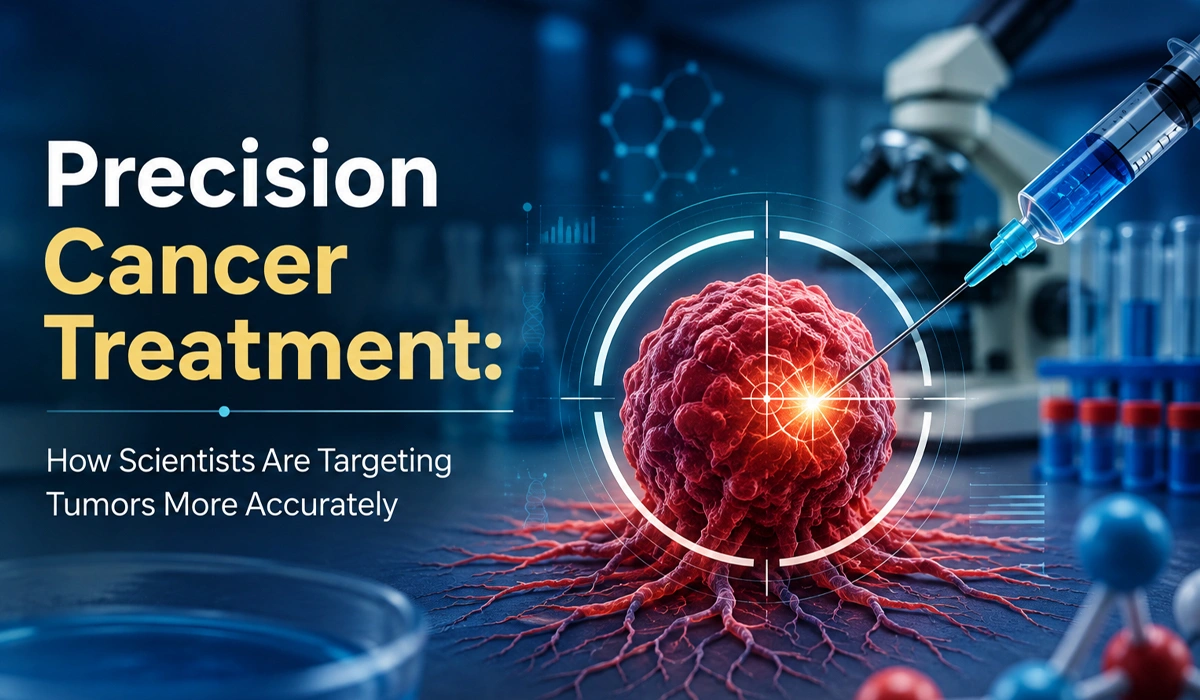
Introduction: What If Cancer Treatment Could Be Chosen by the Tumor’s Biology?
For decades, cancer treatment was largely organized around where a tumor started.
A patient might be told they have lung cancer, breast cancer, colorectal cancer or another type of cancer. Doctors would then consider the cancer’s stage, grade and other clinical characteristics before selecting treatment.
Today, scientists are adding another layer to that picture.
Instead of asking only, “Where is the cancer?”, modern oncology increasingly asks:
“What is driving this particular tumor?”
That question is at the heart of precision cancer treatment.
Precision medicine uses information about genes, proteins and other characteristics of a patient’s cancer to help guide diagnosis and treatment. In some cases, testing can identify a molecular change that can be targeted by a specific medicine.
This does not mean cancer treatment has become a simple matter of taking a genetically matched drug. Cancer is complex. Tumors can contain different groups of cells, biomarkers can change over time, and a treatment that works for one person may not work for another.
But the direction is clear: cancer research is moving toward more detailed tumor characterization and more selective treatment decisions.
The World Health Assembly also endorsed a 2026 resolution supporting precision medicine as a path toward more targeted, personalized and equitable healthcare.
So, how does precision cancer treatment actually work?
1. What Is Precision Cancer Treatment?
Precision cancer treatment is an approach that uses information about a tumor’s molecular, genetic and biological characteristics to help select treatment. Instead of relying only on the cancer’s location, doctors may use biomarkers and genomic information to identify treatments that are more likely to work for a particular tumor.
Precision medicine is sometimes called personalized medicine.
In cancer care, it can involve:
- Tumor genomic testing
- Biomarker testing
- Molecular profiling
- Protein testing
- Targeted therapies
- Immunotherapy selection
- Clinical trials based on tumor characteristics
The National Cancer Institute describes precision medicine as using specific information about a person’s tumor to help diagnose cancer, plan treatment, evaluate treatment response and estimate prognosis.
Why does this matter?
Two people may have the same broad cancer diagnosis but have different molecular features.
Those differences can influence:
- How quickly the cancer grows
- How it responds to treatment
- Whether a targeted drug may work
- Whether immunotherapy may be appropriate
- Whether a clinical trial may be relevant
Practical takeaway: A cancer diagnosis is the beginning of treatment planning—not necessarily the end of the investigation.
2. Why Are Scientists Studying Tumors at the Molecular Level?
Cancer develops through changes that affect how cells grow, divide, survive and spread. By studying these changes, scientists can identify molecular features that may act as treatment targets or biomarkers. This helps researchers develop therapies designed to interfere with specific cancer-driving pathways.
Cancer cells can acquire changes in DNA and other biological systems.
Some changes can activate growth signals. Others may help cancer cells avoid immune attack or become resistant to treatment.
Cancer genomics research now examines not only DNA but also gene expression, proteins and other molecular characteristics.
This has changed how researchers think about cancer.
A simple example
Imagine two tumors located in the same organ.
Tumor A: has a molecular alteration that activates a particular growth pathway.
Tumor B: does not have that alteration but has another biological feature.
Although both tumors may look similar under conventional examination, their molecular profiles may be different.
That difference could influence treatment selection.
Practical tip: Ask your oncology team whether molecular or biomarker testing is relevant to your specific cancer type and treatment stage.
3. What Is Biomarker Testing in Cancer?
Biomarker testing looks for genes, proteins or other biological features in cancer that may help doctors select treatment. Some biomarkers can indicate whether a tumor may respond to a targeted therapy or immunotherapy. Testing may involve tumor tissue, blood or other samples depending on the situation.
Biomarker testing is also called:
- Tumor testing
- Tumor profiling
- Genomic profiling
- Molecular profiling
- Tumor genetic testing
- Somatic testing
The National Cancer Institute notes that biomarker testing is an important part of precision medicine and can help doctors identify treatments that may be appropriate for certain tumors.
Some tests examine a single biomarker. Others examine multiple genes simultaneously through multigene or panel testing.
What can a result show?
A test may identify:
| Result | Possible meaning |
|---|---|
| Actionable biomarker | A treatment targeting that feature may exist |
| Biomarker associated with treatment response | A therapy may be considered |
| Resistance-associated feature | A treatment may be less likely to work |
| Variant of unknown significance | More evidence may be needed |
| No actionable finding | No currently established matched therapy may be available |
Importantly, a biomarker match does not guarantee treatment success.
Cancer biology is more complicated than one genetic result
4. How Does Tumor Genomic Testing Work?
Tumor genomic testing generally begins with a cancer sample obtained through biopsy or surgery. A specialized laboratory analyzes DNA and sometimes other molecular features. The resulting report identifies relevant biomarkers and may list therapies or clinical trials that could potentially match those findings.
A simplified process looks like this:
Step 1: Cancer diagnosis
Doctors establish the cancer type and stage.
Step 2: Sample collection
Tumor tissue may be collected through biopsy or surgery.
Step 3: Laboratory analysis
Scientists analyze selected genes, proteins or other biomarkers.
Step 4: Molecular report
The laboratory reports relevant findings.
Step 5: Clinical interpretation
The oncology team considers whether any finding has treatment relevance.
Step 6: Treatment decision
The result is considered alongside cancer stage, previous treatment, overall health and clinical evidence.
A liquid biopsy may sometimes be used when tumor tissue is difficult or unsafe to obtain.
Important distinction
Tumor genetic testing is not the same as inherited genetic testing.
Tumor testing generally looks for changes that developed in cancer cells during a person’s lifetime. Inherited genetic testing looks for genetic changes that may have been present from birth and can have implications for family members.
5. What Are Targeted Cancer Therapies?
Targeted therapy is designed to interfere with specific proteins or biological pathways that help cancer cells grow, divide or spread. Unlike conventional chemotherapy, which can affect many rapidly dividing cells, targeted therapies are designed around particular molecular targets, although they can still cause significant side effects.
Targeted therapy is considered a foundation of precision medicine.
There are two broad categories:
Small-molecule medicines
These can enter cells and interfere with targets inside the cell.
Monoclonal antibodies
These laboratory-produced proteins can attach to specific targets, including targets on cancer cells.
Depending on the medicine, targeted therapy may:
- Block growth signals
- Prevent cancer cells from dividing
- Help the immune system recognize cancer cells
- Deliver a toxic substance to cancer cells
- Interfere with processes needed for tumor survival
However, targeted does not mean risk-free.
Patients can experience side effects, and cancer cells can sometimes develop resistance.
6. Precision Treatment and Immunotherapy: What Is the Difference?
Targeted therapy directly focuses on a molecular target associated with cancer, while immunotherapy works by helping the immune system recognize or attack cancer. Biomarker testing can help identify patients who may benefit from certain immunotherapies, depending on the cancer and the biomarker.
| Precision approach | Main idea |
|---|---|
| Targeted therapy | Blocks a specific cancer-related target |
| Immunotherapy | Helps the immune system fight cancer |
| Biomarker testing | Identifies biological features that may guide treatment |
| Genomic profiling | Looks for multiple genetic alterations |
| Liquid biopsy | Looks for cancer-related material in blood |
Some immunotherapies depend on specific biomarkers.
For example, tumor characteristics such as microsatellite instability-high (MSI-H) or mismatch repair deficiency can help identify patients who may benefit from certain immune checkpoint therapies.
The key point is that not every patient benefits from every immunotherapy.
Treatment selection requires clinical interpretation.
7. Can Precision Cancer Treatment Work for Every Patient?
No. Precision cancer treatment does not work for every patient. Some tumors have actionable biomarkers, while others do not. Even when a target is identified, the matched treatment may not work because tumors are biologically diverse, biomarkers can change, or resistance can develop.
This is one of the most important realities of precision oncology.
A genomic report can provide valuable information without producing a simple treatment answer.
The NCI notes several limitations, including:
- Insufficient tumor tissue
- No actionable biomarker
- No available matched treatment
- Limited evidence for a particular finding
- Insurance or affordability barriers
- Clinical trial eligibility limitations
- Tumor heterogeneity
- Changes in biomarkers over time
Example
Suppose a tumor contains a target that can be treated with a specific therapy.
That does not necessarily mean every cancer cell contains the same target.
Some cells may survive treatment and continue growing.
This is one reason cancer treatment often requires ongoing monitoring and adjustment.
8. How Scientists Are Tackling Cancer Drug Resistance
Cancer treatment resistance can occur when some cancer cells survive therapy and continue growing. Scientists are studying tumor evolution, molecular changes, combination therapies and repeated testing to understand why resistance develops and how treatment can be adapted.
Resistance is one of the biggest challenges in oncology.
A tumor is not always a single uniform population of cells.
Different groups of cancer cells may have different characteristics. Treatment can eliminate sensitive cells while resistant cells remain.
Researchers are therefore investigating:
- Combination treatments
- New molecular targets
- Next-generation targeted therapies
- Sequential treatment strategies
- Repeated biomarker testing
- Liquid biopsy approaches
- Adaptive clinical trials
The NCI notes that tumor biomarkers can change over time, meaning an earlier test may not always represent the cancer’s current biology.
Practical takeaway: Precision oncology is not necessarily a one-time test. In some circumstances, doctors may consider additional testing when cancer returns or changes.
9. What Role Does Artificial Intelligence Play in Precision Oncology?
AI can help researchers and clinicians analyze large amounts of biological and clinical information, identify patterns and support research into cancer diagnosis and treatment. However, AI does not replace oncologists, laboratory validation or clinical evidence.
Cancer research generates enormous amounts of information.
A single tumor can produce data involving:
- DNA
- RNA
- Proteins
- Imaging
- Pathology
- Treatment history
- Clinical outcomes
AI and computational tools can help researchers analyze these complex datasets.
Potential applications include:
- Medical image analysis
- Pathology analysis
- Genomic pattern recognition
- Drug discovery
- Clinical trial matching
- Treatment-response prediction
- Research into cancer resistance
But an algorithm’s prediction is not automatically a clinically proven treatment recommendation.
Human oversight, validation and appropriate medical judgment remain essential.
10. Precision Cancer Treatment in India: What Patients Should Know
Precision oncology is developing in India, but access is not uniform. Availability of molecular testing, specialized laboratories, oncology expertise, targeted medicines and clinical trials can vary between hospitals and cities. Patients should discuss the relevance, evidence, cost and availability of testing with their oncology team.
India has a growing cancer research and treatment ecosystem, but access remains an important challenge.
The International Agency for Research on Cancer has highlighted barriers to timely cancer diagnosis and treatment access in India.
Recent international discussions also emphasize that precision oncology requires infrastructure, trained professionals, reliable diagnostics and equitable access—not simply new medicines.
For patients in cities such as:
- Delhi
- Mumbai
- Bengaluru
- Chennai
- Hyderabad
- Kolkata
- Pune
- Ahmedabad
specialized oncology services may be available through major cancer centres and tertiary hospitals. Availability varies by institution.
Before ordering a test, ask:
- Why is this test being recommended?
- What treatment decision could it change?
- Is tissue testing or liquid biopsy more appropriate?
- Which biomarkers are being tested?
- How long will results take?
- What will the test cost?
- Is the matched treatment clinically established?
- Could the result identify a clinical trial?
Do not order an expensive genomic test simply because it is marketed as “advanced.”
The test should have a meaningful clinical purpose.
11. Precision Oncology vs Traditional Cancer Treatment
Precision oncology does not completely replace conventional cancer treatment. Instead, it adds molecular information to established clinical factors. Surgery, radiation, chemotherapy, hormone therapy, targeted therapy and immunotherapy may all have important roles depending on the cancer.
| Approach | What guides treatment? | Main role |
|---|---|---|
| Conventional approach | Cancer type, stage, grade and clinical factors | Established cancer treatment |
| Precision oncology | Clinical factors + molecular/biological information | More individualized treatment selection |
| Targeted therapy | Specific molecular target | Blocks cancer-related pathways |
| Immunotherapy | Immune system + relevant biomarkers | Helps immune system attack cancer |
| Clinical trial | Defined eligibility criteria | Tests new or improved treatments |
Precision medicine should therefore be viewed as an additional layer of information, not a replacement for evidence-based cancer care.
WHO emphasizes that high-quality cancer treatment depends on accurate diagnosis and staging, evidence-based standards and equitable access.
12. What Are the Benefits and Limitations of Precision Cancer Treatment?
Precision cancer treatment can improve treatment selection by identifying molecular features that may be matched with specific therapies. However, it has limitations, including uncertain test results, lack of actionable targets, treatment resistance, cost and unequal access. The benefits depend on the cancer type and the quality of available evidence.
Potential benefits
- More detailed tumor characterization
- Identification of actionable biomarkers
- Better treatment selection in appropriate cancers
- Avoiding some treatments unlikely to help
- Identification of relevant clinical trials
- Better understanding of tumor biology
Potential limitations
- Not every tumor has an actionable target
- Testing can be expensive
- Results can be difficult to interpret
- Biomarkers can change
- Matched therapies may not be available
- Treatment can still fail
- Access differs between regions
The NCI specifically notes that biomarker testing does not help everyone and that even a matched therapy may not work.
This balanced view is essential when discussing precision cancer treatment.
13. How Should Patients Evaluate a Precision Oncology Option?
Patients should evaluate precision oncology based on clinical relevance, test quality, medical expertise, treatment evidence, affordability and access to follow-up care. A reputable oncology team should explain what the test can realistically tell you and how its results could affect your treatment.
Patient checklist
| Question | Why it matters |
|---|---|
| Is testing appropriate for my cancer? | Not every cancer requires the same testing |
| What biomarkers will be analyzed? | Different tests examine different features |
| Will the result change treatment? | Helps determine clinical value |
| Is the laboratory appropriately qualified? | Test quality matters |
| Who will interpret the report? | Results need clinical context |
| Is there an approved treatment? | A target does not always mean an available therapy |
| Is a clinical trial possible? | Some treatments remain investigational |
| What are the costs? | Testing and treatment may be expensive |
| What happens after the test? | Follow-up planning is essential |
A good precision oncology service should combine testing + expert interpretation + treatment planning, rather than treating the laboratory report as the final answer.
14. Why Access and Affordability Matter in Precision Cancer Treatment
The scientific promise of precision oncology can only benefit patients when appropriate diagnostics, medicines, trained professionals and follow-up care are accessible. Cost, laboratory infrastructure, geographic location and availability of targeted treatments can create barriers, particularly in lower- and middle-income settings.
This issue is especially important for countries such as India.
WHO and the European Observatory have highlighted infrastructure, workforce, cost, data protection and unequal access as important challenges for wider implementation of precision oncology.
Recent WHO discussions also emphasize the need to make precision medicine more equitable rather than allowing advanced technologies to benefit only patients with access to highly specialized centres.
What does this mean for patients?
The “best” test is not necessarily the most expensive test.
The most useful test is the one that:
answers a relevant clinical question → produces reliable information → can influence treatment.
15. What Does the Future of Precision Cancer Treatment Look Like?
The future of precision cancer treatment is likely to combine genomics, molecular diagnostics, pathology, imaging, artificial intelligence and clinical data. Researchers are also investigating treatments based on tumor characteristics rather than only the organ where cancer began. However, these advances must be supported by strong clinical evidence and equitable access.
Cancer research is moving toward increasingly detailed biological classification.
In some cases, tumors can be grouped according to molecular features that occur across different organs.
The NCI notes that genomic research has revealed similarities between tumors from different parts of the body and has contributed to treatments based on specific molecular features rather than location alone.
Future precision oncology may increasingly involve:
- Multi-omics testing
- More sensitive liquid biopsies
- AI-assisted pathology
- AI-supported drug discovery
- Real-time monitoring of treatment response
- More personalized immunotherapy
- Combination targeted therapies
- Biomarker-driven clinical trials
But scientific progress must be matched by responsible implementation.
Frequently Asked Questions About Precision Cancer Treatment
1. What is precision cancer treatment?
Precision cancer treatment uses information about a tumor’s genes, proteins and other biological characteristics to help doctors select treatment. It may involve biomarker testing, genomic profiling, targeted therapy or immunotherapy.
2. Is precision cancer treatment better than chemotherapy?
Not necessarily. Precision treatment and chemotherapy serve different purposes. Some patients benefit from targeted therapy or immunotherapy, while chemotherapy remains an important treatment for many cancers. The appropriate approach depends on cancer type, stage, biomarkers and individual circumstances.
3. What is biomarker testing for cancer?
Biomarker testing examines genes, proteins or other features of cancer cells that may help doctors select or avoid particular treatments.
4. Is genomic testing necessary for every cancer patient?
No. The usefulness of genomic testing depends on the cancer type, stage, treatment history and available treatment options. Patients should discuss whether testing could change their treatment plan.
5. Can genomic testing find a cure for cancer?
No. Genomic testing does not itself cure cancer. It may identify a biomarker that can help guide treatment, but a matched therapy is not guaranteed to work.
6. What is targeted therapy?
Targeted therapy uses medicines designed to interfere with specific proteins or pathways involved in cancer growth and spread.
7. What is liquid biopsy?
A liquid biopsy uses a sample of blood or another body fluid to look for cancer-related biomarkers. It may be useful in selected situations, but it does not replace every conventional biopsy.
8. Is precision oncology available in India?
Precision oncology services are available at some specialized hospitals and cancer centres in India, but availability of molecular testing, targeted medicines and clinical trials varies between locations and institutions.
9. How much does precision cancer treatment cost in India?
There is no single cost. Expenses can vary substantially depending on the cancer, molecular test, laboratory, medicine, hospital and treatment plan. Patients should request a detailed estimate from their healthcare provider.
10. Can AI choose my cancer treatment?
AI can support research and clinical decision-making, but it should not independently replace an oncologist. AI-generated recommendations require appropriate validation and medical interpretation.
11. Can precision treatment stop cancer from coming back?
Not always. Treatment response depends on many factors, and cancer cells can develop resistance. Precision approaches may help identify treatment options but cannot guarantee that cancer will not return.
12. Should I get a second opinion before precision cancer treatment?
For major treatment decisions, seeking a second opinion from a qualified oncologist or multidisciplinary cancer centre can be reasonable, particularly when the treatment plan is complex or involves expensive molecular testing or targeted therapy.
Why Choose a Precision Oncology Provider?
There is no universal “best” precision oncology provider for every patient. Instead of choosing a centre solely because it advertises advanced technology, evaluate whether it provides:
- Qualified oncology specialists
- Molecular pathology expertise
- Appropriate biomarker testing
- Multidisciplinary treatment planning
- Access to evidence-based targeted therapies
- Clinical trial opportunities where appropriate
- Clear explanation of test results
- Transparent cost information
- Follow-up and treatment monitoring
- Appropriate patient data protection
For patients searching for precision cancer treatment in India, precision oncology in Delhi, molecular cancer testing in Mumbai, or targeted cancer therapy near me, the most important factor is not simply geographic proximity. It is whether the centre can provide clinically appropriate, evidence-based care.
Conclusion: The Future Is More Precise, But Not One-Size-Fits-All
Cancer treatment is entering an era where the biology of a tumor can be as important as its location.
Genomic testing, biomarker analysis, targeted therapies and immunotherapy are giving scientists new ways to understand why cancers behave differently and why treatments work for some patients but not others.
Yet precision cancer treatment is not a magic formula.
A genetic finding does not automatically mean there is an effective medicine. A targeted drug does not guarantee a response. And advanced testing is not automatically useful for every patient.
The strongest approach combines accurate diagnosis, cancer staging, molecular information, clinical evidence and experienced medical judgment.
For patients in India and around the world, the most useful question may therefore not be:
“What is the newest cancer treatment?”
It may be:
“What information can help my cancer care team choose the treatment most appropriate for my particular cancer?”
That is the real promise of precision oncology: not simply more treatment, but more informed treatment.