Introduction: Could the Light Around Your Child Matter?
Imagine a typical school day for a child in India.
The morning starts indoors. School means classrooms, books, notebooks and screens. After school, there may be homework, tuition classes, television, gaming or a smartphone. By evening, the child may have spent most of the day inside.
Parents often ask: “Is screen time causing my child’s eyesight to become weaker?”
The answer is more complicated than simply blaming screens.
Research increasingly points to a combination of factors: genetics, prolonged near work, reduced outdoor time and the visual environment in which children spend their days. The amount of light reaching the eyes may also matter.
This raises an interesting question:
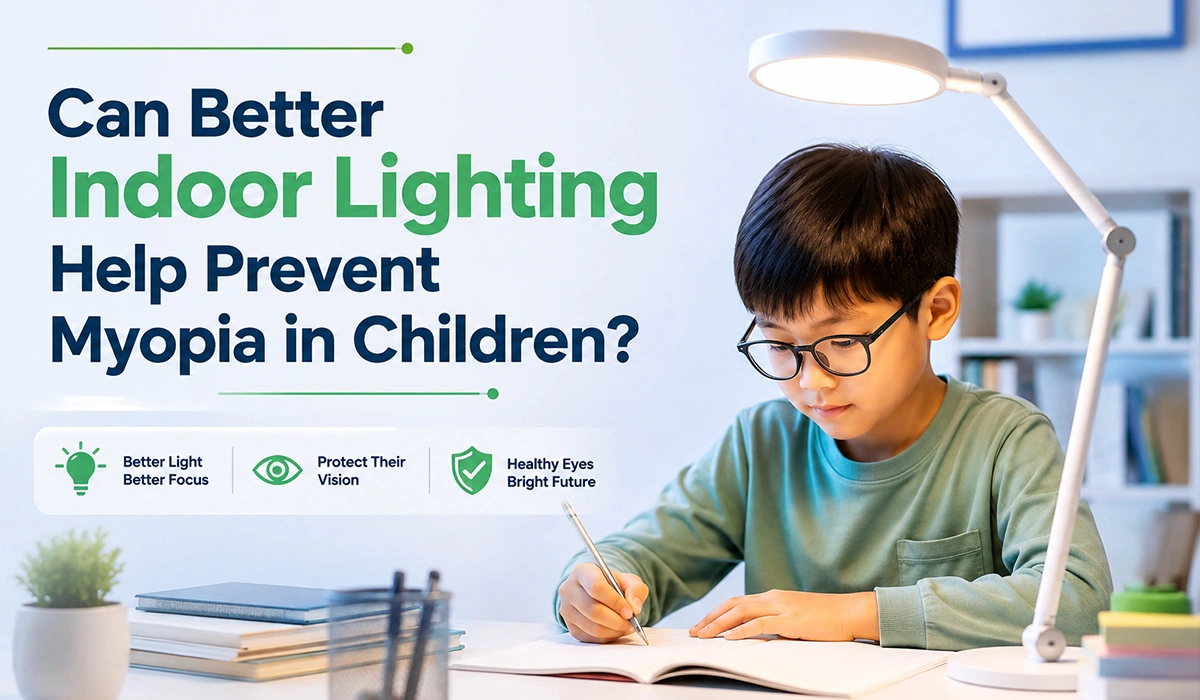
Can better indoor lighting help prevent myopia in children?
The short answer is possibly—but indoor lighting should not be treated as a replacement for outdoor daylight.
Evidence is strongest for spending more time outdoors during daylight. The World Health Organization currently recommends at least 90 minutes outdoors during daylight as one strategy that may help delay myopia onset and progression, together with breaks during near work and appropriate eye care.
At the same time, emerging research is examining whether better-designed indoor lighting could provide additional benefits.
For parents, schools and healthcare professionals, the practical message is simple: improve the child’s complete visual environment rather than searching for one magic light bulb.
1. What Is Myopia in Children?
Myopia, or short-sightedness, is a refractive condition in which distant objects appear blurry because light focuses in front of the retina rather than directly on it. Childhood myopia can progress as the eye grows, and earlier onset can increase the likelihood of developing higher levels of myopia later.
Myopia is becoming an important global eye-health concern. The WHO identifies myopia as one of the eye conditions that can potentially be addressed through preventive strategies, particularly lifestyle changes involving outdoor time and near-work habits.
In India, the issue deserves attention as well. A 2026 systematic review and meta-analysis of Indian schoolchildren found an overall pooled prevalence of refractive errors of approximately 11%, with myopia being the most common refractive error at about 8% in the included evidence base.
These numbers vary substantially by age, location, study method and population, so they should not be interpreted as a single national rate for every Indian child.
Why does childhood onset matter?
When myopia begins early, there is more time for it to progress during childhood and adolescence. Higher levels of myopia are associated with increased lifetime risks of certain eye complications.
That is why prevention, early detection and appropriate myopia management are all important.
2. What Is the Connection Between Light and Myopia?
Light exposure appears to influence childhood eye growth, but the strongest evidence concerns bright outdoor daylight rather than ordinary indoor lighting. Children who spend more time outdoors generally have a lower risk of developing myopia. Researchers are investigating whether characteristics of indoor light can provide additional protection.
The eye does not experience all light environments equally.
Outdoor environments can expose children to dramatically higher illuminance than typical indoor rooms. One study measuring different environments found median outdoor illuminance around 1,175 lux, compared with approximately 179 lux indoors, although values varied considerably by location and conditions.
Another study found outdoor light levels substantially higher than indoor levels even when children were under shade or using sun protection.
This is one reason simply making an indoor room “brighter” does not necessarily reproduce the biological environment of being outdoors.
Practical example
A child studying beside a large window may experience substantially more daylight than a child studying in a closed room with one artificial lamp.
However, a bright indoor classroom is still not equivalent to outdoor daylight.
3. Can Better Indoor Lighting Help Prevent Myopia in Children?
There is promising but still developing evidence that better indoor lighting may influence myopia progression, but it is too early to say that indoor lighting alone prevents childhood myopia. Outdoor daylight remains the better-established environmental strategy.
A 2026 prospective cohort study investigated simulated full-spectrum lighting in classrooms and homes among fourth-grade students. The study included only 85 children—45 in the lighting intervention and 40 controls—and reported differences in spherical equivalent refraction, axial length and choroidal thickness after 6 and 12 months.
The findings are interesting, but they should be interpreted carefully.
It was a relatively small prospective cohort study, not definitive evidence that full-spectrum lighting prevents myopia across the general population.
This distinction is important for parents.
“Promising research” does not mean “proven treatment.”
A responsible recommendation today would be:
- Provide comfortable, adequate indoor lighting.
- Reduce glare and harsh shadows.
- Encourage regular breaks from near work.
- Give children substantial outdoor daylight exposure.
- Arrange regular eye examinations.
- Follow professional advice if myopia is diagnosed.
4. Why Outdoor Daylight Is More Important Than Simply Making a Room Brighter
Outdoor daylight is currently one of the strongest environmental factors associated with lower myopia risk in children. Indoor lighting can improve the visual environment, but it should complement—not replace—time spent outside during daylight.
One of the strongest pieces of evidence comes from a randomized clinical trial in Guangzhou, China.
Researchers added approximately 40 minutes of outdoor activity each school day for children in intervention schools. After three years, myopia incidence was 30.4% in the intervention group versus 39.5% in the control group, an absolute difference of 9.1 percentage points.
This does not mean exactly 40 minutes will produce the same result in every child or population.
But it provides strong experimental evidence that increasing outdoor exposure can reduce the risk of developing myopia.
A later randomized trial also found that encouraging parents to increase children’s outdoor time improved light exposure and was associated with less axial elongation and lower myopic progression.
The practical lesson
Instead of asking:
“Which indoor bulb prevents myopia?”
A better question is:
“How can we create a healthier visual day for the child?”
5. How Bright Should a Child’s Study Area Be?
There is no universally established indoor lux level that can be guaranteed to prevent myopia. A child’s study area should have sufficient, comfortable illumination for reading without excessive glare, deep shadows or visual discomfort.
Lux measures illuminance—the amount of light falling on a surface.
Indoor lighting requirements depend on:
- Room size
- Desk position
- Window size
- Time of day
- Type and placement of lighting
- Reading material
- Screen brightness
- Glare
- Individual visual needs
Research measurements show that indoor environments can vary enormously. In one study, indoor locations ranged from very dim areas to rooms that temporarily exceeded 1,000 lux near large windows.
Therefore, a single “magic lux number” for myopia prevention would oversimplify the science.
Better practice
For homework:
- Place the desk near a source of natural daylight where practical.
- Avoid direct sunlight shining onto the page or screen.
- Use a well-positioned desk lamp when necessary.
- Reduce reflections from screens.
- Keep the surrounding room reasonably illuminated rather than studying with only a bright screen in an otherwise dark room.
6. Does Full-Spectrum Lighting Help Children’s Eyes?
Full-spectrum lighting is an emerging area of myopia research, not yet a universally established method for preventing myopia. A 2026 study reported encouraging findings, but its small sample size means larger and longer studies are needed before strong recommendations can be made.
The recent study from China used simulated full-spectrum lighting designed to resemble the visible spectrum of sunlight, approximately 430–780 nm. The researchers reported favorable changes in several eye-related measurements over 12 months.
This is scientifically interesting because it moves the discussion beyond simple brightness.
Researchers are exploring:
- Spectrum
- Intensity
- Duration
- Timing of exposure
- Outdoor versus indoor light
- Circadian effects
- Eye-growth responses
However, parents should be cautious about products marketed as “anti-myopia lights” or “myopia-prevention bulbs.”
Unless a product has strong clinical evidence supporting its specific claims, it should not be presented as a proven medical intervention.
7. Can Poor Indoor Lighting Cause Myopia?
Poor lighting can contribute to visual discomfort, but it should not automatically be described as a direct cause of myopia. Current evidence supports a broader relationship involving genetics, outdoor exposure and near-work behavior rather than a simple “dim room causes myopia” explanation.
Children may experience:
- Eye strain
- Headaches
- Squinting
- Difficulty focusing
- Discomfort
- Reduced reading comfort
when the visual environment is poorly designed.
But these symptoms are not the same as developing myopia.
Research into childhood light exposure has found associations between different light environments and eye growth, but the causal pathways remain an active area of research.
The distinction matters because parents should not panic if their child studies under ordinary indoor lighting.
The goal is to create a comfortable, well-lit environment while increasing outdoor daylight exposure.
8. What About Screens and Near Work?
Long periods of close-up work, including reading and digital-device use, are associated with myopia risk, particularly when combined with limited outdoor time. Children should take regular breaks and avoid holding books or screens excessively close to their eyes.
The WHO specifically recommends regular breaks during near-vision activities and highlights prolonged near work and insufficient outdoor time as risk factors.
A practical strategy is to break long study sessions into shorter periods.
For example:
30–45 minutes of near work → short visual break → resume activity.
The European Society of Ophthalmology/International Myopia Institute guidance recommends limiting continuous near work to around 30–45 minutes before taking a break and recommends approximately 1–2 hours of outdoor activity daily for school-aged children as a primary prevention strategy.
A simple family rule
Instead of telling a child:
“Stop using your phone.”
Try:
“Use it, then look far away, move around and go outside.”
This approach is often easier to follow.
9. A Better Indoor Lighting Setup for Children’s Homework
The best study environment combines adequate lighting, low glare, comfortable viewing distance, good posture and regular breaks. Natural daylight should be used whenever practical, while artificial lighting should fill in dark areas rather than create harsh contrast.
A practical setup
| Factor | Better approach |
|---|---|
| Natural light | Use daylight near a window when practical |
| Desk lamp | Position to illuminate the work without shining into the eyes |
| Glare | Avoid reflections on books and screens |
| Shadows | Prevent the hand or head from creating strong shadows |
| Screen | Adjust brightness to comfortable surroundings |
| Viewing distance | Avoid holding books/screens extremely close |
| Breaks | Take regular breaks during sustained near work |
| Outdoor time | Aim for substantial daylight exposure every day |
| Eye checks | Follow age-appropriate professional screening |
Practical tip
Do not make the study room extremely dark just because the screen looks bright.
The surrounding environment should also have comfortable illumination.
10. Can Opening Windows Help?
Opening windows can increase natural daylight, but the benefit depends on the amount of daylight actually reaching the child’s eyes. A window alone does not turn an indoor environment into an outdoor light environment.
Window size, direction, building design, curtains, weather and time of day all matter.
Research has shown that rooms with large windows can sometimes reach relatively high illuminance, but indoor levels are generally much lower than open outdoor environments.
So, if a child studies near a window, that is helpful for daylight exposure—but it should not become an excuse to eliminate outdoor activities.
Better strategy
Window + outdoor play + regular breaks is more sensible than window instead of outdoor play.
11. What Should Indian Parents and Schools Do?
Indian families and schools should focus on a complete eye-health routine: more outdoor daylight, sensible near-work habits, comfortable indoor lighting and regular vision screening. This approach is more evidence-based than relying on a specific lamp or lighting technology.
This is particularly relevant in urban environments where children may spend much of their day indoors.
Indian research has documented a substantial burden of refractive errors among schoolchildren, with myopia representing the largest component in a recent systematic review.
Schools can consider
- Outdoor activity periods
- Better classroom daylight
- Comfortable artificial lighting
- Reduced glare
- Regular vision screening
- Breaks between prolonged near-work sessions
- Outdoor school activities where practical
Parents can consider
- Daily outdoor play
- Limiting uninterrupted screen sessions
- Encouraging proper reading distance
- Avoiding homework in poorly lit spaces
- Monitoring complaints of blurred distance vision
- Arranging professional eye examinations
This is especially important for children with a family history of myopia because genetics also influence risk.
12. Indoor Lighting vs Outdoor Daylight: What’s Better?
Outdoor daylight has stronger evidence for myopia prevention than indoor lighting modifications. Indoor lighting can improve visual comfort and may have additional benefits, but current evidence does not justify treating it as an equivalent substitute for outdoor exposure.
| Factor | Indoor Lighting | Outdoor Daylight |
|---|---|---|
| Visual comfort | Can be optimized | Generally comfortable with appropriate conditions |
| Light intensity | Usually lower | Usually much higher |
| Evidence for preventing myopia | Emerging | Stronger |
| Controlled environment | Easier | Less controlled |
| Can replace outdoor time? | No | N/A |
| Research status | Developing | Well established |
| Main recommendation | Use good-quality comfortable lighting | Encourage regular daylight exposure |
Outdoor environments can provide illuminance many times higher than typical indoor environments.
This difference may be one reason outdoor exposure has such a strong relationship with childhood myopia prevention.
13. What Does the Latest Research Say?
The research direction is moving toward understanding light as a measurable environmental factor, but outdoor exposure remains the most established recommendation. New studies on full-spectrum indoor lighting are promising, yet they need confirmation through larger, randomized and longer-term trials.
A 2025 scoping review identified 34 studies examining the visual environment of children and young people at risk of myopia, including research on indoor and outdoor light exposure, near work and related environmental factors.
Meanwhile, the International Myopia Institute’s 2025 clinical digest continues to identify outdoor time as the strongest protective environmental factor for preventing or delaying myopia onset.
This creates an important hierarchy of evidence:
Strongest practical evidence:
Outdoor daylight + healthy near-work habits.
Promising research area:
Optimized indoor lighting and full-spectrum lighting.
Not established:
A particular household bulb or commercial lighting product as a guaranteed myopia-prevention treatment.
14. What Parents Should Do If a Child Already Has Myopia
Better lighting and outdoor habits are useful, but they should not replace professional myopia management. If a child already has myopia, an eye-care professional should assess the prescription and progression and discuss appropriate management options.
Parents should watch for signs such as:
- Sitting very close to the television
- Holding books or devices unusually close
- Squinting to see distant objects
- Difficulty seeing the classroom board
- Frequent headaches
- Complaints of blurred distance vision
- Declining school performance related to vision
The WHO recommends appropriate eye examinations and prescribed correction, alongside lifestyle measures such as outdoor time and regular breaks.
Depending on the child’s age, prescription and progression, an eye-care professional may discuss specialized spectacle lenses, contact-lens approaches or other evidence-based myopia-control strategies.
Lighting is part of prevention—not a substitute for diagnosis or treatment.
15. The Simple “Healthy Vision Day” for Children
A healthy vision routine is more powerful than focusing on one lighting product. Build the child’s day around daylight, movement, sensible near-work periods, comfortable lighting and appropriate eye examinations.
Here is a simple example:
| Time | Healthy Vision Habit |
|---|---|
| Morning | Spend some time outdoors in daylight |
| School | Use comfortable classroom lighting |
| Study | Work at a sensible viewing distance |
| Every 30–45 min | Take a visual break |
| Afternoon | Outdoor play or activity |
| Evening | Use comfortable room lighting for homework |
| Screen time | Avoid long uninterrupted sessions |
| Regularly | Get professional eye checks |
The WHO’s current guidance supports at least 90 minutes outdoors during daylight, while professional myopia-management guidance commonly recommends around 1–2 hours of outdoor activity daily for school-aged children.
16. Common Myths About Lighting and Myopia
Myth 1: “A brighter bulb will prevent myopia.”
Reality: There is not enough evidence to make this claim. Comfortable indoor lighting is beneficial, but outdoor daylight has stronger evidence.
Myth 2: “Screens directly cause every case of myopia.”
Reality: Myopia has multiple risk factors, including genetics, near work and limited outdoor exposure.
Myth 3: “Indoor lighting can replace outdoor time.”
Reality: Ordinary indoor illumination generally does not reproduce outdoor light levels.
Myth 4: “If my child has no symptoms, there is no need for an eye check.”
Reality: Children may not always recognize or report gradual changes in distance vision. Screening and professional assessment are important.
Myth 5: “Full-spectrum lights are already proven to prevent myopia.”
Reality: Recent research is encouraging, but the evidence is still developing and larger studies are needed.
17. Why Choose an Evidence-Based Approach?
The best approach to children’s eye health combines proven habits with careful interpretation of emerging research. Parents should prioritize outdoor daylight, healthy near-work behavior and professional eye care rather than relying on marketing claims about individual lighting products.
A trustworthy eye-health strategy should:
- Clearly distinguish evidence from speculation.
- Avoid promising that one product prevents myopia.
- Use current clinical guidance.
- Encourage professional examinations.
- Consider the child’s individual risk.
- Adapt recommendations as stronger research becomes available.
For schools and healthcare organizations, this evidence-based approach also creates better long-term health communication.
Instead of saying:
“Buy this special light to prevent myopia.”
A more responsible message is:
“Create a healthy visual environment, encourage outdoor daylight and monitor children’s vision regularly.”
18. Frequently Asked Questions About Indoor Lighting and Myopia in Children
Can better indoor lighting help prevent myopia in children?
Better indoor lighting may contribute to a healthier visual environment, and emerging studies are investigating its effect on myopia. However, there is not yet enough evidence to say that indoor lighting alone prevents myopia. Outdoor daylight exposure has stronger evidence and should remain a priority.
Is LED lighting bad for children’s eyes?
There is no good evidence that ordinary LED lighting itself causes childhood myopia. The important factors are overall visual comfort, glare, brightness, exposure patterns and the child’s broader lifestyle. Indoor lighting should be comfortable and appropriate for the activity.
Should children study in bright rooms?
Children should study in adequately and comfortably illuminated rooms. Avoid excessive glare, harsh shadows and strong contrast between a bright screen and a dark room.
How much outdoor time should children get to help prevent myopia?
The WHO recommends at least 90 minutes outdoors during daylight, while professional myopia guidance commonly recommends approximately 1–2 hours daily for school-aged children.
Can sunlight reverse myopia?
No. Outdoor time may help delay myopia onset and may reduce risk, but it should not be described as a way to reverse established myopia.
Does screen time increase myopia risk?
Prolonged near work, including screen use, is associated with myopia risk, especially when combined with insufficient outdoor time. Regular breaks and more outdoor activity are recommended.
Is full-spectrum lighting better for children with myopia?
There is emerging evidence, including a 2026 prospective cohort study, suggesting potential benefits from simulated full-spectrum lighting. However, the study was relatively small, so more research is required before it can be considered a proven myopia-prevention strategy.
Should parents buy a special anti-myopia lamp?
Parents should be cautious about products making medical claims. A specific lamp should not be treated as a proven treatment unless supported by strong clinical evidence and appropriate regulatory status.
Does studying in a dark room cause myopia?
A poorly lit room can cause visual discomfort, but it is too simplistic to say that studying in a dark room directly causes myopia. Myopia is influenced by multiple genetic and environmental factors.
What should I do if my child cannot see the classroom board?
Arrange a comprehensive eye examination. Do not assume the problem is simply tiredness or screen use. If myopia is diagnosed, follow the eye-care professional’s recommendations.
Practical Checklist for Parents
Before worrying about a specific light bulb, ask:
✓ Does my child get outdoor daylight every day?
✓ Does my child take breaks during prolonged reading or screen use?
✓ Is the study area comfortable and adequately illuminated?
✓ Is there excessive glare on the screen or page?
✓ Does my child hold books or devices unusually close?
✓ Can my child see the classroom board clearly?
✓ Does my child have a family history of myopia?
✓ Has my child’s vision been checked regularly?
These questions address the bigger picture.
Conclusion: Better Light Is Helpful. More Daylight Is Better Supported.
So, can better indoor lighting help prevent myopia in children?
The most accurate answer is:
It may help create a healthier visual environment, and emerging research on optimized indoor lighting is promising. But current evidence is much stronger for regular outdoor daylight exposure than for any specific indoor lighting system.
For families in India and around the world, the practical formula is straightforward:
More daylight.
Smarter near-work habits.
Comfortable indoor lighting.
Regular eye checks.
Professional care when needed.
The goal is not to keep children away from books, classrooms or technology. These are essential parts of modern childhood.
The goal is to create balance.
A child can study indoors, use technology responsibly, and still spend meaningful time outside in daylight.
And perhaps that is the most important lesson from current myopia research:
The healthiest environment for a child’s eyes is not simply a brighter room—it is a healthier day.