Introduction: When Stress May Help Instead of Harm
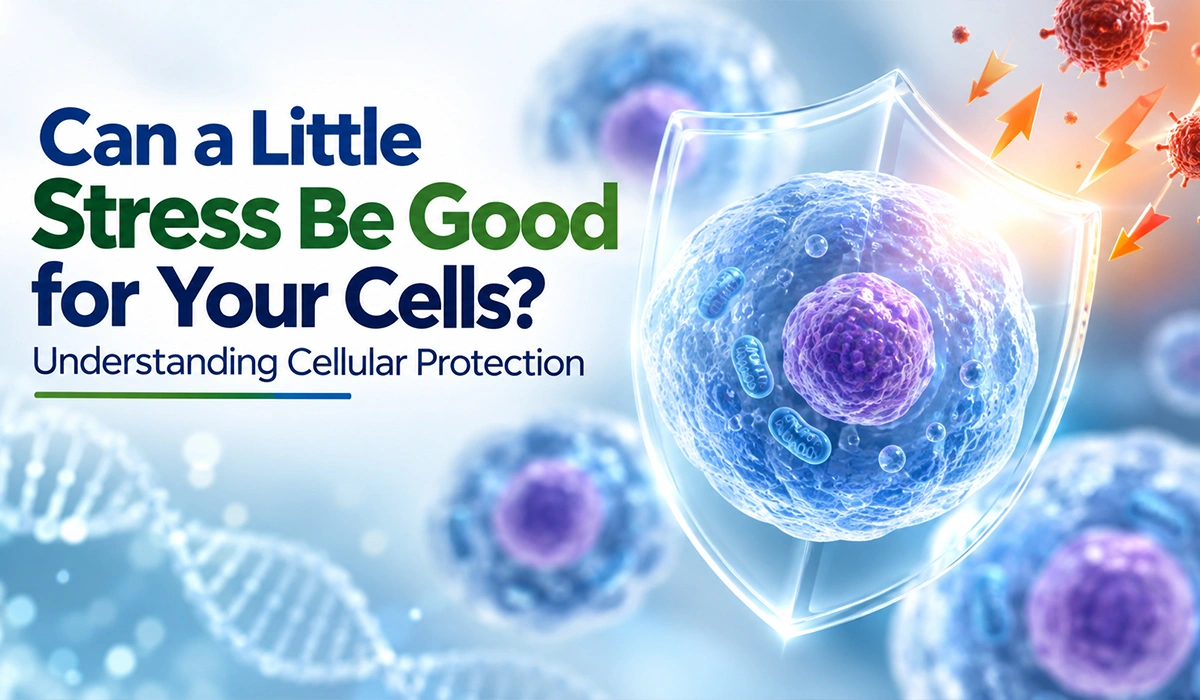
Imagine your cells facing a small challenge—not enough to cause lasting damage, but enough to make them respond. This is the basic idea behind mild stress and cellular protection.
Scientists call this adaptive phenomenon hormesis: a low or moderate stressor can activate protective responses, while a stronger or prolonged stressor can become harmful.
But there is an important distinction: this does not mean that being chronically stressed is good for you. The potential benefit depends on the type, intensity, duration and recovery from the stress.
What Is Hormesis?
Quick answer: Hormesis describes a biological response in which a small challenge can activate adaptive mechanisms that improve a cell or organism’s ability to cope with later challenges.
Examples studied in biology include controlled exercise, temporary metabolic challenges and other mild stressors. Research reviews describe hormesis as a dose-dependent phenomenon—not a universal rule that all stress is beneficial.
How Do Cells Respond to Stress?
Quick answer: Cells detect disturbances and activate signaling pathways that can temporarily change metabolism, protein production and protective mechanisms.
When cells encounter threats such as nutrient shortage or other forms of stress, they can activate stress-response programs designed to restore homeostasis, or internal balance. Recent research shows that cellular stress can influence whether cells recover, adapt or eventually undergo cell death.
Can Mild Stress Strengthen Cellular Defenses?
Quick answer: Potentially, yes. A brief, manageable challenge may stimulate protective adaptations that help biological systems tolerate future stress.
This is sometimes described as adaptive priming. A 2025 Nature Medicine review discusses hormesis as one component of resilience, while emphasizing that excessive or chronic stress can instead contribute to harmful allostatic overload.
What Did a 2026 Study Find About Mild Stress?
Quick answer: A 2026 mouse study found that repeated short-term mild stress or low-dose glucocorticoid treatment improved some stress-related physiological and behavioral outcomes in experimental models.
The researchers linked these effects to changes involving Fkbp5 signaling in a brain region involved in stress regulation. Importantly, this was an animal study, so it does not prove that deliberately creating stress will produce the same benefits in humans.
Mild Stress vs Chronic Stress: What Is the Difference?
| Feature | Mild, Short-Term Stress | Chronic or Excessive Stress |
|---|---|---|
| Duration | Brief | Persistent |
| Biological response | May trigger adaptation | Can contribute to dysregulation |
| Recovery | Usually possible | Recovery may become difficult |
| Potential effect | Adaptive response | Increased health burden |
| Interpretation | Context-dependent | Generally concerning |
The key lesson is dose and recovery matter. WHO notes that some stress can help people respond to everyday challenges, while too much stress can contribute to physical and mental health problems.
What Happens Inside Stressed Cells?
Quick answer: Cells can temporarily alter protein production, metabolism and quality-control pathways to protect themselves.
For example, a 2026 Nature Cell Biology study identified HOIL-1 as part of a cellular pathway that helps safeguard ribosomes during certain forms of stress. The work demonstrates how sophisticated cellular quality-control systems can respond to metabolic and translational stress.
Is Exercise an Example of Beneficial Stress?
Quick answer: Exercise is one of the clearest real-world examples of a controlled physical challenge that can stimulate adaptation.
Physical activity temporarily challenges muscles, metabolism and cardiovascular systems. With appropriate recovery, the body adapts to repeated demands. This is different from deliberately exposing yourself to harmful psychological stress.
Practical tip: Increase exercise gradually and allow adequate recovery rather than assuming that more stress automatically means more benefit.
Does This Mean Stress Is Good for Mental Health?
Quick answer: No. The concept of cellular hormesis should not be used to romanticize chronic psychological stress.
WHO describes stress as a normal response to challenging situations, but persistent stress can contribute to mental and physical health problems. In India and globally, managing excessive stress remains an important part of overall health.
Can You Use Mild Stress as a Health Strategy?
Quick answer: There is not enough evidence to recommend deliberately creating stressful situations as a general health treatment.
Safer approaches involve established healthy behaviors such as regular physical activity, adequate sleep, balanced nutrition, social connection and effective stress-management techniques. WHO specifically recommends these approaches for coping with stress.
What Should Readers Take Away?
The science of mild stress and cellular protection is fascinating because it shows that biological systems are not passive. Cells constantly sense challenges and activate mechanisms designed to maintain balance.
However, the relationship is not simply “stress = good.” A useful model is:
Small, temporary challenge → adaptive response → recovery → potential resilience
Whereas:
Persistent or excessive stress → inadequate recovery → possible biological and health consequences
The 2026 research adds interesting evidence, but much of this area remains experimental, particularly when translating cellular and animal findings into human health recommendations.
Frequently Asked Questions About Mild Stress and Cellular Protection
Can a little stress be good for your cells?
Possibly. Mild, temporary stress can activate adaptive biological responses, a phenomenon known as hormesis. However, the effect depends on the type and dose of stress.
What is hormesis?
Hormesis is an adaptive biological response in which a low-level stressor may stimulate protective mechanisms, while higher or prolonged exposure can become harmful.
Is chronic stress beneficial?
No. Chronic or excessive stress is different from controlled, temporary challenges and can negatively affect physical and mental well-being.
Does the 2026 mild-stress research prove benefits in humans?
No. The highlighted 2026 study was conducted in mice. Its findings provide research clues but do not establish equivalent benefits in humans.
What is the safest way to build resilience?
Evidence-based approaches include regular exercise, sufficient sleep, healthy nutrition, social connection and practical stress-management strategies.
Practical Takeaway
Your cells can adapt to challenges—but adaptation is not the same as “more stress is better.” The emerging science of hormesis suggests that controlled, temporary challenges may activate protective pathways, while chronic stress can overwhelm them.
The smartest goal is not to seek more stress. It is to build healthy challenges, adequate recovery and long-term resilience