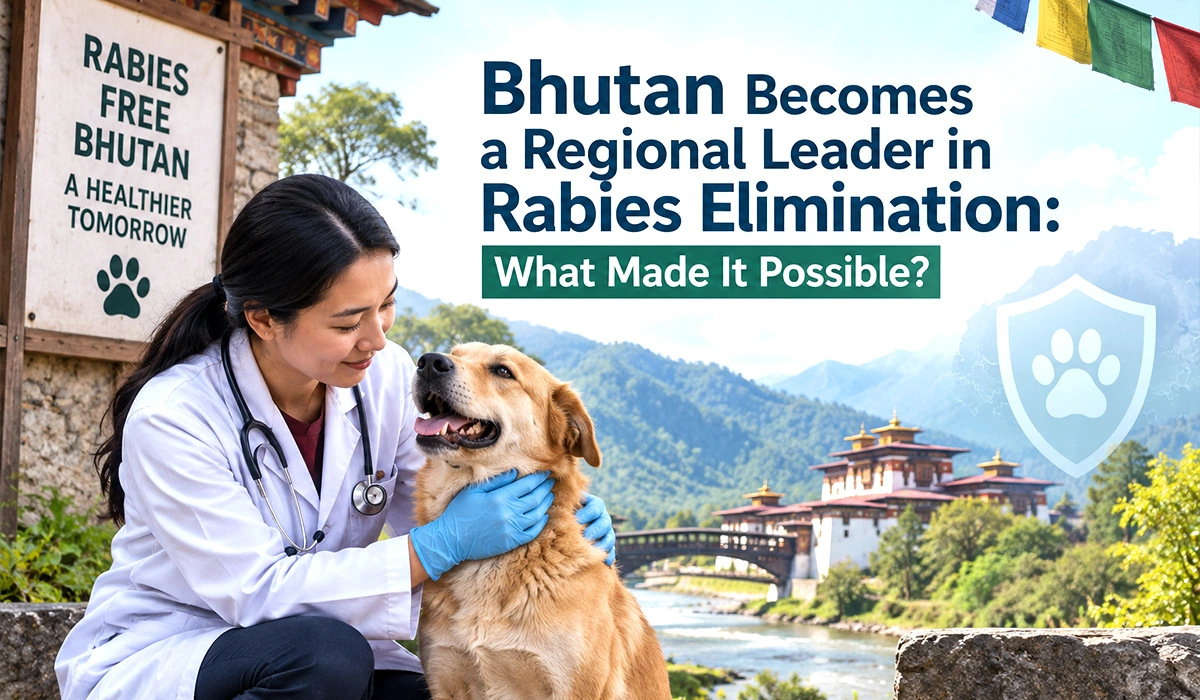
On 4 September 2026, Bhutan reached a major public-health milestone: the World Health Organization (WHO) validated the country’s elimination of dog-transmitted human rabies as a public-health problem. Bhutan is the first country in the WHO South-East Asia Region to achieve this status.
But this success was not achieved through one vaccine campaign or one policy. It came from years of coordinated work involving government leadership, veterinary services, healthcare workers, volunteers, communities and international partners.
What does Bhutan’s rabies elimination mean?
Quick answer: Bhutan has demonstrated sustained interruption of dog-to-human rabies transmission and met WHO requirements for validation.
WHO validation requires evidence that human rabies deaths have remained absent while the country maintains the ability to detect, prevent and respond to possible reintroduction. Bhutan has recorded zero human deaths from dog-mediated rabies since June 2023.
Importantly, “elimination” does not mean rabies has disappeared from every animal population forever. Bhutan must continue surveillance and prevention.
Why is rabies elimination important?
Rabies remains a major global health problem. WHO estimates around 59,000 people die from rabies every year, with about 95% of deaths occurring in Africa and Asia. Dogs are responsible for up to 99% of human rabies transmissions.
The disease is especially dangerous because once clinical symptoms appear, rabies is virtually 100% fatal. Yet deaths are preventable through dog vaccination and timely post-exposure prophylaxis (PEP).
How did Bhutan control rabies?
Quick answer: Bhutan combined mass dog vaccination, humane dog population management, surveillance, public awareness and rapid human post-exposure care.
The country’s strategy reflects the WHO One Health model, connecting human health, animal health and communities rather than treating rabies as only a medical problem.
| Strategy | Why it matters |
|---|---|
| Mass dog vaccination | Reduces transmission at the source |
| Dog population management | Helps maintain sustainable control |
| Human PEP access | Prevents infection after exposure |
| Surveillance | Detects potential outbreaks quickly |
| Community awareness | Reduces bite risk and improves reporting |
| One Health coordination | Connects medical and veterinary response |
The role of mass dog vaccination
Dog vaccination is at the centre of rabies elimination because dogs are the primary source of human transmission.
WHO says sustained vaccination coverage of around 70% of dogs in at-risk areas can achieve effective control of canine rabies.
Bhutan continued mass dog vaccination alongside population management rather than relying on human treatment alone.
Humane dog population management
Bhutan’s programme also focused on managing free-roaming dog populations. The country has used sterilization and vaccination approaches, moving away from older control methods such as mass killing. A national livestock framework assigns local authorities responsibility for dog population management and provides for sterilization and management of free-roaming animals.
This combination matters because vaccination protects the population while responsible population management helps maintain coverage over time.
Why the One Health approach worked
Quick answer: Rabies crosses the boundary between veterinary and human medicine, so Bhutan coordinated both systems.
Bhutan brought together the Ministry of Health, Ministry of Agriculture and Livestock, local governments, communities and De-suung volunteers. WHO and the World Organisation for Animal Health (WOAH) also supported the programme.
This allowed suspected cases to trigger coordinated investigation, surveillance and response.
Community volunteers made a difference
Bhutan’s De-suung volunteers, known as the “Guardians of Peace,” helped extend vaccination, dog population management and awareness activities across communities. WHO specifically highlighted their contribution to the national achievement.
This is an important lesson: national programmes become stronger when local communities participate in delivering them.
Free access to post-exposure treatment
Preventing dog transmission is only one part of rabies elimination.
Bhutan will continue universal, free access to PEP across all 20 Dzongkhags. PEP includes thorough wound washing, human rabies vaccination and, when indicated, rabies immunoglobulin.
For anyone bitten or scratched by a potentially rabid animal, WHO recommends immediate wound washing and prompt medical assessment for PEP.
What can India learn from Bhutan?
Quick answer: India can adapt Bhutan’s emphasis on sustained dog vaccination, integrated surveillance, accessible PEP and community participation.
India continues to face a substantial rabies burden. WHO’s India programme cites an ICMR-National Institute of Epidemiology estimate of 9.1 million animal bites annually, with more than three-quarters caused by dogs.
India launched its National Action Plan for Dog Mediated Rabies Elimination (NAPRE) by 2030, making Bhutan’s achievement particularly relevant to the region.
What happens after elimination?
Bhutan’s work does not stop with WHO validation. The country plans to maintain mass dog vaccination, dog population management, integrated human-animal surveillance and cross-border coordination, particularly with neighbouring Indian states.
This is crucial because animal movement can reintroduce infection into previously controlled areas.
Bhutan Rabies Elimination: Key Takeaways
- Bhutan is the first WHO South-East Asia Region country validated for eliminating dog-transmitted human rabies as a public-health problem.
- The country has reported zero human deaths from dog-mediated rabies since June 2023.
- Dog vaccination attacked the disease at its primary source.
- Humane dog population management supported long-term control.
- One Health coordination connected human and animal health systems.
- Community volunteers helped deliver the programme locally.
- Free PEP remains essential for preventing deaths after exposure.
- Continued surveillance is necessary to prevent reintroduction.
Frequently Asked Questions
Is Bhutan completely free of rabies?
Bhutan has achieved WHO validation for elimination of dog-transmitted human rabies as a public-health problem. Continued vaccination, surveillance and preparedness remain necessary.
Why is Bhutan’s rabies elimination important for India?
Bhutan shares borders with India, and WHO says Bhutan will strengthen cross-border coordination with adjacent Indian states to protect its achievement.
Can rabies be prevented after a dog bite?
Yes. Immediate wound washing followed by appropriate medical assessment and PEP can prevent rabies after exposure.
What is the main lesson from Bhutan?
The biggest lesson is that rabies elimination requires prevention at the animal source plus accessible human healthcare, surveillance and community participation.
Conclusion
Bhutan’s rabies elimination is more than a national achievement—it is a practical demonstration of what coordinated public health can accomplish. Its success shows that dog vaccination, humane population management, accessible PEP, surveillance and One Health collaboration can interrupt dog-mediated rabies transmission.
For India and other rabies-endemic countries, Bhutan provides a valuable regional example: elimination becomes achievable when prevention starts with the animal, treatment reaches the person, and communities become part of the solution.