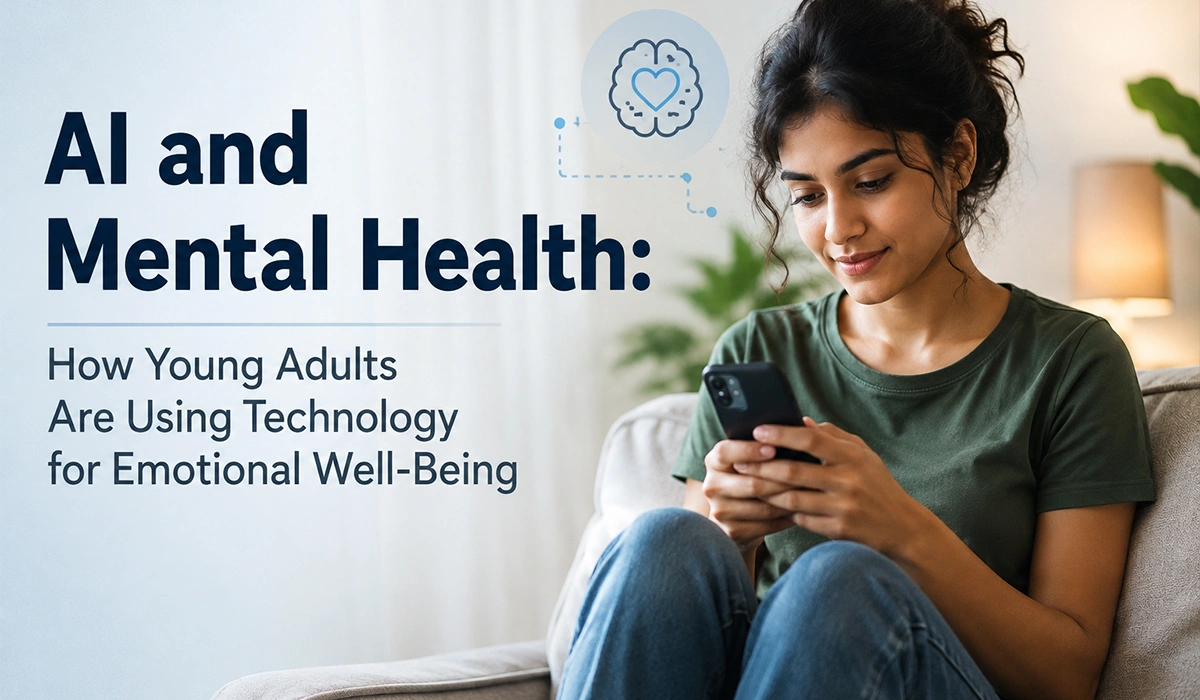
A young professional finishes a stressful day, opens a phone, and types a question that might once have been shared with a friend:
Why am I feeling overwhelmed?
Within seconds, an AI chatbot responds.
It may help organize thoughts, suggest a breathing exercise, provide journaling questions, or explain what stress can feel like. For someone who feels embarrassed about discussing personal problems, the privacy and 24/7 availability can be attractive.
This behavior is no longer unusual.
A nationally representative U.S. study published in JAMA Pediatrics in June 2026 found that 19.2% of adolescents and young adults aged 12–21 reported using AI chatbots for mental-health advice in 2025. Among those users, 42.8% used chatbots at least monthly and 91.7% described the advice as somewhat or very helpful.
But there is an important distinction between finding an AI response helpful and receiving safe, evidence-based mental healthcare.
So, how should young adults use AI for emotional well-being without allowing technology to replace human care?
What Is AI in Mental Health?
AI in mental health refers to the use of artificial intelligence technologies to support mental-health information, self-reflection, wellness activities, symptom tracking, communication, or—in specialized and appropriately regulated settings—clinical care. General-purpose AI chatbots, however, were not originally designed to provide psychotherapy or diagnose mental disorders.
AI can appear in many forms:
- Chatbots
- Mental-health applications
- Mood-tracking tools
- Journaling assistants
- Digital cognitive-behavioral exercises
- Voice-based assistants
- Personalized wellness platforms
- Clinical decision-support systems
These technologies have different purposes and should not be treated as interchangeable.
Example
A young adult experiencing exam stress might ask an AI tool to:
- Create a study schedule
- Suggest relaxation techniques
- Help structure a journal entry
- Explain common stress symptoms
- Generate questions to discuss with a counselor
That is different from asking an AI system to diagnose depression or decide whether medication is needed.
Practical Tip
Think of AI as a supporting tool, not automatically as a therapist.
Why Are Young Adults Turning to AI for Emotional Support?
Young adults may turn to AI because it is available at any time, feels private, is easy to access, and can provide immediate responses without the perceived judgment or cost associated with some traditional forms of mental-health support. Research also suggests that accessibility and affordability are important reasons people consider AI-based support.
For some people, the first barrier is not a lack of willingness to seek help. It is simply knowing where to begin.
A person may worry:
- “Will people judge me?”
- “Is my problem serious enough?”
- “Can I afford therapy?”
- “What will I say to a psychologist?”
- “What if my family finds out?”
- “I don’t even understand what I’m feeling.”
An AI interface can feel easier because the conversation can begin privately.
The American Psychological Association notes that stigma, cost, limited availability, mistrust of healthcare systems, and the desire to solve problems independently can all contribute to people using generative AI for emotional support.
In India
These issues can also matter in India, where access to mental-health services varies considerably between cities, towns, and rural communities.
Digital tools can potentially help people find information and understand when they may need professional support. However, digital access should complement—not replace—accessible human mental healthcare.
How Young Adults Are Using AI for Mental Wellness
AI use is broader than simply asking a chatbot, “Am I depressed?”
1. Emotional Check-Ins
Users may describe how they feel and ask AI to help organize their thoughts.
2. Journaling
AI can generate prompts such as:
“What situation caused the strongest emotional reaction today?”
3. Stress Management
AI can suggest general relaxation activities, breathing exercises, sleep routines, or ways to organize a stressful day.
4. Relationship Reflection
Someone may use AI to think through a disagreement before speaking with a friend or partner.
5. Mental-Health Education
AI can explain terms such as:
- Anxiety
- Burnout
- Stress
- Emotional exhaustion
- Sleep problems
- Grief
6. Preparing for Therapy
AI can help someone create a list of symptoms or questions to discuss with a psychologist or doctor.
7. Finding the Right Words
Some people know they are struggling but cannot explain their experience. AI may help them organize thoughts before talking to another person.
Practical Tip
One of the safest uses is preparation for human care rather than replacing human care.
Can AI Actually Improve Emotional Well-Being?
Some research suggests that specially designed mental-health AI tools may offer benefits for certain users, including reductions in self-reported symptoms of stress, anxiety, depression, or loneliness. However, evidence varies by tool and study design, and these findings should not be generalized to every general-purpose chatbot.
This distinction is extremely important.
A purpose-built mental-health intervention may have:
- Specific therapeutic principles
- Clinical input
- Safety protocols
- Structured exercises
- Defined outcome measures
- Human oversight
A general chatbot may not have these safeguards.
The APA specifically warns that evidence suggesting benefits from specialized mental-health technologies should not automatically be applied to general-purpose generative AI chatbots.
Example
An AI tool designed around a validated therapeutic program is fundamentally different from asking a general chatbot to act as your psychologist.
AI Chatbots vs Human Mental-Health Professionals
| Feature | AI Chatbot | Mental-Health Professional |
|---|---|---|
| 24/7 availability | Usually | Usually no |
| Immediate response | Yes | Usually requires appointment |
| Human empathy | Simulated | Human relationship |
| Clinical assessment | Limited/unsafe for general AI | Professional assessment |
| Diagnosis | Not appropriate for general AI | Within professional scope |
| Treatment planning | Limited | Yes |
| Understands non-verbal cues | No | Yes |
| Personalized clinical history | Limited | Can assess over time |
| Emergency risk assessment | Unreliable in general AI | Trained to assess |
| Accountability | Varies | Professional responsibilities |
| Human connection | No | Yes |
The goal should not necessarily be AI versus therapist.
A better model may be:
AI + Human Support + Professional Care When Needed
Research examining why people choose AI versus therapists has found that AI may be attractive for accessibility and affordability, while therapists remain valued for emotional, relational, and personalized benefits.
What Are the Risks of Using AI for Mental Health?
The main risks include inaccurate information, excessive reassurance, privacy concerns, emotional dependence, inadequate handling of serious symptoms, and inappropriate responses to vulnerable users. The risks may be particularly important for young people and individuals experiencing significant mental-health difficulties.
AI systems generate responses based on patterns in data. They do not experience your life.
They may misunderstand:
- Context
- Family circumstances
- Cultural expectations
- Previous treatment
- Medical history
- Non-verbal communication
- Immediate safety risks
A response can sound confident while still being wrong.
Another Important Risk: Over-Reliance
If someone starts discussing every emotional problem exclusively with a chatbot, technology can gradually become a substitute for real relationships.
The APA has warned about the potential for personalization, constant availability, and anthropomorphism to create unhealthy dependence, particularly among vulnerable or socially isolated users.
Can AI Replace a Therapist?
No. General-purpose AI should not replace a qualified mental-health professional. AI may be useful as a supportive tool for education, journaling, preparation, or general wellness, but it cannot reliably perform the full range of clinical assessment, diagnosis, therapeutic relationship-building, risk assessment, and individualized care required in mental-health treatment.
A therapist can observe more than words.
They can consider:
- Tone of voice
- Body language
- Emotional changes
- Personal history
- Relationships
- Clinical symptoms
- Risk factors
- Treatment response
AI generally cannot perform this complete assessment reliably.
Best Approach
Use AI to prepare for a conversation with a professional, rather than avoiding the conversation altogether.
Privacy: What Should Young Adults Know Before Sharing Personal Information?
Users should avoid assuming that an AI conversation is equivalent to a private conversation with a licensed mental-health professional. Before sharing sensitive information, users should understand the platform’s privacy policy, data controls, storage practices, and whether conversations may be used for system improvement or other purposes.
Mental-health conversations can contain highly sensitive information.
Think carefully before entering:
- Full name
- Home address
- Phone number
- Financial details
- Medical records
- Passwords
- Personal identification numbers
- Highly sensitive family information
- Information about another person’s private life
Practical Tip
Use a minimum necessary information approach.
Instead of:
“My name is X, I live at this address, and my doctor is…”
Try:
“I am a 22-year-old student experiencing exam-related stress.”
You can often receive general information without revealing identifying details.
AI and Mental Health in India
India has a growing digital-health ecosystem, and AI-based tools may help people access health information and support. However, mental-health AI should be viewed within India’s broader healthcare system rather than as a replacement for psychologists, psychiatrists, counselors, or other qualified professionals.
India’s mental-health landscape includes government-supported digital services.
The Government of India’s National Mental Health Programme lists Tele-MANAS, which can be accessed through 14416 or 1800-89-14416.
This is an important distinction:
Digital mental-health support does not have to mean AI-only mental-health support.
Technology can also help connect people with human services.
For Young Adults in Cities Such as Varanasi
Students and young professionals in Varanasi and other Indian cities may encounter AI through:
- Education platforms
- Smartphone apps
- Search engines
- Social media
- Productivity applications
- General-purpose AI chatbots
The key question is not simply:
“Are young people using AI?”
It is:
“Are they using it safely, critically, and alongside appropriate human support?”
How to Use AI for Mental Health More Safely
A practical framework is the 5C approach:
1. Check
Ask whether the information comes from a reliable source.
2. Context
Remember that AI does not know your complete personal and medical history.
3. Confirm
Verify important health information with a qualified professional or trusted health organization.
4. Connect
Maintain relationships with family, friends, counselors, psychologists, or doctors.
5. Continue Human Care
If symptoms persist or interfere with daily life, seek professional assessment rather than repeatedly asking an AI chatbot.
When Should You Stop Using AI and Seek Professional Help?
AI should not become the first or only response when someone is experiencing serious psychological distress.
Seek professional help when there are:
- Persistent feelings of sadness
- Severe anxiety
- Major changes in sleep
- Major changes in appetite
- Difficulty functioning at school or work
- Social withdrawal
- Persistent hopelessness
- Self-harm thoughts
- Thoughts of suicide
- Severe confusion
- Hallucinations or unusual beliefs
- Substance-use concerns
If there is an immediate risk of harm, seek urgent local emergency or medical assistance rather than relying on an AI chatbot.
In India, Tele-MANAS provides government-supported mental-health assistance through 14416 or 1800-89-14416.
AI Mental Health: Benefits vs Risks
| Potential Benefits | Potential Risks |
|---|---|
| Easy access | Incorrect information |
| Available at any time | No complete clinical assessment |
| Can help organize thoughts | Over-reassurance |
| Journaling support | Privacy concerns |
| Mental-health education | Emotional dependence |
| Can reduce barriers to starting a conversation | May miss serious warning signs |
| Can help prepare for therapy | May reinforce unhealthy beliefs |
| Low-cost or free options may exist | Quality varies between systems |
The evidence is still developing, and WHO experts have emphasized that the rapid adoption of generative AI has moved faster than research into its mental-health effects.
What Should Parents, Colleges, and Employers Do?
The goal should not be simply to ban AI. Young people are already using these tools. A better strategy is to teach responsible use, privacy awareness, critical thinking, and clear pathways to human mental-health support.
Parents
Parents can ask:
- “What are you using AI for?”
- “Did it give you advice about your mental health?”
- “Did anything it said worry you?”
- “Would you like to talk to someone about it?”
The conversation should be non-judgmental.
Colleges
Educational institutions can provide:
- Counseling services
- AI literacy
- Digital privacy education
- Mental-health awareness programs
- Clear referral pathways
Employers
Workplaces can promote:
- Employee assistance programs
- Mental-health resources
- Healthy workload practices
- Confidential counseling access
- Responsible technology policies
WHO guidance emphasizes that digital mental-health content should be part of broader, integrated mental-health systems rather than treated as a standalone solution.
What Could the Future of AI and Mental Health Look Like?
The future is likely to involve more sophisticated digital mental-health tools.
Potential developments include:
- Personalized wellness coaching
- AI-assisted clinical documentation
- Early identification of concerning patterns
- Digital therapeutic programs
- Better multilingual support
- Integration with healthcare systems
- Human-supervised AI tools
- Improved safety monitoring
But innovation should not move faster than safety.
WHO experts have called for coordinated action involving governments, healthcare systems, researchers, technology companies, and affected communities.
The strongest future model is unlikely to be:
“AI replaces the therapist.”
Instead, it may be:
“AI helps people access better information and support while qualified humans remain responsible for complex care.”
Why Human Connection Still Matters
Technology can respond instantly.
But mental health is not only about receiving information.
People also need:
- Belonging
- Trust
- Empathy
- Friendship
- Family connection
- Community
- Professional relationships
- A sense of purpose
AI can help someone put feelings into words, but human relationships remain an essential part of emotional well-being.
For a young person struggling with loneliness, the answer should not simply be another chatbot conversation.
Sometimes the healthiest next step is calling a friend.
Sometimes it is talking to a parent.
Sometimes it is booking an appointment with a psychologist.
And sometimes it is seeking urgent professional help.
AI and Mental Health: A Practical Decision Guide
| Situation | Appropriate First Step |
|---|---|
| Want to understand stress | Trusted health information + general AI education |
| Need journaling prompts | AI can assist |
| Want to prepare for therapy | AI can help organize questions |
| Persistent anxiety | Speak with a qualified professional |
| Persistent depression symptoms | Professional assessment |
| Medication questions | Consult a doctor/pharmacist |
| Severe psychological symptoms | Prompt professional evaluation |
| Self-harm or suicide risk | Immediate human/emergency support |
| AI response seems strange or alarming | Stop and verify with a professiona |
Why Choose Evidence-Based Mental-Health Information?
For a healthcare organization or health-information website, the goal should be to help readers make informed decisions—not encourage them to depend on a particular technology.
High-quality mental-health content should:
- Cite reliable evidence
- Distinguish wellness from treatment
- Explain limitations
- Encourage professional care when appropriate
- Avoid sensational claims
- Use understandable language
- Address privacy and safety
- Provide appropriate support pathways
This approach is especially important when discussing rapidly evolving technologies such as generative AI.
AI and Mental Health Frequently Asked Questions
1. Can AI help with mental health?
AI can provide general information, journaling prompts, wellness suggestions, and help users organize thoughts. However, general-purpose AI should not replace professional mental-health assessment or treatment.
2. Why are young adults using AI for emotional support?
Common reasons include accessibility, privacy, convenience, affordability, and the ability to receive an immediate response without feeling judged.
3. How many young people use AI for mental-health advice?
A 2026 JAMA Pediatrics study found that 19.2% of U.S. adolescents and young adults aged 12–21 reported using AI chatbots for mental-health advice in 2025.
4. Can AI diagnose depression?
General-purpose AI chatbots should not be relied upon to diagnose depression or other mental-health disorders. Diagnosis requires appropriate clinical assessment.
5. Is AI therapy safe?
Safety depends on the specific technology, its design, evidence, safeguards, and how it is used. General-purpose AI systems were not created to deliver mental-health treatment and may produce harmful responses in some situations.
6. Can AI replace a psychologist?
No. AI cannot reliably replace the clinical judgment, human relationship, contextual understanding, and risk assessment provided by qualified mental-health professionals.
7. Is it okay to use AI for journaling?
AI can provide journaling prompts and help organize thoughts. Users should avoid sharing unnecessary identifying or highly sensitive information and should not treat AI-generated interpretations as clinical diagnoses.
8. Can AI help with stress?
AI may suggest general stress-management strategies such as breathing exercises, planning, relaxation, or journaling. Persistent or severe stress should be discussed with a qualified healthcare professional.
9. Should students use AI for mental health?
Students can use AI for general education, reflection, or preparing questions for a counselor, but they should not rely on it as their only source of mental-health support.
10. What are the biggest risks of AI mental-health chatbots?
Major concerns include inaccurate advice, excessive reassurance, privacy issues, emotional dependence, cultural limitations, and inadequate responses to serious mental-health conditions.
11. Is AI mental-health support available in India?
Digital mental-health support is available in India through services including Tele-MANAS. The Government of India’s National Mental Health Programme lists 14416 and 1800-89-14416 for Tele-MANAS access.
12. Can AI help me prepare for a therapy appointment?
Yes. It can help you organize symptoms, questions, concerns, or topics you want to discuss. The information should then be reviewed with your healthcare professional.
13. Should I tell my therapist that I use AI?
It can be useful to tell your therapist or doctor if AI is influencing your understanding of symptoms, treatment, relationships, or emotional health. This gives the professional more context.
14. Can AI make loneliness worse?
Potentially. Excessive reliance on a chatbot may reduce motivation for human interaction in some people. The APA has specifically raised concerns about emotional dependence and chatbot use among socially isolated or vulnerable users.
15. When should I stop using AI and talk to a professional?
Talk to a qualified professional when emotional difficulties persist, interfere with daily life, become severe, or involve symptoms such as self-harm thoughts, suicidal thoughts, severe confusion, or unusual beliefs.
Conclusion
AI is becoming part of the way young adults search for information, organize their thoughts, and explore emotional concerns. Recent research shows that this is no longer a fringe behavior: nearly one in five U.S. adolescents and young adults surveyed reported using AI chatbots for mental-health advice in 2025.
The technology offers real advantages: accessibility, speed, convenience, and a low-pressure way to begin thinking about emotional well-being.
But convenience should not be confused with clinical care.
AI can help someone write down what they are feeling. It can suggest questions to take to a therapist. It can explain basic mental-health concepts and support certain everyday wellness activities.
It cannot reliably replace the judgment, empathy, context, accountability, and safety assessment of a qualified mental-health professional.
For young adults in India and around the world, the healthiest approach is therefore not to reject technology—but to use it responsibly.
Use AI to start the conversation, not to end it.
When emotional difficulties become persistent, severe, or disruptive, move from the screen to a qualified human professional. That connection may be the most important form of technology-free support of all.