Introduction: When Talking to a Chatbot Feels Easier Than Talking to a Person
It is late at night. A student is worried about an upcoming exam, a relationship, family pressure, loneliness, or simply feeling overwhelmed. Calling a friend may feel uncomfortable. Booking an appointment with a mental health professional may seem expensive, difficult, or intimidating.
So they open an AI chatbot and type:
“I don’t know what’s wrong with me. Can we talk?”
Within seconds, there is a response.
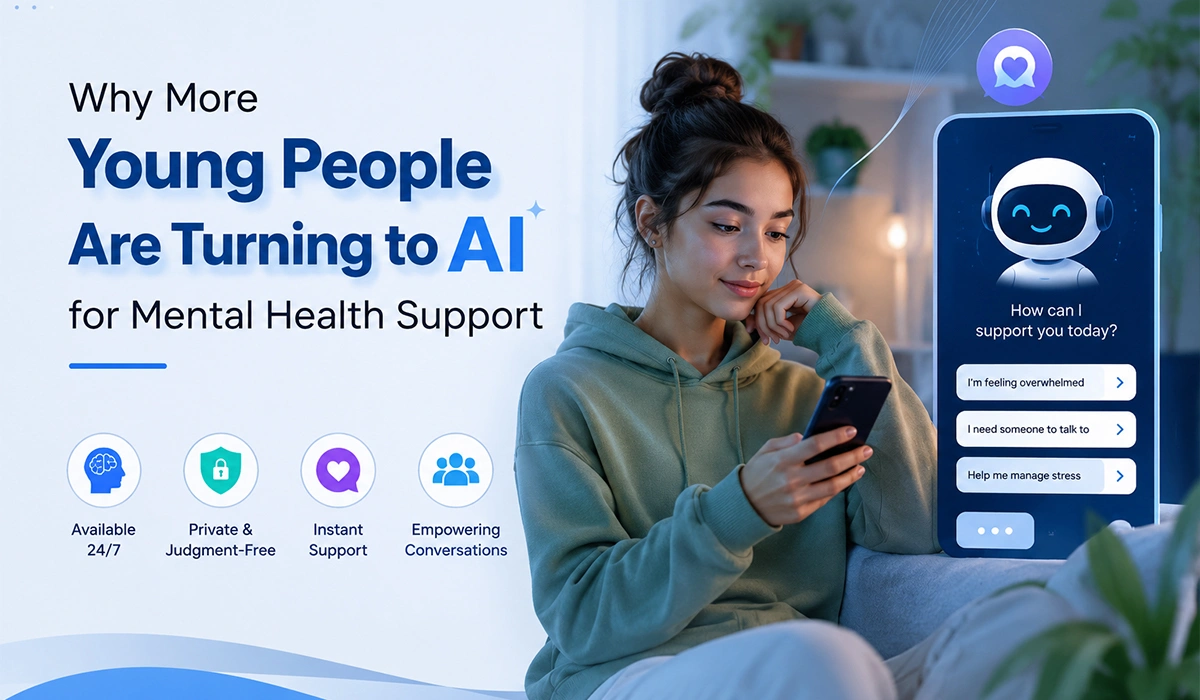
For many young people, this accessibility is part of the appeal of AI for mental health support. The technology is available at almost any hour, does not require an appointment, and can feel less judgmental than talking to another person.
And this is no longer a fringe behavior.
A nationally representative U.S. survey published in JAMA Pediatrics in June 2026 found that 19.2% of adolescents and young adults aged 12–21 reported using AI chatbots for mental health advice in 2025, representing approximately 8.2 million young people. Among those who had used AI for this purpose, 42.8% reported using it at least monthly and 91.7% considered the responses somewhat or very helpful.
But there is an important distinction:
AI can provide conversation, information, and some forms of practical support. It is not automatically a therapist, doctor, or replacement for professional mental healthcare.
The growing use of AI raises a bigger question: Why are young people turning to machines for emotional support, and what happens when technology becomes part of the mental healthcare journey?
1. What Is AI for Mental Health Support?
AI for mental health support refers to using artificial intelligence systems, including conversational chatbots, mental health apps, and digital assistants, to provide information, reflection exercises, emotional conversation, self-management tools, or guidance related to mental well-being.
The term covers a wide range of technologies.
Some systems are designed specifically for mental health. Others are general-purpose AI chatbots that people independently use when they are anxious, lonely, stressed, or emotionally overwhelmed.
What Can AI Do?
Depending on the system, AI may help users:
- Organize their thoughts
- Identify possible sources of stress
- Learn basic coping strategies
- Practice journaling
- Generate questions for a healthcare professional
- Find general mental health information
- Create routines
- Reflect on emotions
- Practice relaxation exercises
- Prepare for a conversation with a counselor
However, these capabilities should not be confused with clinical diagnosis or treatment.
The World Health Organization has specifically warned that generative AI tools that were not designed or tested for mental health are increasingly being used for emotional support, particularly by young people.
Practical tip: Think of AI as a possible supporting tool, not automatically as your healthcare provider.
2. How Common Is AI Mental Health Support Among Young People?
AI use for mental health is becoming increasingly common among young people. A 2026 JAMA Pediatrics study found that 19.2% of U.S. adolescents and young adults aged 12–21 had used AI chatbots for mental health advice in 2025. This was higher than the 13.1% reported in a comparable 2024 survey.
What the Numbers Show
The 2025 study surveyed 1,009 young people and used population weighting to represent more than 42 million U.S. adolescents and young adults.
Among respondents:
| Finding | 2025 result |
|---|---|
| Used AI for mental health advice | 19.2% |
| Estimated population | 8.2 million |
| Used AI at least monthly | 42.8% of AI users |
| Used AI daily or almost daily | 5.8% |
| Found responses somewhat/very helpful | 91.7% |
| Did not tell anyone about their AI use | 63.3% |
The figures are important, but they need context.
The study was conducted in the United States, so the 19.2% figure should not be presented as a worldwide or India-specific rate.
What About India?
India has a different healthcare, cultural, linguistic, and social environment.
Research involving Indian adolescents has highlighted issues such as stigma, privacy, smartphone access, and the need for culturally relevant mental health technology. One 2025 mixed-methods study involving Indian adolescents found that young people valued privacy and anonymity but also identified limitations around personalization and cultural relevance in existing chatbot approaches.
This suggests that AI mental health tools in India cannot simply copy models developed for other countries.
3. Why Are Young People Turning to AI?
Young people may turn to AI because it is convenient, private, available 24/7, and easy to access. For someone worried about judgment, cost, stigma, or finding the right professional, typing into a chatbot can feel like a lower-pressure first step.
1. Immediate Availability
A chatbot does not require waiting for an appointment.
A young person experiencing stress at midnight can open a phone and start a conversation.
2. Perceived Privacy
Some users feel more comfortable writing to a machine than telling another person about personal concerns.
This can be especially important when stigma makes discussing mental health difficult.
3. Less Fear of Judgment
A person may worry:
“What will my friends think?”
“Will my parents understand?”
“Will my teacher judge me?”
An AI interface can feel emotionally safer because there is no visible human reaction.
4. Convenience
AI is already integrated into the digital lives of many young people.
Using a chatbot can feel similar to searching Google, messaging a friend, or using a mobile application.
5. Cost and Access
Professional mental healthcare may be difficult to access because of cost, location, waiting times, availability of specialists, or social barriers.
AI can appear to fill that gap.
But accessibility does not automatically equal clinical quality.
4. Is AI Replacing Therapists?
Not reliably. AI can support certain low-risk activities such as journaling, information gathering, or preparing questions for a professional, but it should not be treated as a substitute for qualified mental health care, particularly for serious or complex conditions.
The difference between a chatbot and a mental health professional is substantial.
A trained professional can:
- Conduct a clinical assessment
- Consider personal history
- Observe behavior and emotional changes
- Evaluate risk
- Develop an individualized treatment plan
- Coordinate care
- Adjust treatment over time
- Provide human therapeutic relationships
AI systems generate responses based on patterns in data and user prompts.
They do not automatically understand a person’s life in the same way a clinician can.
The 2026 JAMA Pediatrics study also cautioned that perceived helpfulness does not necessarily demonstrate the quality or safety of the advice. Researchers noted concerns including chatbot tendencies toward excessive agreement or affirmation.
Simple Comparison
| AI Chatbot | Mental Health Professional |
|---|---|
| Available quickly | Appointment usually required |
| Can provide general information | Provides clinical assessment |
| Can help with reflection | Provides individualized care |
| May be inexpensive/free | Professional services may involve cost |
| Can misunderstand context | Trained to assess clinical context |
| May generate incorrect information | Uses professional training and clinical judgment |
| Cannot reliably manage emergencies | Can assess and respond to clinical risk |
Practical tip: Use AI to prepare for a conversation with a professional—not to avoid necessary professional care.
5. Why AI Can Feel Emotionally Helpful
AI can feel supportive because it responds immediately, maintains a conversational format, and can reflect a user’s words back in an organized way. For someone who feels lonely or overwhelmed, simply having a structured conversation may provide temporary relief.
This does not mean that the AI is experiencing empathy.
It means the system can generate language that sounds empathetic.
That distinction matters.
For example, someone might type:
“I feel like nobody understands me.”
An AI can respond with supportive language, questions, and suggestions.
That may help the person organize their thoughts.
But the system does not have human emotional experience.
The Risk of Excessive Agreement
Researchers behind the 2026 JAMA Pediatrics study highlighted concerns that AI’s perceived helpfulness could partly reflect sycophancy or over-affirmation—essentially telling users what feels reassuring rather than challenging an inaccurate belief when necessary.
For everyday reflection, this may sometimes be harmless.
For serious mental health problems, it can become much more concerning.
6. What Are the Risks of Using AI for Mental Health?
The major risks include inaccurate advice, privacy concerns, over-reliance, inappropriate reassurance, emotional dependence, and failure to recognize serious mental health conditions. These risks are especially important when young or vulnerable people use general-purpose AI without professional oversight.
Risk 1: Incorrect Information
AI can generate plausible but inaccurate answers.
Because the language sounds confident, users may not realize that an answer is wrong.
Risk 2: Misunderstanding the Situation
A chatbot sees text.
A clinician can gather information through a broader assessment.
Risk 3: Emotional Dependence
Some users may gradually begin treating a chatbot as their primary source of emotional support.
That can reduce opportunities to build human relationships.
Risk 4: Privacy
Mental health conversations can contain highly sensitive personal information.
Users should understand the privacy policy and data practices of the AI platform before sharing personal details.
Risk 5: Delayed Professional Care
A person may continue chatting with AI instead of seeking appropriate medical or psychological support.
This is particularly dangerous when symptoms are severe or persistent.
The WHO has called for AI systems interacting with people during emotionally vulnerable moments to prioritize safety, accountability, and human well-being.
7. Why Privacy Matters in AI Mental Health Conversations
Mental health conversations can contain highly sensitive information, so users should avoid assuming that an AI conversation has the same confidentiality protections as a conversation with a healthcare professional.
Before using an AI tool for mental health discussions, consider:
- What information does the platform collect?
- Is conversation data stored?
- How is data used?
- Can conversations be reviewed?
- What privacy controls are available?
- Can information be deleted?
- Is the service designed specifically for healthcare?
Avoid Sharing Unnecessary Information
Young users should be especially cautious about entering:
- Full addresses
- Phone numbers
- Passwords
- Financial information
- Identity documents
- Private information about other people
AI literacy should become part of mental health literacy.
8. Can AI Help Young People in India?
AI may improve access to basic mental health information and low-intensity support in India, particularly where stigma, geographic barriers, or limited access to professionals exist. However, effective use requires cultural sensitivity, privacy protection, appropriate language, and clear boundaries between digital support and clinical care.
India presents unique challenges.
A young person in Delhi may have very different access to mental healthcare than someone living in a smaller town or rural community.
Language is another consideration.
Mental health resources need to work across India’s diverse linguistic and cultural settings.
Research on Indian adolescents has found interest in privacy and text-based interaction, while also highlighting gaps in personalization and cultural relevance.
What AI Could Potentially Support
- Mental health education
- Self-reflection
- Stress-management information
- Finding appropriate services
- Preparing questions for a professional
- Encouraging people to seek help
- Translating basic health information
The goal should be better access to care—not replacing care.
9. AI vs Human Support: Which Is Better?
There is no single answer for every situation.
Comparison
| Situation | AI May Help | Human Support Preferred |
|---|---|---|
| General mental health information | Yes | Helpful |
| Journaling | Yes | Optional |
| Stress-management ideas | Yes | Helpful |
| Preparing for therapy | Yes | Yes |
| Persistent depression symptoms | Limited | Yes |
| Severe anxiety | Limited | Yes |
| Suspected mental health disorder | No diagnosis | Yes |
| Self-harm thoughts | Not sufficient | Immediate human/professional help |
| Crisis situation | Not sufficient | Emergency professional support |
| Complex treatment decisions | No | Yes |
The safest model is often AI + human support, rather than AI instead of humans.
10. What Does Responsible AI Mental Health Support Look Like?
Responsible AI mental health support should be transparent about its limitations, protect user privacy, provide appropriate safety safeguards, avoid pretending to be a human therapist, and encourage professional help when users show signs of serious distress.
In March 2026, WHO convened experts in AI, mental health, ethics, and public policy to discuss responsible AI for mental health and well-being. The experts emphasized that the rapid adoption of generative AI has moved faster than the evidence needed to fully understand its effects on mental health.
A Responsible System Should:
- Clearly identify itself as AI.
- Explain its limitations.
- Protect sensitive user information.
- Avoid making unsupported diagnoses.
- Avoid encouraging emotional dependence.
- Recognize situations requiring professional care.
- Provide appropriate safety guidance.
- Use evidence-based mental health information.
- Be culturally and linguistically appropriate.
- Maintain human oversight where necessary.
11. How Young People Can Use AI More Safely
Young people can reduce risks by treating AI as an information and reflection tool rather than a therapist, avoiding sensitive personal information, checking important health claims with reliable sources, and seeking professional help when symptoms are persistent, severe, or affecting daily life.
A Simple 7-Step Approach
Step 1: Know what you’re using
Check whether the tool is a general chatbot or a purpose-built mental health service.
Step 2: Protect your privacy
Do not share unnecessary identifying information.
Step 3: Ask for general information
Use AI to learn about concepts rather than asking it to diagnose you.
Step 4: Verify important information
Cross-check health information with reputable medical organizations or qualified professionals.
Step 5: Keep humans involved
Talk to trusted friends, family members, teachers, counselors, doctors, or psychologists.
Step 6: Watch for dependence
If you feel unable to cope without the chatbot, take a step back and speak with a person.
Step 7: Escalate when necessary
Persistent or severe symptoms require appropriate professional assessment.
12. What Parents and Teachers Should Know
Parents and educators should not automatically treat AI use as a problem. Instead, they should create an environment where young people can discuss how they use AI, what information they receive, and whether the technology is replacing human support.
The 2026 JAMA Pediatrics study found that 63.3% of young people who had used AI for mental health advice had not disclosed that use to anyone.
That makes open conversations important.
Instead of asking:
“Why are you talking to AI?”
Try asking:
“What kinds of things do you find useful about it?”
and:
“How do you decide whether an AI answer is trustworthy?”
This encourages digital literacy rather than secrecy.
WHO also emphasizes that mental health conditions often begin early in life and that many young people do not receive the care they need.
13. When Should Someone Stop Using AI and Seek Professional Help?
AI should not be the only source of support when emotional or psychological problems are persistent, worsening, interfering with daily life, or creating safety concerns. Professional help is particularly important when someone is experiencing thoughts of self-harm, suicide, psychosis, severe depression, or another mental health emergency.
Seek professional support when:
- Symptoms continue for weeks
- School or work performance is declining
- Sleep or appetite changes significantly
- Anxiety becomes difficult to control
- Someone withdraws from normal activities
- Substance use becomes a coping mechanism
- Relationships are being seriously affected
- There are thoughts of self-harm or suicide
- A person feels unable to stay safe
In an immediate crisis or when someone may be in danger, human emergency and healthcare support should take priority over an AI conversation.
14. The Future of AI and Mental Health
AI will probably become increasingly involved in mental health education, screening, digital care, research, and healthcare administration. The key challenge will be determining where AI adds value and where human clinical judgment must remain central.
The future is unlikely to be simply:
Humans vs AI.
A more realistic model is:
Humans + AI + healthcare systems.
AI could potentially help professionals by:
- Summarizing patient information
- Supporting screening
- Translating information
- Improving access to educational resources
- Helping patients prepare for appointments
- Supporting routine monitoring
But these applications require evidence, regulation, privacy protections, and clinical oversight.
Young people should also have a voice in designing these systems.
A 2026 study involving young people exploring conversational generative AI for youth mental health identified themes around humanizing AI without dehumanizing care, transparency about how systems work, using the right tool at the right time, and creating safe environments for use.
Why Human Connection Still Matters
Technology can respond to a message.
A person can sit beside you.
That distinction remains important.
Mental health is influenced by relationships, family, school, work, community, financial circumstances, physical health, and many other factors. WHO describes mental health as a state of well-being that enables people to cope with life’s stresses, learn, work, and participate in their communities.
AI can be one tool within that larger environment.
It should not become the entire environment.
The most useful question is therefore not:
Can AI replace therapy?
A better question is:
“How can AI responsibly help people reach the right support sooner?”
Evidence-Based Comparison: AI Support vs Professional Care
| Factor | AI Chatbot | Professional Care |
|---|---|---|
| Accessibility | Very high | Depends on location |
| Immediate response | Usually | Usually no |
| Human empathy | Simulated | Human |
| Clinical assessment | Limited/not reliable | Yes |
| Diagnosis | Should not be relied upon | Yes, where qualified |
| Personalized treatment | Limited | Yes |
| Privacy | Depends on platform | Governed by applicable professional/legal rules |
| Crisis management | Not sufficient | Essential |
| Long-term therapeutic relationship | Limited | Yes |
| Best use | Information/reflection/support | Assessment/treatment/care |
Frequently Asked Questions About AI for Mental Health Support
1. Why are young people using AI for mental health support?
Young people may use AI because it is convenient, available at any time, easy to access, and can feel less judgmental than talking to another person. Privacy concerns, stigma, cost, and limited access to professional services may also influence use.
2. How many young people use AI for mental health advice?
A 2026 JAMA Pediatrics study found that 19.2% of U.S. adolescents and young adults aged 12–21 reported using AI chatbots for mental health advice in 2025.
3. Can AI replace a therapist?
No. AI can support information gathering, reflection, and some low-intensity activities, but it cannot reliably replace professional assessment, diagnosis, treatment, or crisis care.
4. Is AI therapy safe?
Safety depends on the technology, how it is designed, and how it is used. General-purpose AI systems may not have been designed or tested for mental health applications, so users should understand their limitations.
5. Can AI diagnose depression or anxiety?
AI should not be relied upon to diagnose a mental health condition. Diagnosis requires appropriate clinical assessment by a qualified healthcare professional.
6. Can AI help with stress?
AI may provide general stress-management information, journaling prompts, breathing exercises, or ideas for organizing thoughts. Persistent or severe stress should be discussed with an appropriate professional.
7. Is it safe to share personal information with an AI chatbot?
Users should be cautious. Before sharing sensitive mental health information, understand the platform’s privacy and data policies and avoid unnecessary identifying details.
8. Are AI chatbots available for mental health support in India?
AI chatbots and digital mental health tools are increasingly available in India, but their quality, evidence base, privacy protections, and cultural relevance can vary. Professional mental healthcare should remain available when clinical assessment or treatment is needed.
9. Can teenagers use AI for mental health questions?
Teenagers may encounter and use AI tools, but they should not depend on them as their primary mental healthcare source. Trusted adults and qualified professionals remain important sources of support.
10. What are the biggest risks of AI mental health chatbots?
Important risks include inaccurate information, over-reassurance, privacy problems, emotional dependence, misunderstanding serious symptoms, and delaying professional care.
11. Can AI help someone prepare for therapy?
Yes. A person may use AI to organize thoughts, create questions, or make a list of symptoms to discuss with a healthcare professional. The AI should not determine the diagnosis.
12. Is AI mental health support cheaper than therapy?
AI tools may have lower or no direct cost, but price should not be the only consideration. A low-cost tool is not necessarily an appropriate substitute for professional care.
13. What should parents do if their child uses AI for emotional support?
Start with an open conversation rather than punishment or criticism. Ask what the child uses the tool for and discuss privacy, misinformation, and the importance of human support.
14. Can AI help reduce mental health stigma?
Potentially. Private digital tools may make it easier for some people to begin learning about mental health. However, reducing stigma also requires supportive families, schools, workplaces, communities, and accessible healthcare.
15. When should someone seek professional help instead of using AI?
Seek professional support when symptoms are persistent, worsening, interfere with everyday life, or involve serious safety concerns. A mental health crisis requires immediate human and healthcare support.
Conclusion
The growing use of AI for mental health support among young people reflects a larger change in how people seek information and emotional support.
AI is attractive because it is fast, accessible, private-feeling, and always available. Recent U.S. research shows that its use for mental health advice is already substantial, with nearly one in five adolescents and young adults reporting such use in 2025.
But popularity should not be confused with clinical effectiveness.
AI can help someone put their feelings into words, learn basic information, organize questions, or take a first step toward seeking help. At the same time, inaccurate information, privacy concerns, over-reliance, and delayed professional care remain important risks.
The future of digital mental healthcare should therefore not be about choosing AI or humans.
It should be about building systems where technology improves access while human expertise, clinical judgment, privacy, safety, and genuine human connection remain at the center.
AI can start a conversation. The right human support can help determine where that conversation should go next.