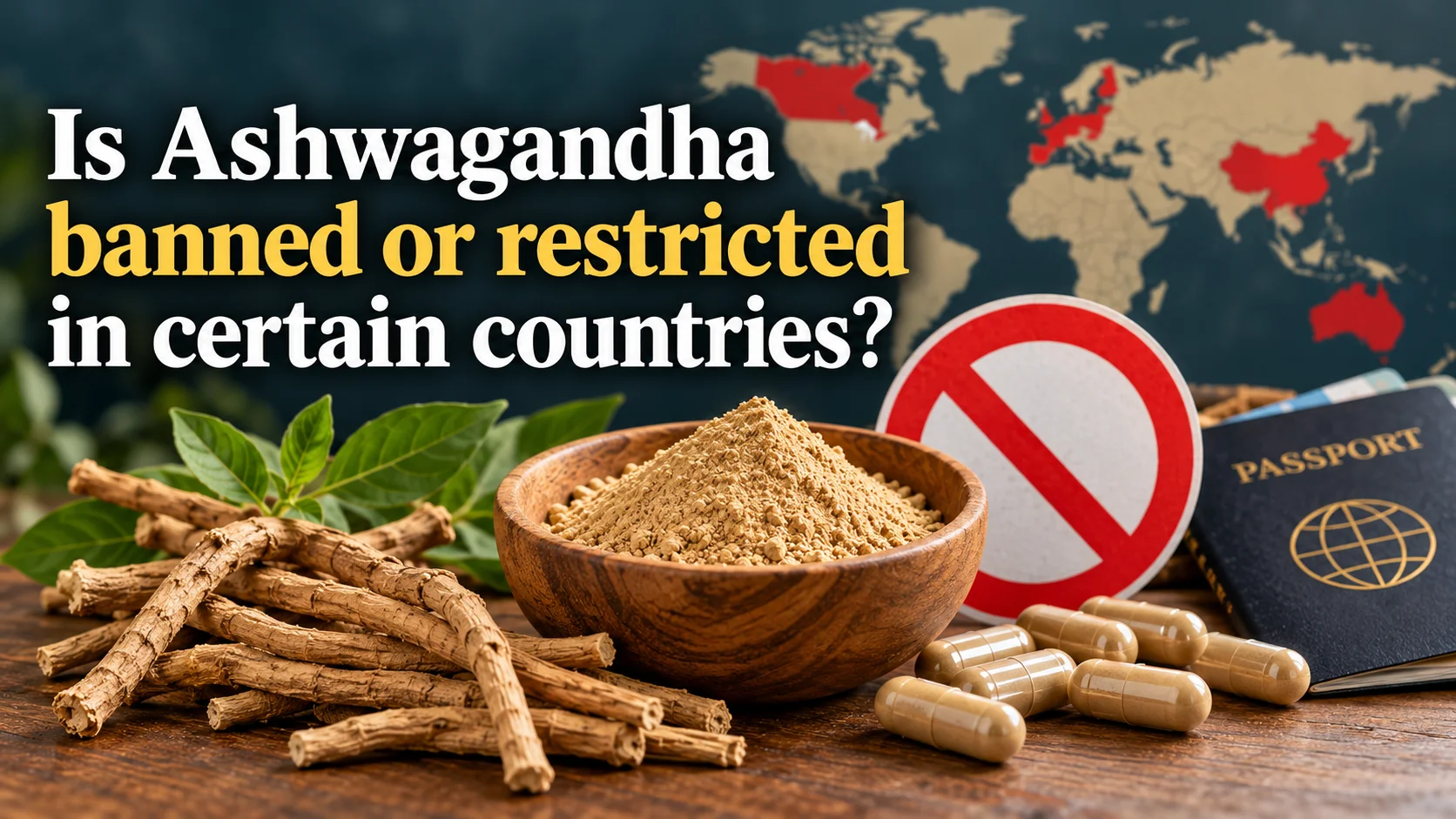
Ashwagandha has been used in traditional Indian wellness practices for centuries. Today, it is sold in capsules, powders, herbal formulations, and dietary supplements worldwide. However, its growing popularity has also raised an important question: Is ashwagandha banned or restricted in certain countries?
The answer is yes. Denmark prohibits the sale of ashwagandha as a food, while other countries apply different rules, safety recommendations, or product-specific requirements. In India, regulations also distinguish between permitted plant parts and ingredients that cannot be used in certain products.
Understanding these differences matters if you are a consumer, healthcare professional, supplement manufacturer, or business exporting Ayurvedic products.
1. What Is Ashwagandha?
Ashwagandha (Withania somnifera), sometimes called Indian ginseng or winter cherry, is a plant used in traditional Ayurvedic practices. Its roots and extracts are ingredients in various wellness products.
Quick answer: Ashwagandha is a traditional herbal ingredient, but its legal status depends on the country, product category, formulation, and intended use.
Products containing ashwagandha may be regulated as foods, dietary supplements, traditional medicines, or other health products. These categories can have different safety and marketing requirements.
2. Is Ashwagandha Banned in Denmark?
Yes. Denmark prohibits the sale of ashwagandha as a food, including supplements and beverages. The Danish Veterinary and Food Administration cites concerns identified in a risk assessment, including possible effects on reproductive hormones and the nervous system. Food Agency
This is an important example of why a product legally sold in one country may not be permitted in another.
Practical tip: Businesses should verify Danish requirements before exporting supplements containing ashwagandha.
3. Is Ashwagandha Banned in India?
Ashwagandha is not subject to a blanket ban in India, but its use in particular products is regulated.
The Food Safety and Standards Authority of India (FSSAI) oversees health supplements and nutraceuticals under its applicable regulations. In an advisory dated 16 April 2026, FSSAI clarified that only ashwagandha roots and their extracts are permitted in specified food-product categories, subject to applicable requirements. Ashwagandha leaves and their extracts are not permitted in those categories. The Ministry of Ayush has also directed relevant manufacturers not to use the leaves in Ayush medicines and products. FSSAI
For Indian manufacturers, checking the plant part, product classification, formulation, and applicable licence requirements is essential.
4. What About Other Countries?
There is no single global rule governing ashwagandha.
| Country | Regulatory position |
|---|---|
| Denmark | Sale as a food, including supplements, is prohibited. |
| India | Certain uses are permitted subject to regulations; ashwagandha leaves are not permitted in specified food products and Ayush products. |
| Germany | The Federal Institute for Risk Assessment has raised safety concerns about ashwagandha preparations; this should not be confused with a blanket national ban. |
| France | The food-safety agency ANSES has advised certain groups to avoid ashwagandha; this is not the same as a universal ban. |
| Canada | Ashwagandha is used in licensed natural health products subject to applicable product and ingredient requirements. |
| Australia | Ashwagandha appears in registered therapeutic goods; products must meet the relevant Australian regulatory requirements. |
These positions are based on information from national authorities and should be checked against current product-specific rules before purchasing, selling, or exporting. Office of Dietary Supplements
5. Why Do Some Countries Restrict Ashwagandha?
Regulators assess potential health risks, available scientific evidence, dosage, and intended use.
Key concerns include:
- Possible effects on thyroid function and hormone levels.
- Potential interactions with medicines.
- Rare reports of liver injury.
- Uncertainty about safety during pregnancy and breastfeeding.
The US National Institutes of Health notes that ashwagandha may interact with medicines, including those for diabetes, blood pressure, immune suppression, and sedation.
6. Is Ashwagandha Safe to Use?
Safety depends on the individual, product, dose, and duration of use. People who are pregnant or breastfeeding, have thyroid or autoimmune conditions, or take regular medication should consult a healthcare professional before using it.
7. How Can Consumers Check Product Legality?
Before buying ashwagandha supplements internationally:
- Check the destination country’s official regulations.
- Confirm whether the product is classified as food, a supplement, or medicine.
- Review the ingredients, plant parts, and dosage.
- Verify the product’s registration or licence where required.
- Consult a qualified healthcare professional about safety.
8. What Should Indian Manufacturers and Exporters Know?
Indian businesses should verify FSSAI or applicable Ayush requirements and check the destination country’s import rules. A product’s availability in India does not guarantee that it can legally be sold abroad.
9. Frequently Asked Questions About Ashwagandha Bans
Is ashwagandha completely banned worldwide?
No. Restrictions differ between countries, and some permit compliant products under specific regulatory frameworks.
Is ashwagandha banned in India in 2026?
There is no blanket ban. However, specific product categories have restrictions, including the prohibition on ashwagandha leaves in the food products covered by the FSSAI advisory.
Can I carry ashwagandha supplements when travelling?
Check the destination country’s customs and health-product rules before travelling. Permission to purchase a product in India does not guarantee permission to import it elsewhere.
Is ashwagandha banned in Europe?
There is no single, uniform answer for every European country. National requirements and product classifications matter; Denmark, for example, prohibits its sale as a food.
10. Internal Linking Suggestions
Consider linking this article to related resources using these anchor texts:
- Ashwagandha Benefits and Safety
- Understanding Ayurvedic Supplements
- How to Choose Quality Herbal Supplements
- Nutraceutical Regulations in India
11. Recommended Schema Markup
For a website publishing this article, consider:
- Article schema: Identifies the article and its author.
- BreadcrumbList schema: Shows the page’s position within the website.
- Organization schema: Describes the publishing organization.
Use FAQPage schema only when the page meets Google’s applicable requirements; structured data does not guarantee enhanced search results.
12. Conclusion: Is Ashwagandha Banned or Restricted?
Ashwagandha is restricted in certain countries, but it is not universally banned. Denmark prohibits its sale as a food, India regulates its use in specific product categories, and other countries apply their own safety and product requirements.
For consumers, the priority is informed, medically appropriate use. For manufacturers and exporters, the priority is verifying current regulations before marketing or shipping products.
Regulations can change. Check the relevant national authority before making purchasing, medical, or commercial decisions.