Introduction: Can AI See What Humans Cannot?
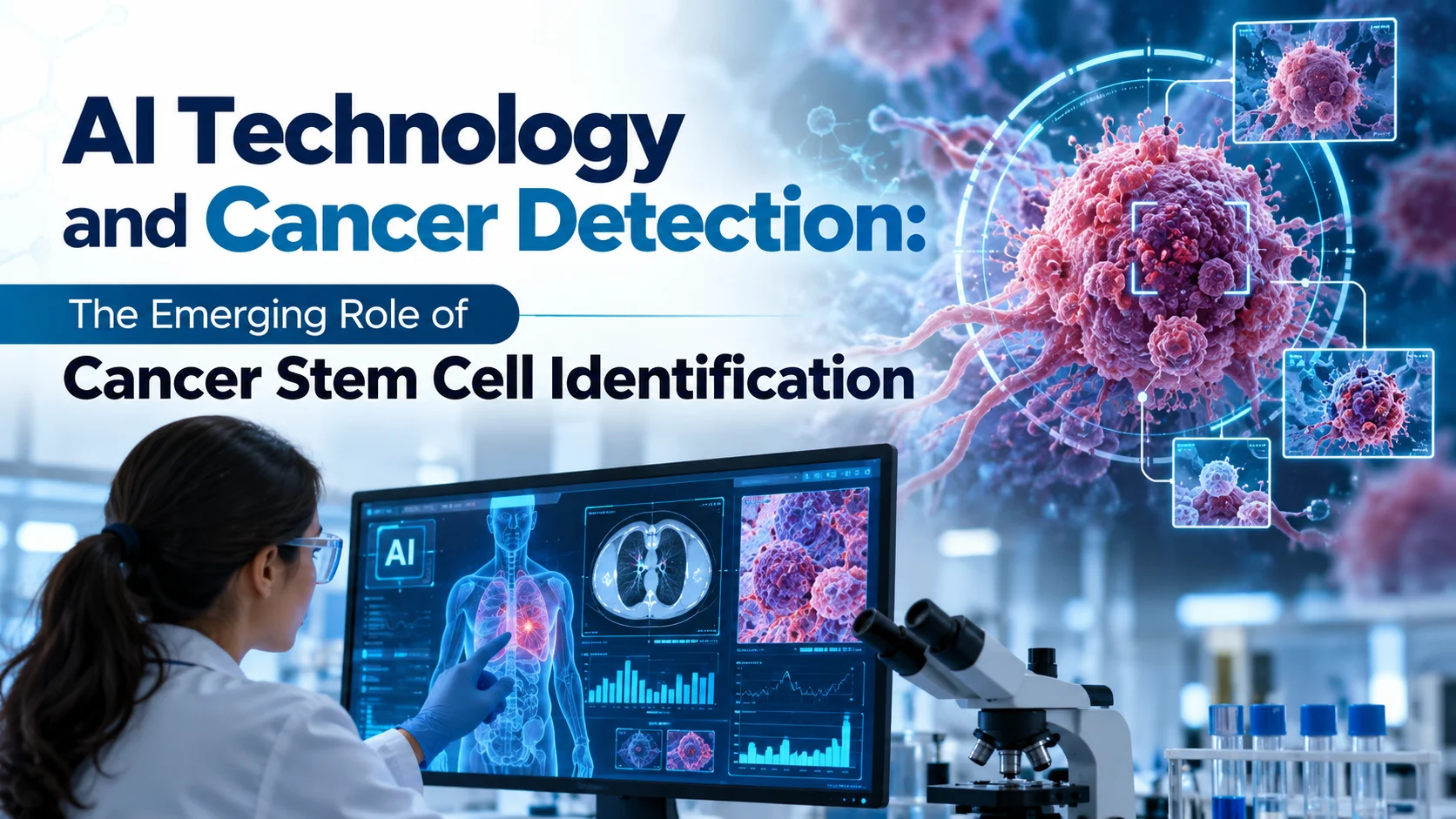
Imagine a pathologist examining thousands of cells in a tumour sample. Some cells may look ordinary, while a much smaller population may have biological properties linked to tumour growth, treatment resistance and recurrence. Could artificial intelligence help researchers find these difficult-to-identify cells?
Cancer stem cells (CSCs) are a specialised population of tumour cells with self-renewal and differentiation capabilities. Research increasingly suggests that AI can help analyse their morphology, molecular characteristics and “stemness” patterns. However, this remains an emerging research area—not a replacement for clinical diagnosis.
Cancer remains a major global health challenge. WHO estimates nearly 10 million cancer deaths worldwide in 2024, while early detection and appropriate treatment can substantially improve outcomes.
1. What Are Cancer Stem Cells?
Quick answer: Cancer stem cells are tumour cells with stem-cell-like properties that can self-renew and generate different tumour cell populations.
These cells are being studied because their biology may contribute to tumour growth, heterogeneity, recurrence and resistance to treatment. Their identification is challenging because CSCs are relatively rare and can differ across cancer types and tumour environments.
Practical tip: CSC research should be viewed as complementary to established pathology, molecular testing and clinical assessment.
2. How Can AI Help in Cancer Detection?
Quick answer: AI can analyse large volumes of medical images and biological data to identify patterns that may be difficult to detect manually.
Machine-learning and deep-learning systems can process pathology images, cellular morphology and molecular datasets. NCI notes that AI-assisted imaging and analysis of tumour data are active areas of cancer-diagnosis research.
3. AI and Cancer Stem Cell Identification
Quick answer: AI may help classify or predict CSC characteristics by analysing cellular images and molecular patterns.
Researchers have developed deep-learning models capable of analysing phase-contrast images and predicting cancer stem-cell characteristics. Studies have also explored AI models for recognising CSC morphology in cultures and tumour tissues.
4. How Does AI Identify Cancer Stem Cells?
A simplified workflow looks like this:
Sample → Imaging/Data → AI Model → Pattern Recognition → CSC Prediction → Research/Clinical Validation
AI can analyse features such as:
- Cell morphology
- Spatial patterns
- Gene-expression profiles
- Stemness-related signatures
- Tumour microenvironment features
- Multi-omics datasets
Recent reviews describe AI-based stemness analysis as a promising way to integrate genomics, transcriptomics and epigenomics.
5. AI in Digital Pathology
Quick answer: Digital pathology converts tissue slides into high-resolution images that AI systems can analyse for patterns.
Modern AI-assisted histopathology is being investigated for tissue classification, prognosis prediction, molecular characteristics and treatment-response prediction.
Example: Instead of examining only individual cells, AI can potentially evaluate patterns across large digital tissue sections.
6. AI vs Traditional Cancer Stem Cell Identification
| Approach | Strength | Limitation |
|---|---|---|
| Cell markers | Established research method | Markers vary between cancers |
| Microscopy | Direct visual information | Human interpretation is time-consuming |
| Molecular testing | Provides biological information | Can require specialised testing |
| AI analysis | Handles large, complex datasets | Requires validation and high-quality data |
| AI + multi-omics | Integrates multiple information types | Still developing for clinical use |
Current research indicates that AI is best considered a supporting technology, rather than a standalone diagnostic method.
7. What Are the Potential Benefits?
Quick answer: AI could make CSC research faster, more scalable and more data-driven.
Potential applications include:
- Automated image analysis
- Identification of rare cellular patterns
- Stemness scoring
- Tumour classification
- Research into treatment resistance
- Patient-risk stratification
- Discovery of potential therapeutic targets
A 2025 review reported that AI-based stemness indices can help researchers investigate CSC-related characteristics and their relationship with tumour behaviour.
8. What Are the Current Challenges?
Quick answer: AI models can be limited by image quality, small datasets, tumour heterogeneity and differences between laboratories.
CSC identification is particularly challenging because CSC populations can be rare and biologically diverse. Poor image contrast and variation between tumour samples can also affect AI performance.
Key challenge: A model that performs well in one research dataset may not automatically perform equally well in hospitals or across different populations.
9. What Does This Mean for India?
India recorded an estimated 1.56 million new cancer cases in 2024, according to IARC’s GLOBOCAN estimates.
For India, AI could eventually support pathology workflows, research laboratories and precision-oncology programmes, particularly where large volumes of imaging and molecular information need to be analysed.
However, deployment requires appropriate validation, infrastructure, trained professionals and responsible handling of patient data.
10. What Could the Future Look Like?
Quick answer: The future may combine AI, digital pathology, single-cell analysis and multi-omics rather than relying on one technology.
Researchers are already investigating combinations of single-cell data and machine learning to understand CSC-related genes and tumour behaviour.
The longer-term goal is not simply to “find cancer cells,” but to understand which cells matter, how they behave and why some tumours return or resist treatment.
11. Can AI Replace Cancer Specialists?
No. AI should currently be viewed as a decision-support and research technology. Cancer diagnosis requires clinical assessment, pathology, imaging and other appropriate investigations interpreted by qualified healthcare professionals.
NCI highlights both the promise of AI-based cancer diagnosis and the need for validated tools that distinguish clinically significant disease from conditions that may not require aggressive treatment.
12. Frequently Asked Questions About AI Technology and Cancer Detection
Can AI detect cancer?
AI can assist researchers and clinicians in analysing medical images and biological data, but it does not independently replace clinical diagnosis.
Can AI identify cancer stem cells?
Research shows potential for AI to analyse CSC morphology and stemness-related patterns, but this remains an emerging field.
Why are cancer stem cells important?
They are studied for their potential role in tumour growth, recurrence and treatment resistance.
Is AI cancer detection available in India?
AI-assisted cancer technologies are being researched and developed, but availability and clinical validation vary by technology, cancer type and healthcare setting.
Can AI predict cancer recurrence?
Some research models attempt to predict prognosis or treatment response, but individual clinical decisions require validated medical evidence.
Conclusion
AI technology and cancer detection are moving toward a more data-driven future. The emerging ability to analyse cancer stem-cell morphology, molecular signatures and stemness patterns could deepen our understanding of why tumours grow, resist treatment and return.
But the most important point is simple: AI is a powerful tool—not a replacement for medical expertise.
The future of cancer detection may belong to the combination of AI + digital pathology + molecular biology + expert clinical judgment, helping researchers move closer to earlier, more precise and personalised cancer care.