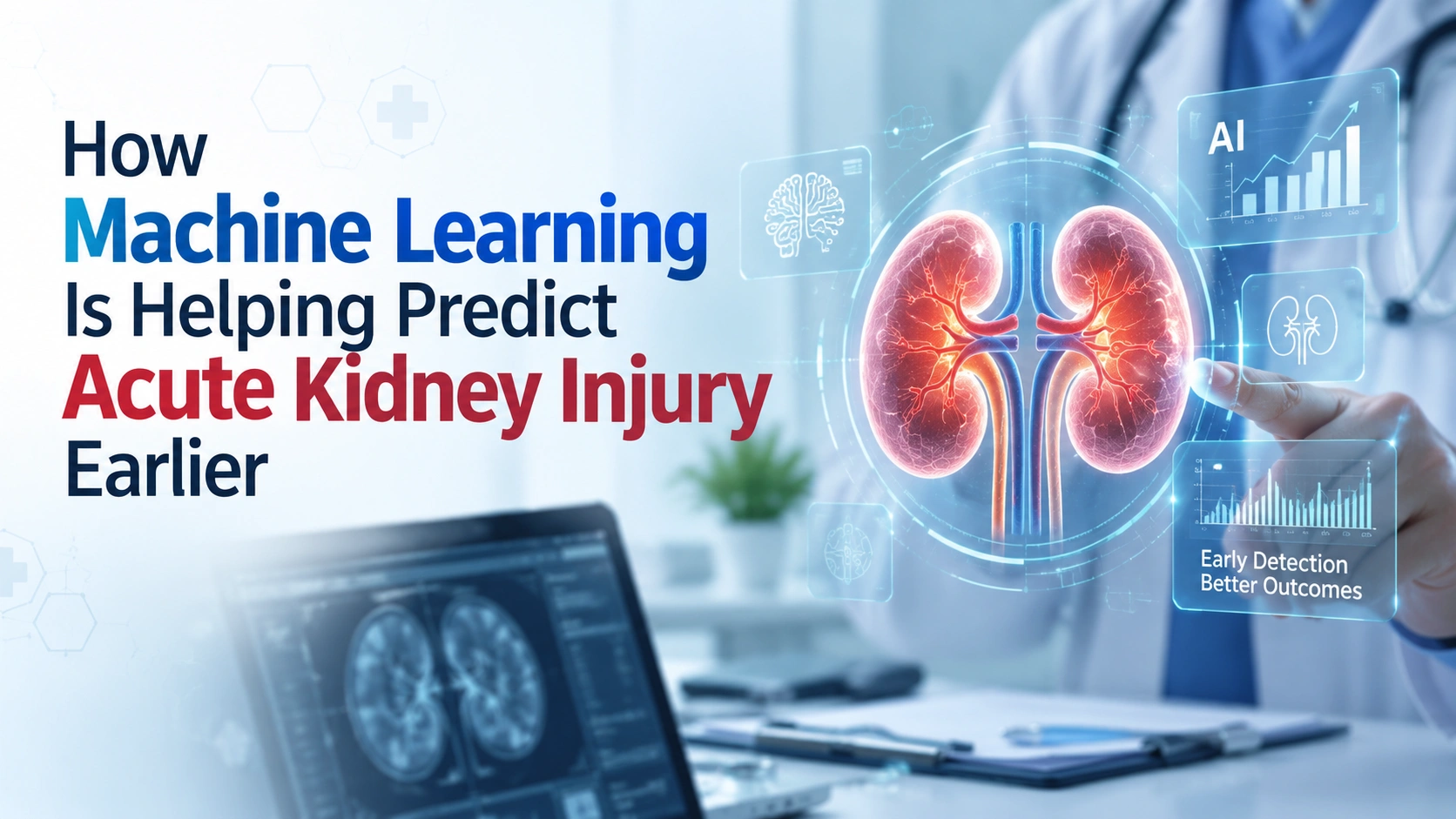
A patient in a hospital may look stable while subtle changes are already appearing in their laboratory results, vital signs, medications, fluid balance, and other clinical data. Acute kidney injury (AKI) can develop quickly, making early recognition important. Today, researchers are exploring whether machine learning can identify patterns that signal increased AKI risk before conventional clinical indicators become obvious.
This does not mean AI replaces doctors. Instead, machine-learning systems can potentially analyze large volumes of patient information and provide an additional early warning for healthcare professionals.
What Is Acute Kidney Injury?
Quick answer: Acute kidney injury is a sudden decline in kidney function that can develop over hours or days. It is commonly assessed using changes in serum creatinine and urine output. Current KDIGO guidance also places greater emphasis on earlier identification, risk prediction and prevention.
AKI can occur in different settings, including hospitals and intensive-care units. Causes may include severe illness, reduced blood flow to the kidneys, infections, certain medicines, or other kidney stressors.
Early recognition gives clinicians an opportunity to investigate the cause and manage potentially contributing factors.
Why Is Early AKI Prediction Important?
Quick answer: Kidney injury can evolve rapidly, so identifying patients at increased risk before AKI becomes clinically obvious may give healthcare teams more time to evaluate and respond.
Traditional monitoring often depends on laboratory measurements and clinical observations. Machine learning adds another approach: analyzing multiple data points simultaneously to identify patterns associated with future AKI.
How Does Machine Learning Predict AKI?
Quick answer: Machine-learning models learn relationships from patient data and use those patterns to estimate the likelihood of AKI developing.
A simplified process looks like this:
- Collect data – laboratory results, vital signs, medications and other clinical information.
- Train the model – algorithms learn patterns from historical patient records.
- Test performance – researchers evaluate the model on separate data.
- Generate risk estimates – the system identifies patients who may have elevated AKI risk.
- Support clinical review – healthcare professionals interpret the information alongside the patient’s overall condition.
The FDA describes machine learning as techniques that train AI algorithms to improve performance on a particular task.
What Patient Information Can AI Analyze?
Machine-learning systems may incorporate several types of clinical information, depending on how the model was developed.
| Data Type | Possible Role |
|---|---|
| Serum creatinine | Indicator used to assess kidney function |
| Urine output | Important measure in AKI assessment |
| Blood pressure | May provide information about kidney perfusion |
| Medication information | Can help identify potential risk factors |
| Vital signs | Provides information about a patient’s condition |
| Laboratory results | Adds broader clinical context |
| Demographic information | May contribute to risk modelling |
The exact variables differ between models, and not every algorithm uses the same information.
What Does the Research Show?
Quick answer: Research suggests machine learning has potential for AKI risk classification, but performance varies between models and clinical settings.
A 2025 systematic review and meta-analysis examined machine-learning models developed for AKI risk classification, highlighting growing research interest in this application.
Importantly, a promising research result does not automatically mean a model is ready for routine clinical use.
Can AI Detect AKI Before It Happens?
Quick answer: Some research models are designed specifically to predict future AKI risk rather than simply identify AKI after it has already developed.
This distinction matters. A prediction system could potentially provide an earlier warning, allowing clinicians to review the patient’s condition and possible contributing factors.
However, prediction accuracy depends on the quality of the training data, patient population, clinical setting and model validation.
What Are the Benefits of Machine-Learning AKI Prediction?
Potential advantages include:
- Earlier risk identification
- Analysis of large clinical datasets
- Continuous monitoring of available patient information
- Support for clinical decision-making
- Identification of complex patterns
- Potentially more personalized risk assessment
The FDA notes that AI/ML technologies can support applications including early disease detection, diagnosis, prognosis and risk assessment.
What Are the Challenges?
Machine learning is not automatically accurate simply because it uses large amounts of data.
Important challenges include:
- Poor-quality or incomplete clinical data
- Bias in training datasets
- Differences between hospitals and patient populations
- False alarms
- Difficulty explaining some algorithmic predictions
- Limited external validation
- Changes in clinical practice over time
The FDA specifically highlights concerns around bias, uncertainty, performance evaluation and real-world monitoring of AI-enabled medical technologies.
AI Should Support Doctors, Not Replace Them
Quick answer: Machine learning should be viewed as a clinical-support technology rather than an independent replacement for medical judgment.
For healthcare AI to be useful, clinicians need to understand the intended use, relevant inputs, validation evidence and limitations of a model. FDA guidance on clinical decision-support software emphasizes transparency and enabling healthcare professionals to independently review the basis of recommendations.
What Could the Future Look Like?
Future AKI prediction systems may combine laboratory results, electronic health records, continuous monitoring and other clinical information to produce more timely risk assessments.
The 2026 KDIGO AKI/AKD guideline update places increased emphasis on risk prediction, early identification and prevention, including validated risk models, biomarkers and electronic alerts.
This creates an important opportunity for AI research—but clinical validation remains essential.
Frequently Asked Questions About Machine Learning and Acute Kidney Injury
Can machine learning predict acute kidney injury?
Yes. Research has developed machine-learning models designed to classify or predict AKI risk, although their accuracy and clinical usefulness vary between models and settings.
How can AI help detect AKI earlier?
AI can analyze multiple clinical variables and identify patterns associated with increased AKI risk, potentially providing an additional warning for clinicians.
Does AI diagnose acute kidney injury?
AI can support risk assessment and clinical decision-making, but diagnosis and treatment should remain under appropriate healthcare professional oversight.
What is the main benefit of early AKI prediction?
Earlier identification may give clinicians more time to investigate potential causes and manage the patient’s condition.
Is machine learning ready to replace doctors in AKI care?
No. Machine-learning systems have limitations and should complement—not replace—clinical assessment and professional judgment.
Final Takeaway
Machine learning is creating new possibilities for earlier AKI risk prediction by finding patterns across complex clinical data. But the goal is not to replace medical professionals—it is to give them better information, earlier, so that clinical decisions can be made with greater context.