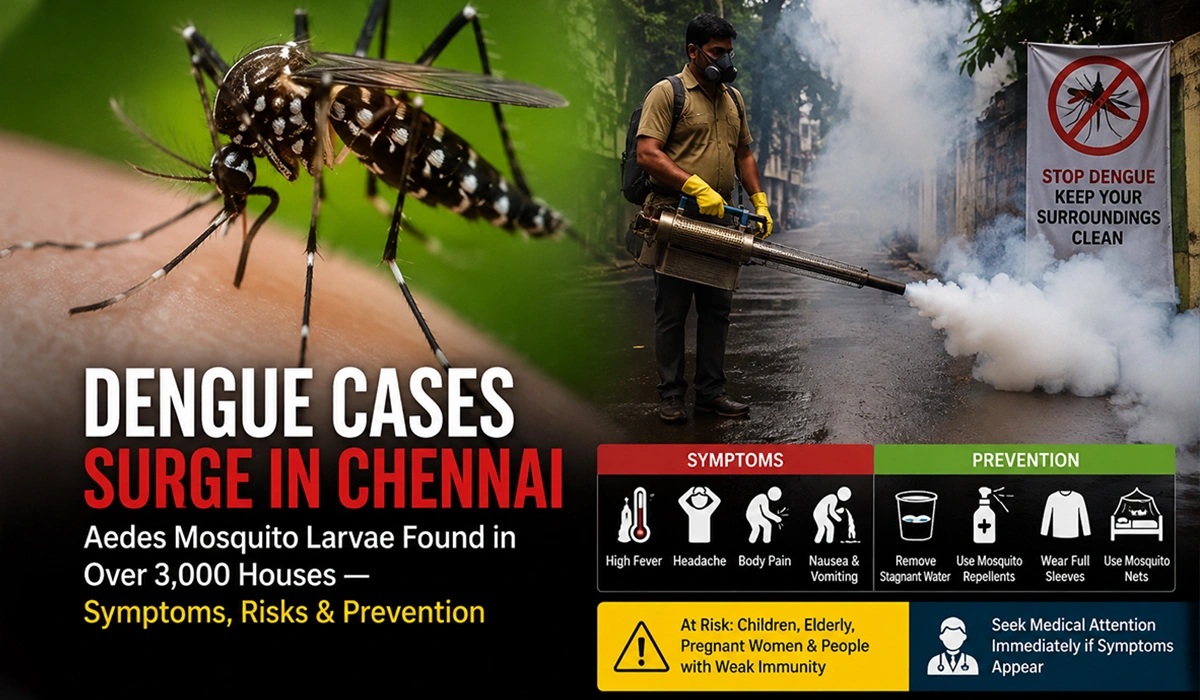
Dengue Cases Surge in Chennai: What Is Happening?
Chennai is seeing increased dengue activity as mosquito-control inspections have identified Aedes mosquito larvae in 3,326 houses and 4,029 containers across the city’s 15 zones during checks conducted in the week reported on August 24, 2026. Greater Chennai Corporation (GCC) has intensified anti-larval activities, surveillance and mosquito-control measures.
The numbers are important because the mosquito that transmits dengue often breeds in small amounts of stagnant water around homes, workplaces and construction sites.
According to GCC data cited in recent reports, Chennai recorded an estimated 302 dengue cases during the first three weeks of August, compared with 282 in July and 137 in June. In August 2025, the city recorded 363 cases for the entire month.
This does not mean every person in Chennai is at high risk of infection. But it does highlight why residents should take mosquito prevention seriously.
Quick answer
Why are dengue cases rising in Chennai?
The recent increase is occurring alongside widespread detection of Aedes mosquito breeding sites. Rain, water accumulation, dense urban environments and containers that hold stagnant water can create suitable breeding conditions. GCC has therefore increased surveillance, source reduction and fogging while asking residents to remove potential breeding sites.
1. What Do the Latest Chennai Dengue Numbers Tell Us?
The latest surveillance gives a useful picture of the situation.
| Indicator | Latest reported figure |
|---|---|
| Houses positive for Aedes larvae | 3,326 |
| Containers positive for Aedes larvae | 4,029 |
| Chennai zones covered | 15 |
| Dengue cases, June 2026 | 137 |
| Dengue cases, July 2026 | 282 |
| Dengue cases, first 3 weeks of August 2026 | 302 |
| Highest reported house count | 610 in Thiru. Vi. Ka. Nagar |
The figures come from GCC data reported in August 2026.
Thiru. Vi. Ka. Nagar recorded the highest number of houses positive for Aedes larvae, with 610 houses reported as positive. Other areas identified as having significant domestic breeding activity included Tondiarpet, Royapuram, Adyar, Perungudi and Sholinganallur.
At the state level, Tamil Nadu also reported substantial dengue activity. A report citing Health Minister K.G. Arunraj said the state had recorded 12,543 dengue cases and four deaths from January through August 23, 2026. Chennai was reported as having the highest number of cases among districts.
Practical takeaway
The most useful response is not panic. It is source reduction: identify and eliminate places where Aedes mosquitoes can breed.
2. What Is Dengue Fever?
Direct answer: Dengue is a viral infection transmitted primarily through the bite of infected Aedes mosquitoes, particularly Aedes aegypti. It is common in tropical and subtropical areas and can range from a mild illness to severe dengue requiring hospital care.
Dengue is caused by dengue viruses, with four recognised serotypes: DENV-1, DENV-2, DENV-3 and DENV-4. Infection with one serotype provides long-term protection against that same serotype, but not necessarily against the others.
Most infections are mild or may cause no noticeable symptoms. However, some patients can develop severe dengue, which can cause serious bleeding, shock or organ impairment.
This is why recognising symptoms and warning signs matters.
3. Why Are Aedes Mosquitoes a Concern in Chennai?
Direct answer: Aedes mosquitoes are the main vectors responsible for dengue transmission. They commonly live close to people and can breed in small water-holding containers around homes. Their daytime biting behaviour means mosquito protection should not be limited to nighttime.
The Greater Chennai Corporation notes that Aedes aegypti and Aedes albopictus are important dengue vectors and that breeding can occur in water-storage containers, tyres, discarded items and other places where water collects.
Potential breeding locations include:
- Buckets and containers
- Flowerpots and plant saucers
- Discarded bottles
- Old tyres
- Water-storage vessels
- Construction materials
- Open drums
- Plastic containers
- Roof or terrace water accumulation
- Other objects capable of holding rainwater
A key point is that a large pond is not necessary. Small water-holding objects can become breeding sites.
4. How Does Dengue Spread?
Direct answer: Dengue is primarily transmitted through the bite of an infected Aedes mosquito. It is not normally spread directly through casual person-to-person contact. An infected person can, however, infect mosquitoes that bite them, allowing those mosquitoes to transmit the virus to other people.
The transmission cycle is relatively simple:
Infected person → Aedes mosquito → another person
When a female Aedes mosquito feeds on a person carrying dengue virus, it can become infected. After the virus develops inside the mosquito, it can transmit the infection when it bites another person.
This is why protecting a person who already has dengue from mosquito bites is also important.
5. What Are the Common Symptoms of Dengue?
Direct answer: Common dengue symptoms include sudden fever, severe headache, pain behind the eyes, muscle and joint pain, nausea or vomiting and rash. Symptoms typically begin about 4–10 days after infection and can last several days.
Common symptoms include:
- High fever
- Severe headache
- Pain behind the eyes
- Muscle and joint pain
- Nausea
- Vomiting
- Skin rash
- Fatigue
Not everyone experiences all of these symptoms.
Because dengue can resemble other infections, symptoms alone cannot reliably confirm dengue. A healthcare professional may recommend testing based on symptoms, timing and local transmission.
Important
If you develop a high fever while dengue is circulating in your area, do not assume it is simply a seasonal fever. Contact a healthcare professional for appropriate evaluation.
6. What Are the Warning Signs of Severe Dengue?
Direct answer: Severe dengue can develop around the time the fever decreases, often during the critical phase of illness. Severe abdominal pain, persistent vomiting, bleeding, rapid breathing, extreme weakness or restlessness, blood in vomit or stool and pale or cold skin require urgent medical attention.
Warning signs include:
- Severe abdominal pain
- Persistent vomiting
- Bleeding gums or nose
- Blood in vomit or stool
- Rapid breathing
- Extreme weakness
- Restlessness
- Excessive thirst
- Pale or cold skin
One important misconception is that a falling fever always means recovery.
WHO notes that the critical phase can occur around the time the temperature decreases. Therefore, patients and caregivers should continue monitoring for warning signs even after the fever starts to come down.
If warning signs appear, seek urgent medical care.
7. Why Can Dengue Become Severe?
Dengue does not affect every patient in the same way.
Many people recover without developing severe complications. However, some infections can progress to severe dengue.
A previous dengue infection can also be relevant because infection with one dengue serotype does not provide complete protection against the other serotypes. WHO notes that sequential infection with different serotypes can increase the risk of severe disease.
Other people may also require closer medical observation depending on their age, pregnancy status, underlying health conditions and clinical condition.
The important lesson is simple:
Do not judge dengue severity only by how high the fever is.
Clinical monitoring and medical assessment matter.
8. How Can Chennai Residents Prevent Dengue at Home?
Direct answer: The most important household measure is to eliminate mosquito breeding sites. Regularly empty, clean, scrub or cover water-holding containers, and remove objects that can collect rainwater. This reduces the number of mosquito eggs, larvae and pupae that can develop into adult mosquitoes.
Use the weekly inspection rule
Once a week, check:
Home → Balcony → Terrace → Garden → Parking area → Construction/storage areas
Look for:
- Standing water
- Uncovered containers
- Plant trays
- Old tyres
- Bottles and cans
- Buckets
- Water tanks
- Drainage areas
- Discarded objects
WHO recommends emptying, cleaning and scrubbing essential water containers at least weekly to help remove mosquito eggs.
A simple household habit
No stagnant water = fewer breeding opportunities.
This is one of the most practical actions residents can take.
9. Why Are Construction Sites Important?
Construction sites can unintentionally create mosquito breeding environments.
Open containers, discarded materials, depressions in surfaces, equipment and temporary water-storage areas can collect rainwater.
That is why dengue prevention cannot stop at individual homes.
Builders, contractors, apartment associations and site managers should inspect construction areas regularly.
GCC has also reported special source-removal drives at new construction sites and additional attention to schools, parks and public places.
Practical checklist for construction sites
- Empty unnecessary containers
- Cover water-storage vessels
- Remove discarded materials
- Inspect low-lying areas
- Check equipment after rainfall
- Prevent water accumulation
- Cooperate with civic mosquito-control teams
10. Why Does Rain Increase Dengue Risk?
Direct answer: Rain can increase dengue risk when it creates additional water-holding sites where Aedes mosquitoes can lay eggs. Transmission is influenced by mosquito populations, temperature, rainfall, humidity and other environmental factors.
Rain itself does not cause dengue.
The problem is what happens after the rain.
For example:
Rain → water collects in containers → Aedes lays eggs → larvae develop → adult mosquitoes emerge → transmission risk increases
Urban environments can provide numerous artificial containers and water-holding surfaces.
This makes regular inspection especially important during periods of intermittent rainfall.
11. How Is Chennai Responding to the Dengue Risk?
The Greater Chennai Corporation has intensified vector-control activities in response to the recent findings.
According to the reported GCC data:
- 2,076 domestic breeding checkers have been engaged for door-to-door anti-larval activities.
- 470 portable fogging machines are being used daily.
- Source-removal activities are being carried out.
- Special attention is being given to construction sites.
- Schools, parks and other public spaces are being monitored.
The civic body’s broader health information also describes household inspections, mosquito-control activities and surveillance for mosquito-borne diseases.
These interventions are important, but dengue prevention cannot depend entirely on fogging.
Why?
Fogging primarily targets adult mosquitoes. Removing breeding sources addresses the problem earlier in the mosquito life cycle.
That is why household participation remains essential.
12. Fogging vs Source Reduction: Which Matters More?
| Measure | Main purpose | What residents should know |
|---|---|---|
| Fogging | Controls adult mosquitoes | Useful as part of an integrated response |
| Larval control | Targets immature mosquitoes | Helps reduce mosquito development |
| Source reduction | Removes breeding sites | One of the most important household actions |
| Personal protection | Reduces mosquito bites | Important during daytime |
| Community surveillance | Identifies hotspots | Helps authorities target interventions |
WHO identifies source reduction—eliminating mosquito egg-laying sites—as a key dengue-control strategy.
Therefore, residents should not assume that fogging alone makes a neighbourhood safe.
The best strategy is integrated mosquito control.
13. How Can You Protect Yourself From Aedes Mosquito Bites?
Aedes mosquitoes can bite during the day, unlike the common assumption that mosquito protection is only needed at night. WHO recommends several measures to reduce exposure.
Practical protection
Wear:
Long sleeves and clothing that covers exposed skin.
Use:
An appropriate insect repellent according to its label instructions.
Protect your home:
Use window and door screens where possible.
During daytime rest:
Use mosquito nets, especially for infants and people sleeping during the day.
Around the home:
Remove standing water.
For children, follow the age restrictions and application instructions on mosquito-repellent products.
14. What Should You Do If You Suspect Dengue?
Question: What should someone do if they develop dengue-like symptoms?
Direct answer: If you develop symptoms consistent with dengue, especially during an active outbreak, contact a healthcare professional for assessment. Rest, maintain adequate fluid intake and follow medical advice. Seek urgent care if warning signs such as severe abdominal pain, persistent vomiting or bleeding develop.
Do not rely on social-media remedies or self-diagnosis.
WHO advises that aspirin and ibuprofen should be avoided in suspected dengue because they can increase bleeding risk. A healthcare professional can advise on appropriate fever and pain management.
Seek urgent medical care for:
- Severe abdominal pain
- Persistent vomiting
- Bleeding
- Blood in vomit or stool
- Difficulty or rapid breathing
- Extreme weakness
- Pale or cold skin
- Significant restlessness
15. Who Should Take Extra Care?
Anyone in an area with dengue transmission should take precautions.
However, medical monitoring may be particularly important for people who have factors associated with greater risk of complications, including young children, older adults and pregnant people, depending on their clinical circumstances. WHO also highlights increased risk of severe disease with certain repeat infections.
If someone in your household develops dengue-like symptoms:
- Contact a healthcare professional.
- Follow recommended testing and monitoring.
- Encourage adequate fluids as advised.
- Prevent mosquito bites around the patient.
- Watch carefully for warning signs.
Protecting the patient from mosquito bites can also help reduce the chance of mosquitoes acquiring the virus and transmitting it to others.
16. Chennai Dengue Prevention: A 10-Minute Home Checklist
You do not need a complicated routine.
Set aside a few minutes each week and check:
| Area | What to check |
|---|---|
| Balcony | Plant trays and containers |
| Terrace | Buckets, drains and stored materials |
| Garden | Pots and water-holding objects |
| Parking | Old tyres and discarded containers |
| Kitchen | Open water containers |
| Bathroom | Stored water |
| Water tank | Proper covering |
| Construction area | Equipment and stagnant water |
| Outside home | Bottles, cans and waste |
| Neighbourhood | Shared stagnant-water sources |
Tip: Do this inspection after rainfall as well as during your regular weekly check.
17. Is Chennai Facing a Dengue Outbreak?
Direct answer: The latest figures show increased dengue activity and widespread Aedes breeding sites, prompting intensified civic surveillance and mosquito-control measures. However, the available reports do not by themselves establish that the entire city is experiencing an uncontrolled outbreak. Residents should remain alert without panicking.
This distinction is important.
Recent GCC data shows:
3,326 houses positive for Aedes larvae + 4,029 positive containers + 302 dengue cases in the first three weeks of August.
The figures justify prevention efforts, but individual risk depends on factors such as location, mosquito density, exposure and transmission.
Tamil Nadu’s Health Minister also said on August 27 that the health department was monitoring dengue clusters and that the situation was under control while seeking public cooperation.
18. What Should Chennai Residents Do Now?
The best response is practical rather than fearful.
Five actions to take today:
1. Empty stagnant water
Check every container around your home.
2. Cover stored water
Keep tanks, drums and other water-storage vessels properly covered.
3. Inspect weekly
Aedes breeding can develop in small water-holding objects.
4. Protect against daytime bites
Use suitable repellents and cover exposed skin.
5. Take fever seriously
If you develop dengue-like symptoms, speak with a healthcare professional.
WHO emphasises that community participation is a key part of dengue prevention.
One clean home surrounded by breeding sites is not enough.
Dengue prevention works best when an entire community participates.
Chennai Dengue Frequently Asked Questions
What is the main mosquito that spreads dengue?
The main vector is Aedes aegypti, although Aedes albopictus can also transmit dengue. These mosquitoes commonly live close to human habitation.
Are Aedes mosquitoes active during the day?
Yes. Aedes mosquitoes are primarily day-biting mosquitoes, so protection should not be limited to nighttime.
What are the first symptoms of dengue?
Common symptoms include high fever, headache, pain behind the eyes, muscle and joint pain, nausea, vomiting and rash.
How long after a mosquito bite can dengue symptoms appear?
Symptoms generally develop around 4–10 days after infection.
Can dengue be prevented?
Risk can be reduced by preventing mosquito bites and eliminating Aedes breeding sites around homes and communities.
Does stagnant water cause dengue?
Stagnant water itself does not cause dengue. It can provide breeding sites for Aedes mosquitoes, which can then transmit dengue virus if infected.
Is fogging enough to prevent dengue?
No. Fogging can help control adult mosquitoes, but source reduction and elimination of breeding sites are essential parts of dengue control.
Can dengue spread directly from one person to another?
Dengue is primarily transmitted through infected Aedes mosquitoes rather than casual direct contact between people.
What medicines should be avoided if dengue is suspected?
WHO advises avoiding aspirin and ibuprofen because they can increase the risk of bleeding. Speak with a healthcare professional about appropriate symptom management.
When should a dengue patient seek emergency care?
Seek urgent medical attention for warning signs such as severe abdominal pain, persistent vomiting, bleeding, rapid breathing, blood in vomit or stool, extreme weakness or pale/cold skin.
Final thought
Dengue prevention is not just a government responsibility. It starts with every bucket, pot, tyre and container that we allow—or prevent—from holding stagnant water.
For Chennai, the most powerful dengue-control tool may be surprisingly simple:
Check. Empty. Clean. Cover. Repeat.