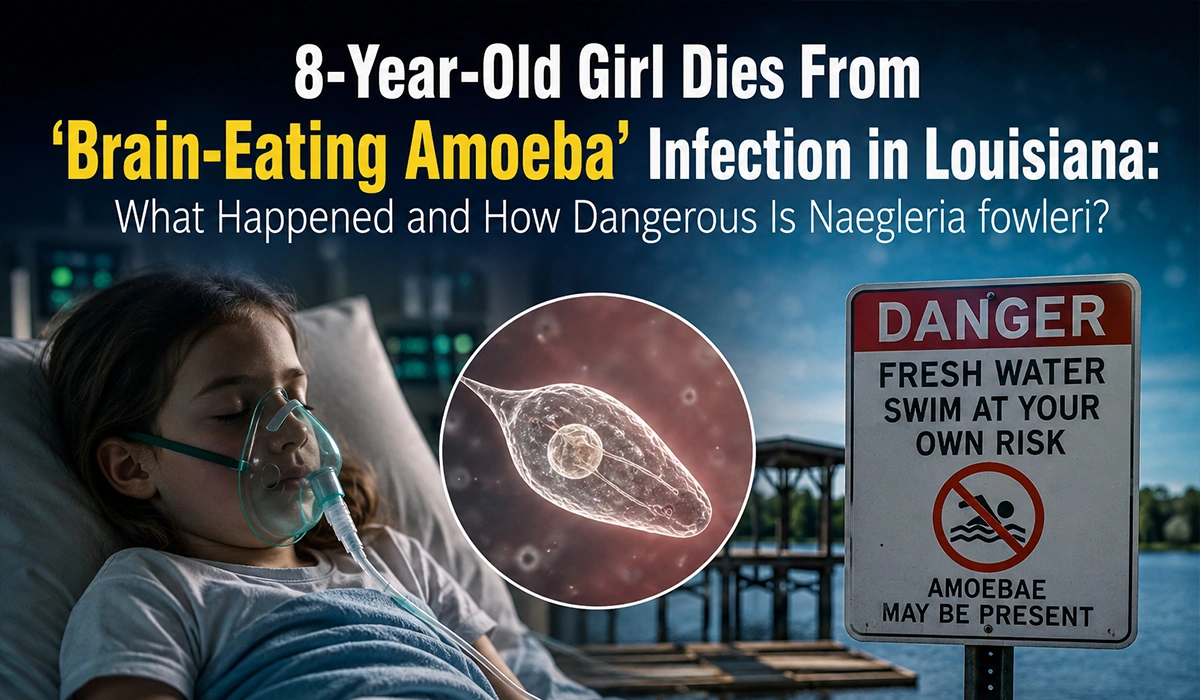
The death of an 8-year-old Louisiana girl has brought renewed attention to one of the rarest and most dangerous water-related infections known to medicine.
The child, identified by her family as Lillian Smart, died in August 2026 after being diagnosed with an infection caused by Naegleria fowleri, commonly described as the “brain-eating amoeba.” Health authorities and news reports linked the suspected exposure to swimming in Lake Claiborne in northern Louisiana.
The organism can cause primary amebic meningoencephalitis (PAM), a rapidly progressive infection of the brain and its surrounding tissues. Although the disease is extremely rare, it is almost always fatal once infection occurs.
The story is frightening, but it is important to put the risk into perspective: millions of people swim in freshwater every year, while only a handful of PAM cases are reported annually in the United States.
So what exactly happened, how does Naegleria fowleri infect people, and what can families do to reduce the risk?
What Happened to the 8-Year-Old Louisiana Girl?
Lillian Smart, an 8-year-old from Louisiana, died after developing PAM caused by Naegleria fowleri. Her family and reporting on the case indicate that she likely encountered the organism while swimming in Lake Claiborne. Louisiana health officials confirmed the infection in August 2026.
According to reports, Lillian had been hospitalized in Louisiana after becoming seriously ill. Her family later announced her death, saying that the brain injuries caused by the infection were too severe for her to recover.
The case is particularly notable because Louisiana had not recorded a confirmed Naegleria fowleri case since 2013, according to Associated Press reporting. CDC surveillance data list four Louisiana cases from 1937 through 2025; the 2026 case is therefore a rare event even in a state where warm freshwater exposure is possible.
Key facts
| Fact | Details |
|---|---|
| Patient | 8-year-old girl, Lillian Smart |
| Location | Louisiana, United States |
| Organism | Naegleria fowleri |
| Disease | Primary amebic meningoencephalitis (PAM) |
| Suspected exposure | Lake Claiborne freshwater |
| Outcome | Death |
| Nature of infection | Extremely rare but usually fatal |
What Is Naegleria fowleri?
Naegleria fowleri is a microscopic, free-living amoeba that lives primarily in warm freshwater. In extremely rare circumstances, contaminated water entering the nose can allow the organism to travel toward the brain and cause PAM.
The organism is naturally found in environments such as:
- Warm freshwater lakes
- Rivers
- Ponds
- Hot springs
- Some inadequately maintained recreational-water environments
- In rare situations, contaminated tap water
The term “brain-eating amoeba” is a media-friendly description rather than the organism’s scientific name. It is used because the amoeba can invade brain tissue during PAM and cause extensive inflammation and tissue destruction.
Importantly, simply encountering the organism does not automatically result in infection.
The CDC describes PAM as very rare, with typically fewer than 10 cases reported annually in the United States. Between 1962 and 2024, 167 U.S. cases were reported, with only four survivors.
How Does the “Brain-Eating Amoeba” Enter the Body?
Infection occurs when water containing Naegleria fowleri goes up the nose. The amoeba can then travel along the olfactory pathway toward the brain. Drinking contaminated water does not cause PAM.
This distinction is extremely important.
People generally become infected during activities such as:
- Swimming in warm freshwater.
- Diving or jumping into lakes or ponds.
- Submerging the head in contaminated water.
- Stirring up sediment in shallow freshwater.
- In rare situations, using contaminated water for nasal or sinus rinsing.
The infection does not occur simply because someone swallows contaminated water.
There is also no evidence that PAM spreads from one infected person to another.
Why Is Warm Freshwater a Concern?
Naegleria fowleri thrives in warm freshwater environments, particularly during hot weather. Higher temperatures can create conditions that are more favorable for the amoeba.
The organism is associated with warm or hot freshwater such as lakes, ponds, rivers and hot springs.
CDC guidance notes that infections are often associated with summer exposure, when freshwater temperatures rise. Risk can also increase when water levels become lower and warmer.
This is one reason cases are more commonly reported during warmer months.
However, the presence of warm water does not mean an infection is likely. The overall risk remains extremely low.
What Are the Symptoms of Naegleria fowleri Infection?
Early PAM symptoms can include headache, fever, nausea and vomiting. As the infection progresses, symptoms can rapidly become much more severe, including stiff neck, confusion, seizures, hallucinations and coma.
Early symptoms
The first symptoms can resemble more common illnesses, including bacterial meningitis:
- Severe headache
- Fever
- Nausea
- Vomiting
According to the CDC, symptoms generally begin around five days after exposure, although they can appear anywhere from one to 12 days afterward.
Later symptoms
As PAM progresses, a person may develop:
- Stiff neck
- Confusion
- Difficulty paying attention
- Loss of balance
- Seizures
- Hallucinations
- Coma
The illness can progress extremely quickly after symptoms begin.
Practical warning
A person who develops sudden severe headache, fever, vomiting or stiff neck after recent exposure to warm freshwater should seek urgent medical attention and tell healthcare professionals about the water exposure.
That information can be important because PAM is so uncommon that clinicians may initially consider more common causes of meningitis.
How Dangerous Is Naegleria fowleri?
PAM is one of the most dangerous infections associated with Naegleria fowleri. The infection progresses rapidly and is fatal in more than 97% of reported U.S. cases, according to CDC information.
The danger comes from the speed and severity of the infection.
Once the organism reaches the brain, it causes inflammation and destruction of brain tissue. Brain swelling can become severe, and the disease may progress to coma and death within a short period.
CDC data from 1937–2025 document 173 U.S. PAM cases. Texas and Florida have reported the largest numbers, while Louisiana has recorded four cases through 2025.
This highlights an important point:
The infection is extremely dangerous, but the probability of getting it is extremely low.
Fear should not replace practical prevention.
Can You Get the Brain-Eating Amoeba From Drinking Water?
No. Naegleria fowleri infection occurs when contaminated water enters the nose, not when it is swallowed.
This is one of the most common misconceptions about the organism.
The amoeba needs a pathway through the nasal cavity to reach the brain. Drinking contaminated water does not provide that route.
However, contaminated water can pose a risk during nasal rinsing or sinus irrigation.
For this reason, CDC recommends using distilled, sterile or appropriately boiled water for nasal rinsing rather than untreated tap water.
Can Naegleria fowleri Spread From Person to Person?
No. PAM caused by Naegleria fowleri is not considered a contagious person-to-person infection.
A person with PAM does not ordinarily transmit the amoeba to family members, friends or healthcare workers through normal contact.
The infection is primarily associated with a specific environmental exposure: contaminated water entering the nose.
This is another reason why the Louisiana case should be understood as a rare environmental infection, rather than an outbreak spreading between people.
What Are the Risk Factors?
The main risk factor is exposure to warm freshwater in which Naegleria fowleri may be present, particularly when activities allow water to enter the nose.
Higher-risk activities include:
| Activity | Risk consideration |
|---|---|
| Swimming in warm lakes | Water may enter the nose |
| Diving/jumping | Increased chance of nasal water exposure |
| Playing in shallow freshwater | Sediment can be disturbed |
| Hot springs | Naturally warm water can support the amoeba |
| Nasal rinsing with unsafe water | Direct nasal exposure |
| Properly maintained chlorinated pool | Much lower concern |
| Drinking contaminated water | Does not cause PAM |
The CDC emphasizes that the overall probability of infection remains very low.
How Can Families Reduce the Risk?
The most effective prevention strategy is to prevent warm freshwater from entering the nose. Avoiding warm freshwater activities is the most certain way to prevent exposure, while practical precautions can reduce risk for people who choose to swim.
During freshwater activities
- Hold your nose when jumping or diving.
- Consider using a nose clip.
- Keep your head above water in hot springs.
- Avoid stirring up sediment in shallow freshwater.
- Be particularly cautious during very warm weather.
- Follow local public-health warnings about recreational water.
For children, adult supervision is especially important around natural bodies of water.
For nasal rinsing
Use only:
- Distilled water
- Sterile water
- Properly boiled and cooled water
Do not use untreated water for nasal irrigation.
Does This Matter for People in India?
Yes. Although the Louisiana case occurred in the United States, Naegleria fowleri is found around the world, and India has reported cases of PAM and other forms of amebic meningoencephalitis.
This is particularly relevant for people who swim or bathe in warm freshwater.
India’s National Centre for Disease Control (NCDC) has published information on primary amoebic meningoencephalitis and notes that the disease can be difficult to diagnose because it is uncommon and may be underreported.
Recent research also highlights cases in Kerala, where amebic meningoencephalitis has emerged as a significant public-health concern.
A 2026 CDC Emerging Infectious Diseases study identified 159 cases of amebic meningoencephalitis in Kerala during January–November 2025. Nine of the PCR-confirmed cases were caused by N. fowleri.
A separate 2026 review identified reported Indian N. fowleri cases from 2018–2025 involving exposures such as ponds, lakes, water parks and domestic water sources.
India-specific takeaway
The Louisiana case should not be interpreted as evidence that a similar outbreak is occurring throughout India. Instead, it is a reminder that warm freshwater exposure and safe water practices deserve attention, especially during hot weather.
How Is PAM Diagnosed?
Diagnosis requires specialized laboratory testing because early PAM symptoms can resemble bacterial meningitis and other neurological infections. Healthcare professionals may use cerebrospinal-fluid testing and molecular or microscopic methods to identify the organism.
Diagnosis can be challenging because:
- The disease is exceptionally rare.
- Early symptoms are nonspecific.
- It can resemble bacterial meningitis.
- The disease progresses rapidly.
- Specialized laboratory expertise may be required.
A history of recent warm freshwater exposure can therefore be an important clinical clue.
The CDC notes that definitive laboratory diagnosis is important and that testing capabilities are available only in a limited number of specialized laboratories in the United States.
Is There Treatment for Naegleria fowleri Infection?
Treatment is possible, but there is no reliably effective cure, and PAM remains extremely difficult to treat because of its rapid progression. Survivors are exceptionally rare.
Treatment has involved combinations of medicines, including drugs such as amphotericin B, azithromycin, fluconazole, rifampin and miltefosine, alongside intensive supportive care. However, evidence is limited because so few cases occur and very few patients survive.
This is why early recognition and immediate specialist medical care are critical when PAM is suspected.
Treatment decisions must be made by qualified medical professionals and depend on the individual patient.
Is “Brain-Eating Amoeba” an Outbreak or a Pandemic Threat?
No. The Louisiana case does not indicate a widespread outbreak or pandemic. Naegleria fowleri infections remain extremely rare, despite their very high severity.
The phrase “brain-eating amoeba” can make the organism sound like a rapidly spreading infectious disease. It is important to distinguish severity from transmissibility.
Unlike respiratory viruses:
- It does not normally spread between people.
- It is not transmitted by coughing or sneezing.
- Drinking contaminated water does not cause PAM.
- Cases generally involve specific environmental exposures.
The major public-health challenge is therefore awareness, early recognition, safe water practices and rapid diagnosis, rather than preventing person-to-person transmission.
What Should Parents Know Before Children Swim in Lakes?
Parents do not need to avoid every swimming activity because of Naegleria fowleri, but they should understand the difference between properly maintained swimming facilities and warm natural freshwater. Practical precautions can reduce nasal exposure.
Before allowing children to swim:
- Check local water advisories.
- Prefer properly maintained and disinfected swimming facilities.
- Be cautious with warm natural freshwater.
- Discourage diving or jumping into potentially contaminated water.
- Teach children not to stir up shallow sediment.
- Consider nose clips during freshwater activities.
- Never use untreated water for nasal rinsing.
- Seek urgent medical attention if concerning symptoms develop after freshwater exposure.
The goal is risk reduction, not unnecessary panic.
Key Difference: Rare Does Not Mean Harmless
There are two facts about Naegleria fowleri that can appear contradictory:
Fact 1: PAM is extremely rare.
Fact 2: Once infection occurs, it is extremely dangerous.
Both are true.
CDC surveillance has recorded only 173 U.S. cases through 2025, despite the enormous number of people who participate in freshwater activities.
Therefore, people should not interpret news about a single case as meaning that every lake or swimming activity is dangerous.
Instead, the appropriate response is awareness + prevention + rapid medical attention when warning symptoms appear.
Naegleria fowleri Frequently Asked Questions
What is Naegleria fowleri?
Naegleria fowleri is a free-living microscopic amoeba that can live in warm freshwater. In rare circumstances, it can enter through the nose and cause primary amebic meningoencephalitis.
What is primary amebic meningoencephalitis?
Primary amebic meningoencephalitis, or PAM, is a severe infection of the brain and surrounding tissues caused by Naegleria fowleri. It progresses rapidly and is almost always fatal.
Can you get the brain-eating amoeba from drinking water?
No. Infection occurs when contaminated water enters the nose. Swallowing water containing the amoeba does not cause PAM.
Can Naegleria fowleri spread from person to person?
No. PAM caused by N. fowleri is not considered a person-to-person infection.
What are the first symptoms?
Early symptoms can include headache, fever, nausea and vomiting. Symptoms can progress rapidly to stiff neck, confusion, seizures and coma.
How long after exposure do symptoms appear?
Symptoms usually begin around five days after exposure but can occur between one and 12 days.
Is there a risk in India?
Yes. Naegleria fowleri occurs globally, and India has reported PAM cases. Recent research has documented cases associated with freshwater exposure, including in Kerala.
How can I reduce the risk?
Prevent water from entering the nose during warm freshwater activities, use a nose clip when appropriate, avoid disturbing shallow sediment and use only safe water for nasal rinsing.
Should people stop swimming?
Not necessarily. The risk of PAM is extremely low. People can reduce risk by following recreational-water safety guidance and taking precautions around warm freshwater.
Final Takeaway
The death of 8-year-old Lillian Smart in Louisiana is a heartbreaking reminder of how severe Naegleria fowleri infection can be. The organism can cause PAM when contaminated water enters the nose, and once symptoms begin, the disease can progress with extraordinary speed.
But there is an equally important message: PAM is exceptionally rare.
For families, the practical response is not fear of every swimming pool or lake. It is understanding the risk, preventing warm freshwater from entering the nose, using safe water for nasal rinsing, following local water advisories and seeking emergency medical care when severe symptoms occur after freshwater exposure.
For India, the subject deserves particular attention because recent surveillance and research show that Naegleria fowleri and other free-living amoebae can cause serious disease in the country, particularly in the context of freshwater exposure.
The most useful message is simple: know the risk, take sensible precautions, and never ignore sudden neurological symptoms after freshwater exposure