For years, the conversation around lung cancer has sounded simple: smoking causes lung cancer, so non-smokers are not at risk.
But real life is more complicated.
Consider a person living in a major Indian city. They may never have smoked a cigarette, yet spend years exposed to outdoor air pollution, traffic emissions or workplace dust. Another person may have spent decades around biomass cooking smoke. Someone else may have a family history of lung cancer or a chronic lung condition.
Does that automatically mean they should receive a CT scan every year?
No.
But it does mean that lung cancer risk cannot always be understood by asking only one question: “Do you smoke?”
The World Health Organization identifies tobacco smoking as the leading risk factor for lung cancer, while also recognizing secondhand smoke, outdoor and household air pollution, occupational exposures, radon, chronic lung disease and genetic susceptibility as important contributors.
This distinction is particularly important in India, where exposure patterns can differ from those in Western populations.
At the same time, there is an important medical reality: India does not currently have a universally adopted national lung cancer screening programme for the general population. The National Institute of Cancer Prevention and Research (NICPR) states that there are no recommended national guidelines for lung cancer screening in India and identifies low-dose CT as the screening method used for appropriately selected high-risk people.
So the goal is not to suggest that everyone should get screened.
The goal is to understand who may be at higher risk, what screening can and cannot do, and why a broader risk conversation matters.
1. What Is Lung Cancer Screening?
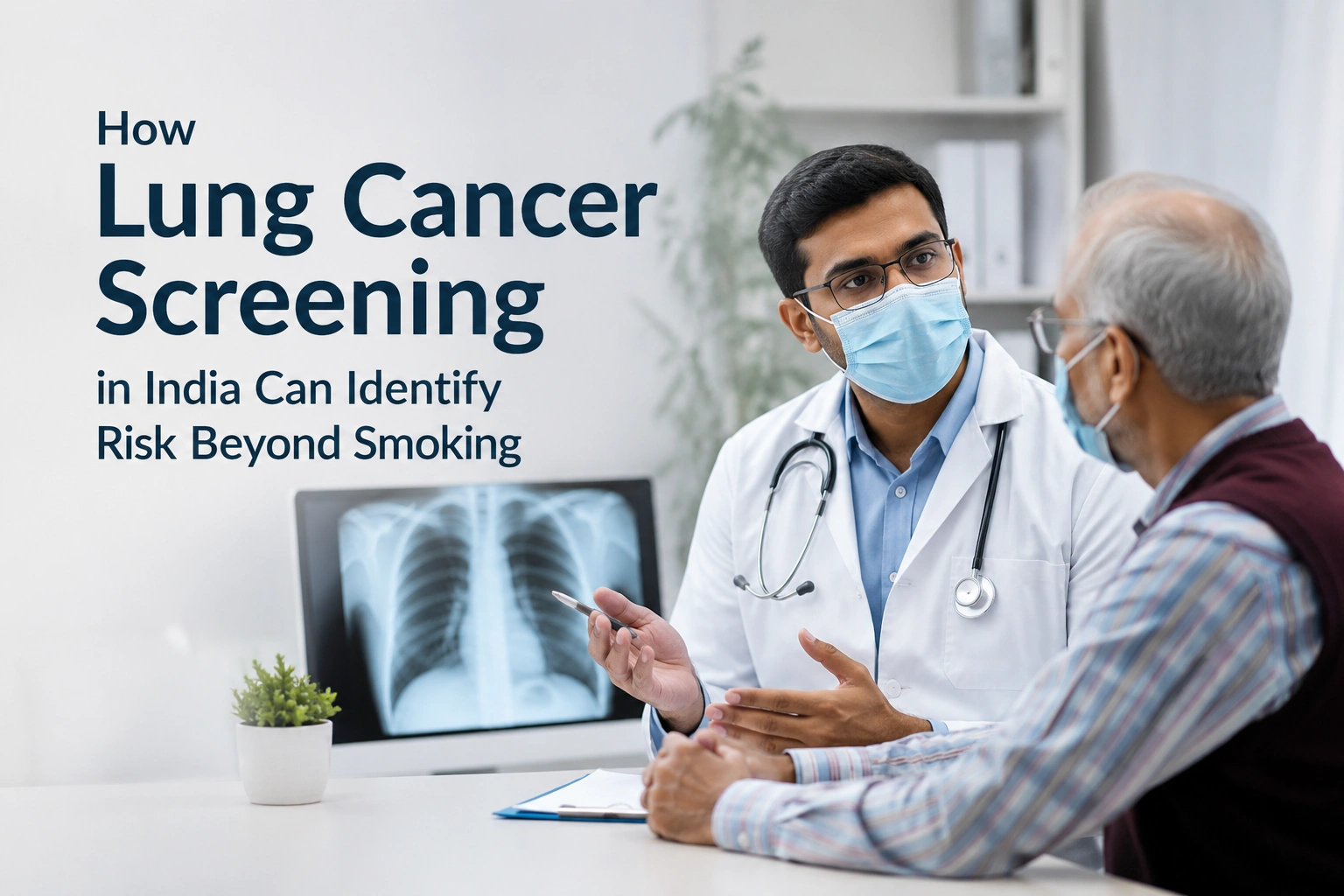
Lung cancer screening is testing people who do not have symptoms to look for lung cancer at an earlier stage. The established screening test for people at sufficiently high risk is low-dose computed tomography (LDCT). It is different from diagnostic testing, which is performed when symptoms or other findings already suggest disease.
What does screening actually mean?
Screening is not the same as checking whether your lungs are “healthy.”
A screening programme is designed to identify possible cancer before symptoms appear, in people whose risk is high enough that the benefits of early detection are expected to outweigh potential harms.
LDCT uses a lower radiation dose than a standard diagnostic CT scan and can identify small lung abnormalities that may not be visible on a conventional chest X-ray.
However, an abnormal scan does not automatically mean cancer.
A lung nodule can have many possible causes, including previous infection, inflammation or other non-cancerous conditions.
Practical tip: Do not order a CT scan simply because you are worried about lung cancer. Discuss your age, smoking history, symptoms, family history and environmental or occupational exposures with a qualified doctor first.
2. Why Smoking Is Not the Only Lung Cancer Risk Factor
Smoking remains the most important preventable risk factor for lung cancer, but it is not the only one. WHO lists secondhand smoke, household and outdoor air pollution, occupational exposures such as asbestos and silica, radon, certain chronic lung diseases and genetic susceptibility among other risk factors.
The misconception that “non-smoker equals no risk” can create a false sense of security.
India has several exposure patterns worth considering:
| Risk factor | Possible exposure |
|---|---|
| Active smoking | Cigarettes, bidis and other tobacco products |
| Secondhand smoke | Household, workplace or social exposure |
| Outdoor air pollution | PM2.5, traffic and industrial emissions |
| Household air pollution | Smoke from solid fuels and poor ventilation |
| Occupational exposure | Asbestos, silica, diesel exhaust and industrial dust |
| Chronic lung disease | Certain long-standing lung conditions |
| Family history | Genetic susceptibility may contribute |
| Radon | Naturally occurring radioactive gas in some environments |
These factors do not mean that exposure will inevitably cause cancer.
Rather, they help explain why lung cancer risk is multifactorial.
3. How Air Pollution Changes the Conversation in India
Long-term exposure to air pollution is an established lung cancer risk factor. WHO identifies both outdoor and household air pollution among important contributors to lung cancer. However, air pollution exposure alone does not currently mean that every non-smoker should receive routine LDCT screening.
Air pollution is particularly relevant to conversations about lung health in densely populated Indian cities.
Fine particulate matter can penetrate deep into the respiratory system. Long-term exposure can contribute to respiratory and cardiovascular disease and is also associated with lung cancer risk.
But there is a crucial distinction:
Risk factor ≠ screening eligibility.
Someone may have significant pollution exposure but still not meet evidence-based criteria for routine lung cancer screening.
This is one reason personalized medical assessment is important.
Practical example
A 42-year-old person who has never smoked but lives in a heavily polluted urban environment should not automatically conclude that they need annual CT scans.
Instead, a doctor may consider:
- Age
- Symptoms
- Duration and intensity of exposure
- Occupational history
- Family history
- Existing lung disease
- Previous imaging
- Overall health
4. What About Lung Cancer in Non-Smokers?
Yes, lung cancer can occur in people who have never smoked. WHO recognizes several non-smoking-related risk factors. However, current major screening recommendations generally focus on people at substantially elevated risk, particularly based on age and smoking history, rather than recommending routine LDCT for every non-smoker.
This is an important balance.
The fact that non-smokers can develop lung cancer does not mean that every non-smoker should undergo CT screening.
At present, there is insufficient evidence to support population-wide LDCT screening of all people who have never smoked.
Research is continuing to investigate whether more sophisticated risk models can identify additional groups who could benefit.
Some Indian clinical observations have also drawn attention to lung cancer among never-smokers, particularly women. For example, a 2024 ASCO-reported observational study examined 89 never-smoking women from non-smoking families at a cancer centre in Karnataka and highlighted the need to investigate environmental and other potential risk factors.
Such studies are important—but they should not be interpreted as proof that every non-smoker requires CT screening.
5. Which Indian Workers May Face Higher Risk?
Certain occupations can involve long-term exposure to substances associated with lung cancer, including asbestos, silica, diesel exhaust, dust and industrial fumes. A detailed occupational history can therefore be an important part of assessing lung cancer risk, especially when exposure has been prolonged.
Occupational history is sometimes overlooked during routine health discussions.
People who have worked around:
- Construction dust
- Asbestos-containing materials
- Mining environments
- Silica
- Diesel exhaust
- Industrial chemicals
- Welding fumes
- Heavy particulate matter
may have exposures worth discussing with a healthcare professional.
The risk depends on the substance, intensity and duration of exposure, workplace controls and other personal factors.
Practical tip
If you have spent years in an industrial or dusty workplace, don’t simply tell your doctor that you are a “non-smoker.”
Explain what you worked with and for how many years.
That information may be clinically more useful.
6. Does Family History Matter?
A family history of lung cancer may contribute to an individual’s overall risk, although it does not mean that a person will develop the disease. Family history should be considered alongside age, smoking, environmental exposure, occupational exposure and other health factors.
Genes can influence how the body responds to environmental exposures.
A person with a close relative who developed lung cancer may therefore reasonably ask whether their own risk is higher.
The answer depends on the broader picture.
Doctors may consider:
- Which relative had lung cancer
- Their age at diagnosis
- Whether they smoked
- Whether multiple relatives were affected
- The patient’s own smoking history
- Environmental and occupational exposure
A family history is a risk signal, not a diagnosis.
7. What Role Do Chronic Lung Conditions Play?
Some chronic lung diseases are associated with increased lung cancer risk. WHO lists certain chronic lung diseases among lung cancer risk factors. A person with persistent respiratory problems should discuss their symptoms and medical history with a healthcare professional rather than relying on routine screening alone.
Long-standing lung disease can make the clinical picture more complicated.
For example, symptoms such as chronic cough or breathlessness may be attributed to an existing condition when another problem needs investigation.
This is why doctors consider changes from a person’s normal pattern.
Important distinction
Screening: for people without symptoms.
Diagnostic evaluation: for someone with symptoms or an abnormal clinical finding.
If a person develops concerning symptoms, they should not wait for a routine screening appointment.
8. When Is Low-Dose CT Recommended?
There is strong evidence for annual LDCT screening in appropriately selected high-risk adults. For example, the USPSTF recommends annual LDCT for adults aged 50–80 years who have at least a 20 pack-year smoking history and currently smoke or quit within the previous 15 years. These criteria are not an Indian national guideline.
A pack-year measures cumulative cigarette smoking exposure.
For example:
- 1 pack per day for 20 years = 20 pack-years
- 2 packs per day for 10 years = 20 pack-years
- ½ pack per day for 40 years = 20 pack-years
The USPSTF criteria are useful as an international evidence reference, but they should not simply be copied into Indian healthcare practice.
NICPR specifically notes that India does not currently have recommended national lung cancer screening guidelines.
This makes individualized medical decision-making particularly important.
9. Can Lung Cancer Screening Go Beyond Smoking?
Risk assessment can go beyond smoking, but routine LDCT screening for non-smokers is not yet established as a universal recommendation. Doctors can consider environmental exposures, occupational history, family history, age and underlying lung conditions when deciding whether an individual needs further evaluation.
This distinction is central to the future of lung cancer prevention.
International guidelines have begun exploring more sophisticated approaches to identifying high-risk individuals.
The CHEST guideline, for example, discusses validated risk-prediction calculations and life-year-gained approaches for selected people who do not fit traditional age-and-smoking criteria but may still have a sufficiently high predicted net benefit from screening.
That does not mean every person with pollution exposure should receive LDCT.
It means the future of screening may become more risk-based and personalized.
10. Screening vs Diagnostic Testing: What Is the Difference?
| Feature | Screening | Diagnostic evaluation |
|---|---|---|
| Main purpose | Find disease before symptoms | Investigate symptoms or abnormal findings |
| Typical population | Selected high-risk people without symptoms | People with symptoms or concerning findings |
| Common imaging method | LDCT in eligible high-risk groups | CT or other tests depending on the situation |
| Does an abnormal result confirm cancer? | No | No |
| May require biopsy? | Sometimes, depending on findings | Sometimes |
| Requires medical interpretation? | Yes | Yes |
Quick answer
Screening is not a substitute for seeing a doctor when symptoms occur. A person with persistent symptoms may need diagnostic evaluation regardless of whether they meet screening criteria. Screening programmes are intended for people without symptoms who have sufficient risk to justify testing.
This distinction can prevent dangerous delays.
11. What Symptoms Should Never Be Ignored?
Possible symptoms of lung cancer include a persistent cough, chest pain, shortness of breath, coughing up blood, unexplained weight loss, fatigue and repeated lung infections. These symptoms can also occur with many other conditions, so they do not automatically indicate cancer.
Seek medical evaluation if symptoms are:
- Persistent
- Getting worse
- Unexplained
- Different from your usual respiratory symptoms
Particularly important warning signs include:
- Cough that does not go away
- Blood in sputum
- Unexplained weight loss
- Persistent chest discomfort
- Increasing breathlessness
- Repeated respiratory infections
- Unexplained fatigue
Do not wait for a screening scan simply because you want to “check.”
If symptoms are present, medical evaluation comes first.
12. How Can Indians Understand Their Personal Lung Cancer Risk?
A useful risk conversation should look beyond smoking and consider age, tobacco exposure, secondhand smoke, air pollution, household fuel exposure, occupation, family history, chronic lung disease and symptoms. The result should be discussed with a healthcare professional rather than interpreted through a single online risk calculator.
A simple personal checklist can help.
Ask yourself:
1. Tobacco exposure
Have I ever smoked? For how long and how much?
2. Secondhand smoke
Have I lived or worked around regular tobacco smoke?
3. Air pollution
Have I experienced prolonged exposure to high levels of outdoor or indoor pollution?
4. Occupation
Have I worked around asbestos, silica, diesel exhaust, dust or industrial chemicals?
5. Family history
Has a close family member developed lung cancer?
6. Lung health
Do I have a chronic lung condition?
7. Symptoms
Do I have persistent or unexplained respiratory symptoms?
8. Age and overall health
Would screening provide meaningful benefit given my age and health status?
This framework does not diagnose cancer.
It simply creates a better conversation with a doctor.
13. Benefits and Limitations of Low-Dose CT Screening
LDCT can detect lung cancer earlier in appropriately selected high-risk populations and has been shown to reduce lung cancer mortality. However, screening can also produce false-positive findings, overdiagnosis and radiation exposure. Therefore, it is most useful when targeted to people likely to benefit.
Potential benefits
- Earlier detection
- Greater opportunity for potentially curative treatment
- Reduced lung cancer mortality in appropriately selected high-risk populations
- Detection of small abnormalities before symptoms appear
Potential limitations
- False-positive findings
- Anxiety from indeterminate nodules
- Additional imaging
- Possible invasive procedures
- Overdiagnosis
- Radiation exposure
This is why “more screening” does not automatically mean “better healthcare.”
The right question is:
Who is most likely to benefit from screening, and who is more likely to experience its harms?
14. What Should India Do About Lung Cancer Risk Beyond Smoking?
India needs a broader approach combining tobacco control, air-pollution reduction, workplace safety, public awareness, timely diagnosis and research into risk-based screening. At present, India does not have a universally recommended national lung cancer screening programme, making evidence-based clinical assessment particularly important.
A future lung cancer strategy could involve several layers.
Prevention
- Reduce tobacco use
- Avoid secondhand smoke
- Improve workplace safety
- Reduce exposure to hazardous dust and fumes
- Improve household ventilation
- Address air pollution
Early detection
- Improve awareness of warning symptoms
- Strengthen diagnostic facilities
- Reduce delays between symptoms and diagnosis
- Improve access to specialist care
Research
- Study Indian-specific risk patterns
- Understand lung cancer among never-smokers
- Evaluate pollution-related risk
- Develop validated risk-prediction models
- Determine whether broader screening strategies are beneficial
India needs solutions based on Indian evidence, not simply guidelines imported from another population.
15. What Should You Do If You Are Worried About Your Risk?
Start with a risk assessment rather than automatically booking a CT scan. Tell your doctor about smoking, secondhand smoke, pollution, occupational exposures, family history, chronic lung conditions and any persistent symptoms. The doctor can then determine whether observation, diagnostic testing, specialist referral or screening is appropriate.
A practical approach is:
Step 1: Know your exposure history.
Write down your smoking and occupational history.
Step 2: Review your symptoms.
Do not dismiss persistent respiratory changes.
Step 3: Discuss your family history.
Step 4: Ask whether you meet evidence-based screening criteria.
Step 5: If you do not meet standard criteria but have unusual risk factors, ask whether specialist risk assessment is appropriate.
Step 6: Do not rely on commercial “lung cancer screening packages” without understanding what they actually include.
A chest X-ray, CT scan, blood test or “full-body check-up” should not automatically be described as an effective lung cancer screening programme.
Lung Cancer Screening in India: Key Takeaways
| Question | Key point |
|---|---|
| Is smoking the biggest risk factor? | Yes, smoking remains the leading preventable risk factor. |
| Can non-smokers develop lung cancer? | Yes. |
| Can air pollution contribute to risk? | Yes, outdoor and household air pollution are recognized risk factors. |
| Does every non-smoker need LDCT? | No. Routine screening of all non-smokers is not currently established. |
| What is the established screening test? | Low-dose CT for appropriately selected high-risk individuals. |
| Does India have a national lung cancer screening guideline? | NICPR currently states that there are no recommended national guidelines. |
| Are symptoms the same as screening eligibility? | No. Symptoms require diagnostic evaluation. |
| Can family and occupational history matter? | Yes. |
| Can screening cause harm? | Yes, including false positives, overdiagnosis and radiation exposure. |
| What is the best first step? | Individual risk assessment with a healthcare professional. |
Frequently Asked Questions: Lung Cancer Screening in India
1. Can non-smokers get lung cancer?
Yes. Lung cancer can occur in people who have never smoked. Other recognized risk factors include secondhand smoke, air pollution, occupational exposures, chronic lung diseases and genetic susceptibility.
2. Should non-smokers in India get a low-dose CT scan?
Not routinely. Current evidence does not support LDCT screening for every non-smoker. A doctor should assess the person’s overall risk and determine whether further evaluation is appropriate.
3. Is air pollution a risk factor for lung cancer?
Yes. WHO recognizes outdoor and household air pollution as important lung cancer risk factors.
4. What is the best test for lung cancer screening?
Low-dose CT is the established screening test for appropriately selected high-risk populations. Chest X-rays and sputum cytology are not equivalent substitutes for LDCT screening.
5. Is there a lung cancer screening programme in India?
India does not currently have a universally adopted national lung cancer screening guideline. NICPR notes that no national screening guidelines are currently recommended.
6. Can a chest X-ray detect lung cancer early?
A chest X-ray is not considered an adequate substitute for LDCT lung cancer screening in high-risk populations because of its lower sensitivity for detecting early disease.
7. Who qualifies for lung cancer screening?
Eligibility depends on the guideline being used and the individual’s risk. The USPSTF, for example, recommends annual LDCT for adults aged 50–80 with at least 20 pack-years who currently smoke or quit within the previous 15 years.
8. What is a pack-year?
A pack-year measures cumulative cigarette exposure. Smoking one pack per day for 20 years equals 20 pack-years.
9. Can pollution exposure alone qualify someone for CT screening?
Not necessarily. Pollution is a recognized risk factor, but exposure alone does not automatically establish eligibility for routine LDCT screening.
10. When should I see a doctor?
Seek medical evaluation for persistent cough, coughing blood, unexplained weight loss, chest pain, increasing breathlessness, persistent fatigue or repeated respiratory infections.
11. Can lung cancer be prevented?
Not every case can be prevented, but risk can be reduced by avoiding tobacco, reducing secondhand smoke and hazardous workplace exposures, and addressing environmental risks such as air pollution.
12. Is lung cancer screening the same as a full-body health check?
No. Lung cancer screening is a specific process designed for people at sufficiently high risk. A general health package does not automatically provide evidence-based lung cancer screening.
What This Means for Indian Families
The biggest mistake is to think about lung cancer in only two categories:
“Smoker” or “non-smoker.”
Real-world risk is more complicated.
A person may have multiple exposures, while another may have very few. Some people may benefit from screening, while others may experience more harm than benefit from unnecessary scans.
That is why the future of lung cancer prevention is likely to involve better risk assessment, stronger prevention and more personalized early-detection strategies.
For now, the practical message is straightforward:
Do not ignore symptoms because you do not smoke.
Do not assume pollution exposure automatically means you need a CT scan.
Do not use a commercial screening package as a substitute for medical advice.
And if you have a significant combination of risk factors, discuss them with a qualified healthcare professional
Conclusion: Lung Cancer Risk Is Bigger Than a Smoking Question
Lung cancer prevention in India needs a wider conversation.
Smoking remains the most important preventable risk factor, but it is not the whole story. Air pollution, secondhand smoke, workplace exposures, household air pollution, family history and certain chronic lung conditions can also influence risk.
At the same time, risk beyond smoking does not automatically mean screening beyond smoking.
That distinction matters.
LDCT screening has proven value for appropriately selected high-risk populations, but unnecessary scans can also cause false alarms, additional procedures, overdiagnosis and radiation exposure.
For India, where national lung cancer screening guidance remains limited, the most responsible approach is to combine prevention, awareness, individualized risk assessment and timely medical evaluation.
The message is simple:
You don’t need to smoke to take your lung health seriously.
And early action does not always mean getting a scan. Sometimes, it starts with asking the right questions about the air you breathe, the work you do, your medical history and the symptoms you should never ignore.