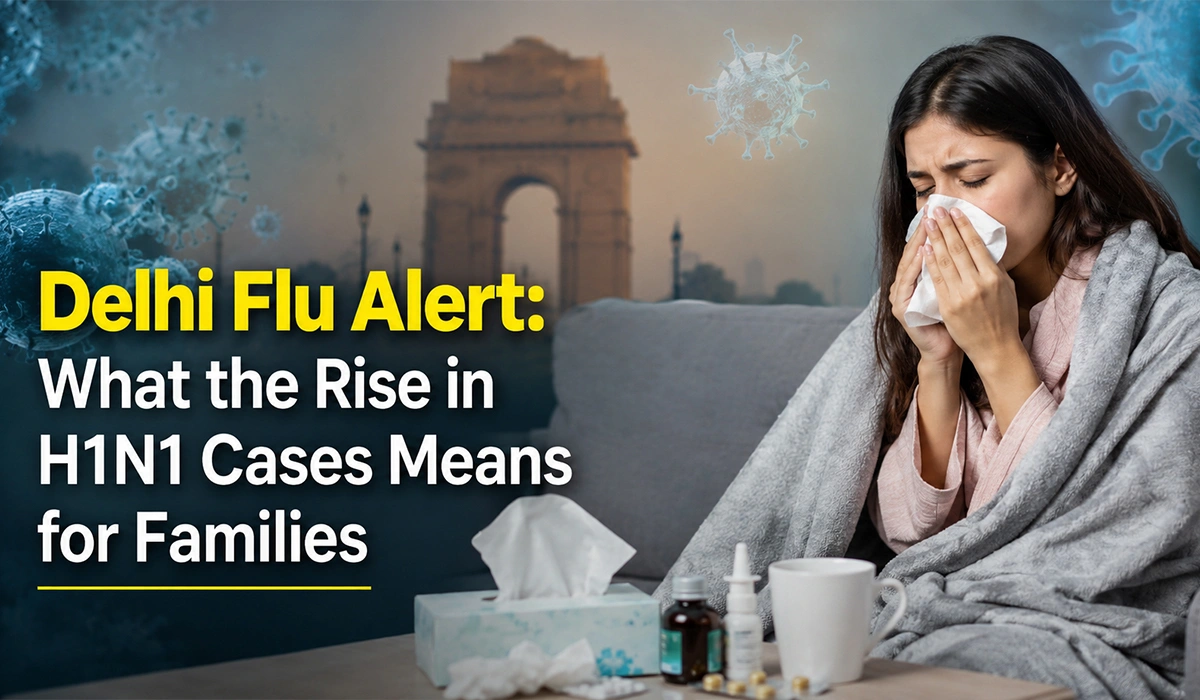
Introduction: Why Delhi Families Are Paying Attention to H1N1 Again
A fever that starts suddenly. A cough that becomes persistent. Body aches that make even routine activities difficult. During Delhi’s monsoon period, these symptoms can easily be dismissed as another seasonal viral infection.
But there is a reason families are paying closer attention this year.
Recent reports indicate that Delhi has recorded 1,344 H1N1 cases so far in 2026, compared with 229 cases reported by the same period in the previous year—a substantial increase. Reports also describe a rise in flu-like illness across parts of Delhi-NCR, including Gurgaon and Faridabad.
This does not mean every person with fever or cough has H1N1. Nor does the rise mean that every infection will become severe. Seasonal influenza is common, and most people recover without serious complications. However, influenza can become dangerous for certain people, including young children, older adults, pregnant women and people with underlying medical conditions.
So what should Delhi families actually do?
The answer is not panic. It is awareness, early attention to symptoms, sensible prevention and timely medical care when warning signs appear.
1. What Is H1N1 Influenza?
H1N1 is a subtype of influenza A virus that can cause seasonal flu. The strain associated with the 2009 pandemic continues to circulate as part of seasonal influenza in many parts of the world. It spreads mainly through respiratory transmission and can cause symptoms ranging from mild illness to serious respiratory complications.
H1N1 is sometimes called “swine flu,” a term that can create unnecessary confusion. Today’s circulating H1N1 is considered part of seasonal influenza rather than simply a disease associated with pigs.
Influenza viruses spread readily from person to person. Respiratory droplets and particles released when an infected person coughs, sneezes or talks can contribute to transmission. Close contact and contaminated hands or surfaces can also play a role.
Practical tip: If someone in your household develops flu-like symptoms, reduce close contact with vulnerable family members and maintain good respiratory and hand hygiene.
2. Why Are H1N1 Cases Rising in Delhi?
The current rise in Delhi’s H1N1 cases is a public-health signal, but a single cause should not be assumed. Respiratory viruses can circulate more readily when people spend time in close indoor settings, while seasonal and environmental conditions can influence transmission patterns. Current reporting also links the Delhi-NCR increase with the monsoon period.
Delhi’s monsoon season brings changes in temperature, humidity and daily routines. Crowded public transport, schools, workplaces, markets and other shared environments can create opportunities for respiratory infections to spread.
Recent reports have highlighted increased H1N1 activity across Delhi-NCR, with hospitals in neighbouring areas also seeing more flu-related patients.
However, it is important to distinguish an increase in reported cases from proof that the virus itself has suddenly become more dangerous.
Influenza surveillance is designed to identify changes in respiratory virus activity and help health systems respond. India’s National Centre for Disease Control maintains seasonal influenza surveillance resources, technical guidelines and laboratory information for H1N1.
Practical tip: Follow current public-health and medical guidance rather than relying on social-media claims about the reason for the increase.
3. What Are the Common Symptoms of H1N1?
H1N1 can cause symptoms similar to other influenza infections. Common symptoms include fever, cough, sore throat, headache, body aches, fatigue and a runny or blocked nose. Symptoms often begin relatively suddenly. Some people may develop more serious respiratory symptoms or complications.
Common H1N1 symptoms
| Symptom | What it may feel like |
|---|---|
| Fever | Sudden fever or feeling feverish |
| Cough | Often dry and persistent |
| Sore throat | Pain or irritation while swallowing |
| Body aches | Muscle or joint discomfort |
| Headache | Mild to significant headache |
| Fatigue | Unusual weakness or tiredness |
| Runny nose | Nasal discharge or congestion |
| Chills | Feeling unusually cold or shivering |
Not everyone experiences every symptom.
A person can also have another respiratory infection with almost identical symptoms. That is why symptoms alone cannot reliably establish whether someone has H1N1.
Example: A parent develops fever, cough and body aches after several colleagues become sick. Those symptoms are compatible with influenza, but they do not prove H1N1 infection.
Practical tip: Persistent, worsening or severe symptoms deserve medical assessment rather than repeated self-medication.
4. H1N1 vs Common Cold: How Are They Different?
A common cold is generally milder than influenza. Flu often begins more suddenly and is more likely to cause significant fever, body aches, fatigue and a persistent cough. However, symptoms overlap, so it is not always possible to distinguish the two without clinical evaluation or testing when testing is indicated.
| Feature | Common Cold | Influenza/H1N1 |
|---|---|---|
| Onset | Often gradual | Often sudden |
| Fever | Less common | Common |
| Body aches | Usually mild | Can be significant |
| Fatigue | Usually mild | Can be pronounced |
| Cough | Common | Often prominent |
| Complications | Usually uncommon | Possible, particularly in high-risk people |
| Testing | Usually unnecessary | May be considered depending on symptoms/risk |
The comparison is useful, but it should not be used as a home diagnostic test.
Influenza can range from mild to severe, and WHO notes that most people recover within about a week, although cough and weakness can last longer.
Practical tip: Don’t focus only on whether the illness “looks like flu.” Pay attention to severity, duration and the person’s risk factors.
5. H1N1 or Dengue? Why Delhi Families Should Be Careful
During Delhi’s monsoon period, influenza and dengue can create a diagnostic challenge because some early symptoms—particularly fever, headache and fatigue—can overlap. A person should not assume that every fever is H1N1 or dengue. Medical assessment is important when symptoms are persistent, severe or unusual.
This is particularly relevant because dengue is also a seasonal concern in Delhi.
Influenza is a respiratory viral infection. Dengue is transmitted by infected Aedes mosquitoes. Their causes and treatments are therefore very different.
Why self-diagnosis can be risky
Taking medication based only on an assumption about the illness can delay appropriate care. For example, someone may initially think they have “flu” while another infection is responsible for their symptoms.
Recent Delhi reporting has specifically highlighted the overlap between H1N1 and dengue symptoms as a reason for careful diagnosis.
Practical tip: If fever persists, becomes severe, or is accompanied by unusual symptoms, contact a healthcare professional rather than guessing the cause.
6. Who Is Most at Risk of Severe Influenza?
Most healthy people recover from influenza, but severe illness is more likely in certain groups. These include young children, older adults, pregnant women and people with chronic or serious health conditions or weakened immune systems.
Higher-risk groups may include people with conditions affecting the:
- Lungs
- Heart
- Kidneys
- Liver
- Metabolic system
- Immune system
Pregnancy also increases concern because influenza can lead to more serious illness.
For families, this means that the same infection may have very different consequences for different household members.
A simple family risk check
Ask:
- Is anyone at home very young or elderly?
- Is anyone pregnant?
- Does anyone have a chronic medical condition?
- Does anyone have a weakened immune system?
- Is someone experiencing worsening symptoms?
If the answer to any of these questions is yes, a lower threshold for medical consultation is sensible.
7. When Should You See a Doctor for H1N1 Symptoms?
Seek medical advice when flu-like symptoms are severe, worsening, persistent or occurring in someone at higher risk of complications. Difficulty breathing, chest pain, confusion, severe weakness, dehydration or a significant deterioration after initial improvement should not be ignored.
A simple fever does not automatically mean an emergency.
But families should know the difference between watching symptoms at home and waiting too long for medical care.
Medical attention for:
- Difficulty breathing or shortness of breath
- Chest pain or pressure
- Severe weakness
- Confusion or unusual drowsiness
- Signs of dehydration
- Persistent or worsening fever
- Symptoms that improve and then become significantly worse
- Severe symptoms in a high-risk person
Children require particular attention if they are struggling to breathe, unusually sleepy, unable to drink adequately or becoming significantly weaker.
Practical tip: Keep a simple record of fever, symptoms, fluid intake and medicines taken. This can make a medical consultation more useful.
8. How Does H1N1 Spread?
H1N1 influenza spreads primarily through respiratory transmission. An infected person can release infectious particles while coughing, sneezing or talking. Close contact and poor respiratory hygiene can increase the likelihood of transmission. Regular hand hygiene and staying away from others when sick can help reduce spread.
Think about a typical Delhi morning.
A crowded metro. A busy office. A classroom full of students. A family gathering.
One infected person may have many opportunities to interact closely with others.
That is why prevention is not only an individual responsibility. It also protects the people around us.
Helpful habits
- Cover your mouth and nose when coughing or sneezing.
- Wash hands regularly.
- Avoid close contact when you are sick.
- Improve ventilation where practical.
- Avoid touching your eyes, nose and mouth with unwashed hands.
- Follow current vaccination guidance.
Practical tip: If you’re sick, staying home when possible can protect colleagues, classmates and vulnerable family members.
9. Can the Flu Vaccine Help Prevent H1N1?
Yes. Seasonal influenza vaccination is an important tool for reducing the risk of influenza infection and, especially, severe outcomes. Because influenza viruses change over time, vaccine formulations are updated according to surveillance and recommendations. WHO identifies vaccination as the most effective way to reduce the risk of flu and severe illness.
India’s NCDC published recommendations for the influenza vaccine composition for the 2025–2026 season, including an A(H1N1)pdm09 component alongside A(H3N2) and B/Victoria.
The important point is that influenza vaccination is seasonal and formulation-specific. People should discuss the appropriate vaccine and timing with a qualified healthcare professional.
Who may particularly benefit?
Vaccination is especially relevant for people at increased risk of severe influenza, as well as groups for whom annual vaccination is recommended under applicable medical guidance.
Practical tip: Don’t wait for an outbreak headline before discussing flu vaccination with your doctor if you or a family member may benefit.
10. What Is the Treatment for H1N1?
Treatment depends on the severity of illness and the person’s risk profile. Many people with uncomplicated influenza recover with supportive care, while people at higher risk of complications may need medical evaluation and antiviral treatment. Antiviral medicines should be used according to professional medical advice.
Treatment may include:
- Adequate fluids
- Rest
- Fever and symptom management
- Medical monitoring
- Antiviral medication when clinically appropriate
Antibiotics do not treat influenza because influenza is caused by a virus, not bacteria. Antibiotics may only be appropriate if a healthcare professional identifies a bacterial infection or complication.
India’s NCDC maintains dedicated technical guidance covering patient categorization, home care, masks, clinical protocols and laboratory testing for seasonal influenza A(H1N1).
Practical tip: Avoid taking antibiotics or prescription antivirals without appropriate medical advice.
11. What Should Families Do at Home If Someone Has Flu?
A person with mild influenza symptoms should generally rest, maintain adequate fluid intake, monitor symptoms and reduce close contact with others. High-risk individuals and people with worsening symptoms should seek medical advice promptly rather than relying only on home care. India’s NCDC provides specific technical guidance for influenza home care.
A practical household plan
Step 1: Create distance
If possible, allow the sick person to rest in a separate, well-ventilated area.
Step 2: Reduce sharing
Avoid sharing drinking glasses, utensils and personal items.
Step 3: Maintain hygiene
Wash hands regularly and clean commonly touched surfaces.
Step 4: Monitor
Track fever and changes in breathing, hydration, alertness and overall condition.
Step 5: Protect vulnerable family members
Keep the sick person away from elderly relatives, young children, pregnant women and other high-risk individuals where practical.
Step 6: Know when to escalate
If symptoms worsen or warning signs appear, contact a healthcare professional.
12. How Can Delhi Families Reduce H1N1 Risk?
The strongest prevention strategy combines vaccination where appropriate, respiratory hygiene, hand hygiene, sensible distancing when sick, ventilation and early medical attention for severe symptoms. No single measure provides complete protection, but several simple habits can reduce transmission and help protect vulnerable family members.
Family flu-prevention checklist
| Action | Why it matters |
|---|---|
| Consider seasonal flu vaccination | Helps reduce influenza risk and severe outcomes |
| Wash hands regularly | Reduces transmission through contaminated hands |
| Cover coughs and sneezes | Limits respiratory spread |
| Stay home when sick | Protects others |
| Improve ventilation | Reduces concentration of respiratory particles |
| Avoid unnecessary close contact with vulnerable people | Reduces their exposure |
| Seek care for severe symptoms | Helps prevent delayed treatment |
The goal is not to make everyday life fearful.
The goal is to make healthy habits automatic.
13. What About Children and H1N1?
Children can develop influenza and may spread it efficiently in households and schools. Most recover, but younger children can be at greater risk of complications. Parents should pay attention to breathing, hydration, alertness and the overall trajectory of illness rather than focusing only on the fever number.
Recent Delhi-NCR reporting has raised concerns about children taking longer to recover from flu-like illness during the current rise in cases.
Parents should watch for:
- Difficulty breathing
- Poor fluid intake
- Unusual sleepiness
- Significant weakness
- Persistent or worsening symptoms
- A child who appears much sicker than expected
Schools and childcare settings also make respiratory hygiene important.
Teaching children to cover coughs, wash hands and avoid close contact when unwell can become part of everyday health education.
Practical tip: Do not send a child back to school simply because the fever has temporarily decreased if the child remains significantly unwell.
14. H1N1 Prevention: What Works and What Doesn’t?
Evidence-based prevention focuses on vaccination, respiratory hygiene, hand hygiene, reducing exposure when sick and appropriate medical care. Unproven “immune boosters,” unnecessary antibiotics or self-prescribed medicines should not replace established prevention and treatment practices.
| Approach | Recommended? | Reason |
|---|---|---|
| Seasonal flu vaccination | Yes, when appropriate | Evidence-based prevention |
| Hand hygiene | Yes | Helps reduce transmission |
| Covering coughs | Yes | Reduces respiratory spread |
| Staying home while sick | Yes | Protects others |
| Adequate rest and fluids | Yes | Supports recovery |
| Unnecessary antibiotics | No | Do not treat viral influenza |
| Self-prescribing antivirals | No | Requires medical guidance |
| Unproven supplements as flu treatment | No | Not a substitute for medical care |
This distinction matters because fear can create a market for quick fixes.
Families need reliable information more than complicated health products.
15. Why Early Attention Matters During a Delhi Flu Surge
During periods of increased influenza activity, early recognition helps families make better decisions about isolation, medical consultation and protection of vulnerable people. It also reduces the chance that severe symptoms are dismissed as an ordinary seasonal cold.
There is a psychological trap during flu seasons:
“Everyone has it, so it must not be serious.”
That assumption can be dangerous.
The majority of people with influenza may recover without major complications. But the minority who develop severe disease need appropriate care.
This is why risk matters more than headlines.
A healthy young adult with mild symptoms may have a very different risk profile from an elderly person with chronic lung disease.
Practical tip: Judge illness by the person’s symptoms, risk factors and progression—not only by how common the infection seems to be.
16. Delhi-NCR Flu Awareness: What Families in Gurgaon, Noida and Faridabad Should Know
Respiratory infections do not stop at municipal or state boundaries. People travel daily between Delhi, Gurgaon, Noida, Ghaziabad and Faridabad for work, education and family activities. Therefore, flu awareness is relevant across the wider NCR, not only within Delhi.
Recent reporting has noted increased flu activity in neighbouring Gurgaon and Faridabad alongside the Delhi rise.
For NCR residents, the practical message remains the same:
Recognise symptoms. Reduce transmission. Protect vulnerable people. Seek care when needed.
Local searches such as “H1N1 doctor near me,” “flu treatment in Delhi,” “influenza testing near me” or “H1N1 hospital in Delhi” can help people locate healthcare services, but online search results should not replace professional medical judgment.
If symptoms are severe, seek appropriate medical care rather than spending excessive time comparing online information.
17. Myths vs Facts About H1N1
H1N1 is a seasonal influenza virus, not a new mysterious disease. Most people recover, but severe illness can occur. Understanding what is true—and what is exaggerated—helps families respond appropriately.
| Myth | Fact |
|---|---|
| Every fever is H1N1 | Many infections can cause fever |
| H1N1 always causes severe illness | Most people recover, but some develop complications |
| Antibiotics cure H1N1 | Antibiotics do not treat viral influenza |
| Flu vaccination is unnecessary | Vaccination is an important prevention tool |
| A healthy person cannot get seriously ill | Risk is lower but not zero |
| Symptoms alone confirm H1N1 | Testing/clinical assessment may be required |
| “Swine flu” means it is simply caught from pigs | H1N1 is now part of seasonal human influenza circulation |
Good health communication should reduce unnecessary fear without creating false reassurance.
18. Why Choose Reliable Healthcare Information?
During an active flu season, people may encounter conflicting information across social media, messaging apps and online searches. Reliable healthcare content should distinguish confirmed facts from speculation, explain uncertainty and direct readers toward qualified medical care when necessary.
For a healthcare brand such as Nukind Healthcare, the most valuable role in public health communication is to make health information easier to understand without overstating medical claims.
Useful healthcare communication should be:
- Evidence-informed
- Easy to understand
- Transparent about uncertainty
- Free from exaggerated claims
- Focused on practical action
- Clear about when professional care is needed
Nukind Healthcare should not be positioned as a substitute for doctors, diagnostic laboratories or public-health authorities.
The strongest trust signal is responsible communication.
H1N1 Prevention Checklist for Delhi Families
Save this checklist for the current flu season:
Protect yourself
- Consider seasonal influenza vaccination after discussing it with a healthcare professional.
- Wash your hands regularly.
- Avoid touching your face with unwashed hands.
- Cover coughs and sneezes.
- Maintain ventilation where possible.
Protect your family
- Keep sick family members away from vulnerable people when practical.
- Avoid sharing personal items.
- Monitor children and older adults closely.
- Encourage sick household members to rest.
Know when to seek help
- Breathing difficulty
- Chest pain
- Severe weakness
- Confusion
- Dehydration
- Persistent or worsening symptoms
- Severe illness in a high-risk person
Frequently Asked Questions About H1N1 Cases in Delhi
Are H1N1 cases increasing in Delhi in 2026?
Recent reports say Delhi has recorded 1,344 H1N1 cases so far in 2026, compared with 229 cases reported by the same period in the previous year. The increase has also been reported across parts of Delhi-NCR.
What are the first symptoms of H1N1?
Common symptoms include sudden fever, cough, sore throat, headache, body aches, fatigue and a runny or blocked nose. Symptoms can overlap with other respiratory infections.
Is H1N1 dangerous?
H1N1 can cause mild illness in many people, but influenza can become severe, particularly among young children, older adults, pregnant women and people with certain medical conditions.
Can H1N1 be treated?
Yes. Treatment depends on the individual’s condition. Supportive care may be sufficient for uncomplicated illness, while high-risk patients may require medical evaluation and antiviral treatment.
Do antibiotics work for H1N1?
No. H1N1 is caused by influenza virus, so antibiotics do not treat the virus. Antibiotics may be prescribed only when a bacterial infection or complication is diagnosed by a healthcare professional.
Can the flu vaccine prevent H1N1?
Seasonal influenza vaccines are designed to protect against circulating influenza strains and can reduce the risk of influenza and severe outcomes. Vaccine composition is updated according to surveillance and recommendations.
Should children get the flu vaccine?
Parents should discuss seasonal influenza vaccination with their child’s healthcare professional, particularly if the child belongs to a group at increased risk of complications.
How long does H1N1 last?
Many people recover from influenza symptoms within about a week, although cough and tiredness can last longer. Recovery varies according to age, health status and severity.
Is H1N1 the same as dengue?
No. H1N1 is an influenza virus infection, while dengue is a mosquito-borne viral infection. Some symptoms can overlap, so persistent or severe fever should be medically assessed.
Can I diagnose H1N1 at home?
Symptoms alone cannot reliably confirm H1N1. A healthcare professional may recommend testing depending on symptoms, risk factors and the clinical situation.
Should I go to hospital for every fever?
No. Many influenza cases are mild. However, severe or worsening symptoms, breathing problems, chest pain, confusion, dehydration or severe illness in a high-risk person warrant medical attention.
Is H1N1 spreading outside Delhi?
Recent reports have described increased flu activity in parts of Delhi-NCR, including Gurgaon and Faridabad.
Can I prevent H1N1 naturally?
Healthy habits such as good hand hygiene, respiratory etiquette, appropriate ventilation and avoiding close contact when sick can reduce transmission. Seasonal influenza vaccination is also an important prevention measure.
When should I see a doctor for flu symptoms?
Consult a healthcare professional if symptoms are severe, worsening, persistent or affecting someone at higher risk of complications. Emergency medical attention may be needed for breathing difficulty, chest pain, confusion or severe deterioration.
Conclusion: Awareness Is Better Than Alarm
The rise in reported H1N1 cases in Delhi deserves attention, but it should not create panic.
The latest reports indicate a substantial increase in reported cases compared with the previous year, while influenza remains an infection from which most people recover.
The most useful response is practical:
Know the symptoms.
Protect vulnerable family members.
Maintain good respiratory and hand hygiene.
Consider appropriate seasonal influenza vaccination.
Avoid unnecessary antibiotics and self-medication.
And seek medical advice when symptoms become severe or unusual.
For families across Delhi and the wider NCR—including Gurgaon, Noida, Ghaziabad and Faridabad—health awareness is one of the simplest forms of prevention.
A flu alert does not mean fear.
It means knowing what to watch for, knowing how to reduce risk, and knowing when to ask for help.