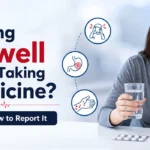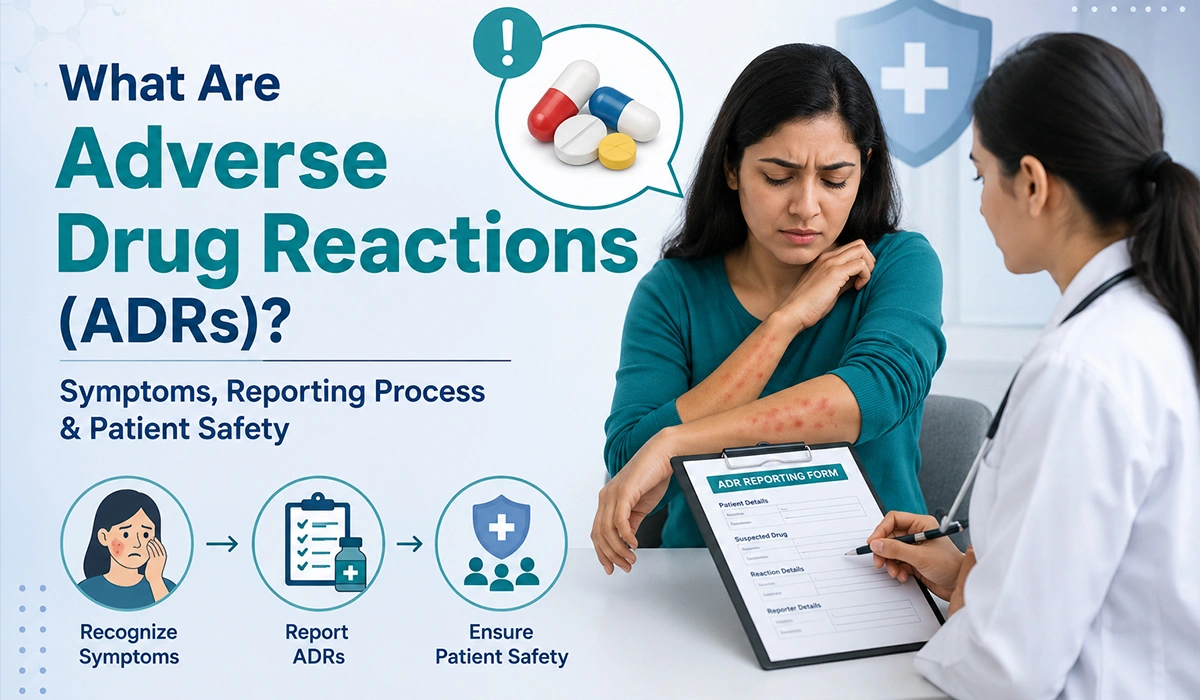
What Are Adverse Drug Reactions (ADRs)?
A medicine may be prescribed to treat one problem, but sometimes it can cause an unwanted or harmful response. A patient may develop a rash after starting a new medicine, experience severe stomach upset, or notice another unexpected change.
The important question is: When should a medicine-related symptom be reported?
An adverse drug reaction (ADR) is an unwanted or harmful response associated with the use of a medicine. Pharmacovigilance systems collect these reports to identify safety signals, understand risks and help improve the safe use of medicines. The World Health Organization describes pharmacovigilance as the science and activities involved in detecting, assessing, understanding and preventing adverse effects and other drug-related problems.
In India, patients and healthcare professionals can report suspected ADRs through the Pharmacovigilance Programme of India (PvPI) coordinated by the Indian Pharmacopoeia Commission (IPC).
What Is an Adverse Drug Reaction?
An adverse drug reaction is an unwanted or harmful response associated with a medicine. It can range from mild symptoms such as nausea or headache to serious reactions that may require hospitalization or become life-threatening. Importantly, a report can be submitted when a reaction is suspected; the patient does not have to prove that the medicine caused it.
Understanding ADRs
Medicines undergo safety evaluation before they reach patients, but clinical trials cannot reveal every possible reaction. Trials may involve limited numbers of people, shorter observation periods and carefully selected participants. Safety monitoring therefore continues after medicines enter routine use.
This ongoing monitoring is known as pharmacovigilance.
It can identify:
- Previously unknown side effects
- Rare reactions
- Serious reactions
- Drug interactions
- Problems associated with particular patient groups
- Patterns involving particular medicines
- Medication-related safety concerns
Practical Tip
If a new or unusual symptom appears after starting, stopping or changing a medicine, tell a healthcare professional rather than assuming the symptom is unrelated.
ADR vs Side Effect vs Medication Error: What Is the Difference?
These terms are often used interchangeably, but they are not exactly the same.
| Term | Meaning | Example |
|---|---|---|
| Adverse Drug Reaction | Harmful or unwanted response associated with a medicine | Suspected allergic reaction after taking a medicine |
| Side Effect | An additional effect that may occur with a medicine | Drowsiness with a medicine known to cause sedation |
| Medication Error | Preventable mistake in prescribing, dispensing, administering or using a medicine | Taking the wrong dose because of an incorrect instruction |
| Drug Interaction | One medicine, food or substance changes another medicine’s effect | Two medicines affecting each other’s activity |
| Overdose | Taking more medicine than intended or recommended | Taking several doses accidentally |
Medication errors and ADRs can overlap, and medication-related harm may arise from multiple factors. WHO identifies medication errors as an important source of preventable patient harm.
Practical Tip
When reporting a suspected reaction, provide as much information as possible about all medicines, supplements and other healthcare products you were using around the time the reaction occurred.
What Are the Common Symptoms of an ADR?
ADR symptoms vary widely because different medicines affect different body systems. Common reactions may include nausea, vomiting, diarrhea, headache, dizziness, drowsiness, skin rash and itching. Some reactions can be more serious and may involve breathing difficulty, severe allergic symptoms, abnormal bleeding, organ problems or hospitalization.
Possible symptoms include:
Digestive symptoms
- Nausea
- Vomiting
- Diarrhea
- Constipation
- Abdominal discomfort
Skin-related symptoms
- Rash
- Itching
- Hives
- Swelling
- Skin peeling or blistering
Nervous-system symptoms
- Headache
- Dizziness
- Drowsiness
- Confusion
- Tremors
Other possible symptoms
- Changes in blood pressure
- Palpitations
- Unusual bleeding
- Changes in blood tests
- Breathing problems
The presence of a symptom does not automatically mean that a medicine caused it. Illnesses, infections, allergies and other medicines may produce similar symptoms.
Practical Tip
Record when the symptom started, when the medicine was taken and whether the symptom improved or worsened. This information can help a healthcare professional assess the situation.
Which ADR Symptoms Need Urgent Medical Attention?
Some symptoms should not wait for routine ADR reporting.
Seek urgent medical care for symptoms such as:
- Difficulty breathing
- Severe swelling of the face, lips, tongue or throat
- Loss of consciousness
- Severe chest pain
- Seizures
- Severe confusion
- Signs of severe bleeding
- Sudden severe weakness
- Severe skin reactions involving blistering or peeling
- Other rapidly worsening or life-threatening symptoms
A serious adverse reaction may include an event that results in death, is life-threatening, requires hospitalization or prolongs hospitalization, causes significant disability, or results in a congenital anomaly or birth defect. These are among the criteria used by PvPI for serious adverse reactions.
Do not wait for an ADR form if you are experiencing a medical emergency.
Why Do Adverse Drug Reactions Happen?
ADRs can happen because of the medicine itself, individual differences between patients, interactions with other substances, underlying health conditions or other factors. Some reactions are predictable, while others may be unexpected or rare.
Factors that can influence medicine safety include:
- Age
- Body weight
- Kidney function
- Liver function
- Allergies
- Pregnancy
- Other medical conditions
- Other medicines
- Herbal products
- Supplements
- Dose
- Duration of treatment
- Genetic differences
For example, an older adult taking several medicines may have a different risk profile from a younger person taking one medicine.
WHO highlights polypharmacy, high-risk situations and transitions of care as important areas for medication safety.
Practical Tip
Keep an updated list of your medicines and show it to your doctor or pharmacist whenever a new medicine is prescribed
Who Is More Vulnerable to Medicine-Related Harm?
Certain situations can require additional attention.
Higher-risk groups may include:
- Older adults
- Children
- Pregnant women
- People with kidney disease
- People with liver disease
- Patients taking multiple medicines
- People with a history of drug allergies
- Patients receiving high-risk medicines
This does not mean that every person in these groups will experience an ADR. Rather, individual assessment and appropriate monitoring can be particularly important.
Example
A patient taking several medicines for different health conditions may accidentally receive two products containing similar ingredients. Checking the complete medication list can help identify potential problems.
Practical Tip
Before starting a new medicine, tell your healthcare professional about prescription medicines, over-the-counter products, vitamins, supplements and herbal remedies you use.
How Are Adverse Drug Reactions Evaluated?
Quick Answer
Healthcare professionals and pharmacovigilance experts assess suspected ADR reports by examining the medicine involved, timing of exposure, symptoms, medical history, other medicines and available investigation results. A report does not automatically prove causation; multiple factors may need to be considered.
A typical evaluation may consider:
- Which medicine was taken?
- What dose was used?
- When was the medicine started?
- When did the reaction begin?
- What symptoms occurred?
- Were other medicines being used?
- Did the medicine get stopped or changed?
- Did the symptoms improve?
- Did the reaction return after re-exposure?
- Are there alternative explanations?
India’s PvPI system uses structured pharmacovigilance processes to collect and assess suspected ADR information.
Important Point
Patients do not need to determine causality themselves.
If you suspect a medicine caused a problem, report the suspected reaction and allow healthcare professionals and pharmacovigilance experts to evaluate it.
Why Should Patients Report Adverse Drug Reactions?
Reporting suspected ADRs helps medicine-safety authorities collect real-world information that may not have been identified during clinical trials. Multiple reports can help reveal patterns, generate safety signals and support actions such as warnings, monitoring recommendations or changes in medicine use.
WHO emphasizes that reliable, real-time safety information is essential for monitoring medicines. It also encourages patients to seek medical advice and report unwanted reactions even when they are uncertain whether the medicine caused them.
In India, PvPI encourages reporting of suspected reactions whether they are:
- Known or unknown
- Serious or non-serious
- Frequent or rare
Think of ADR reporting as a safety signal.
One report may represent one patient.
Thousands of reports can reveal a pattern.
That pattern can help regulators and healthcare professionals better understand medicine safety.
How to Report an ADR in India
India has a dedicated national pharmacovigilance system through PvPI, with the Indian Pharmacopoeia Commission serving as the National Coordination Centre.
Patients and healthcare professionals can report suspected ADRs through several routes.
Step 1: Recognize the suspected reaction
Note the symptom or medical problem that appeared after medicine use.
Step 2: Collect medicine information
Keep the:
- Medicine name
- Strength
- Dose
- Batch number, if available
- Manufacturer
- Prescription or packaging
- Date treatment started
- Date reaction began
Step 3: Record patient information
The reporting process may require information such as:
- Age
- Sex
- Relevant medical history
- Existing conditions
- Other medicines being taken
The current PvPI reporting form includes patient information, suspected reaction details, investigations and relevant medical/medication history.
Step 4: Report to PvPI
Patients can use the consumer medicine side-effect reporting form and submit it through an appropriate ADR Monitoring Centre or the National Coordination Centre.
PvPI provides consumer reporting forms in multiple Indian languages, including Hindi, Bengali, Gujarati, Kannada, Malayalam, Marathi, Assamese, Oriya, Tamil and Telugu.
Step 5: Use the PvPI helpline if needed
The official PvPI helpline is:
1800-180-3024
The Indian Pharmacopoeia Commission states that the helpline provides ADR reporting support and operates on working days. Its upgraded IVR system also supports ADR reporting in multiple Indian languages.
Practical Tip
For the latest forms, reporting options and ADR Monitoring Centre information, use the official Indian Pharmacopoeia Commission/PvPI resources rather than relying on unofficial websites.
What Information Should You Include in an ADR Report?
A useful report should be as complete and accurate as possible.
| Information | Why It Matters |
|---|---|
| Patient age | Helps assess risk |
| Sex | Can influence some reactions |
| Medicine name | Identifies suspected product |
| Strength | Helps assess exposure |
| Dose | Helps evaluate possible dose-related effects |
| Start date | Establishes timing |
| Reaction date | Helps assess the relationship |
| Symptoms | Describes the suspected ADR |
| Other medicines | Helps identify interactions |
| Medical history | Identifies possible risk factors |
| Investigations | Provides supporting clinical information |
| Outcome | Shows whether the patient recovered or required care |
Do not delay emergency medical treatment simply because some information is missing.
ADR Reporting in Varanasi and Uttar Pradesh
For people in Varanasi, Uttar Pradesh, ADR reporting follows India’s national pharmacovigilance framework rather than requiring a separate city-specific system.
A patient can seek help from a healthcare professional or identify an appropriate ADR Monitoring Centre (AMC) through the national PvPI network. The Indian Pharmacopoeia Commission maintains information on ADR Monitoring Centres.
This is particularly useful for patients searching online for:
- ADR reporting in Varanasi
- Medicine side-effect reporting in Varanasi
- Pharmacovigilance support in Uttar Pradesh
- How to report medicine side effects in India
- ADR reporting near me
Practical Tip
If you are in Varanasi and have a suspected ADR, first seek appropriate medical advice for your symptoms. For formal reporting, use the national PvPI channels.
How Can Patients Reduce the Risk of ADRs?
No medicine is completely free from risk, but safer medication practices can reduce avoidable harm.
1. Take medicines exactly as prescribed
Do not change the dose without professional advice.
2. Do not share prescription medicines
A medicine appropriate for one person may be unsafe for another.
3. Tell your doctor about allergies
Previous reactions can be important when selecting medicines.
4. Keep a medicine list
Include prescriptions, OTC medicines, vitamins and supplements.
5. Ask questions
WHO’s Medication Without Harm initiative promotes the simple patient-safety approach:
Know. Check. Ask.
6. Check labels
Look carefully at medicine names, strengths and instructions.
7. Avoid duplicate ingredients
Some products may contain the same active ingredient under different brand names.
8. Do not stop essential medicines suddenly
Some medicines need gradual dose reduction or medical supervision.
ADRs, Medication Errors and Patient Safety
Patient safety is broader than adverse drug reactions.
It includes preventing:
- Wrong medicine
- Wrong dose
- Wrong patient
- Wrong route
- Drug interactions
- Allergic reactions
- Monitoring failures
- Communication errors
WHO reports that medication-related harm represents a substantial proportion of preventable harm in healthcare. Its 2024 policy brief notes that medicines and therapeutic options account for nearly half of preventable harm in medical care.
This is why medication safety requires cooperation between:
Patients + Doctors + Pharmacists + Nurses + Hospitals + Regulators + Pharmaceutical Companies
What Happens After You Report an ADR?
An ADR report becomes part of a larger medicine-safety monitoring system. Pharmacovigilance teams review reports, assess patterns and look for potential safety signals. A single report does not necessarily prove that a medicine caused an event, but individual reports can contribute valuable evidence when combined with other information.
The broader process may involve:
Patient experiences a suspected reaction
↓
ADR is reported
↓
Report is reviewed
↓
Relevant information is assessed
↓
Potential safety signals are investigated
↓
Regulatory or safety action may be considered when appropriate
The WHO Programme for International Drug Monitoring allows participating countries to contribute individual case safety reports to the global VigiBase database.
Why Pharmacovigilance Matters for Modern Healthcare
Pharmacovigilance is not simply about collecting complaints.
It is a continuous safety process.
Medicines are used by millions of people with different:
- Ages
- Genetics
- Diets
- Medical conditions
- Medication combinations
- Environments
- Treatment durations
Real-world medicine use can therefore reveal safety information that was not fully visible before a medicine was widely used.
WHO describes pharmacovigilance as an essential component of patient care and rational medicine use.
Why Choose a Safety-Focused Healthcare Approach?
For a healthcare organization or pharmaceutical company, patient safety should remain central to responsible medicine use.
A strong pharmacovigilance culture should include:
- Clear safety information
- Appropriate product communication
- Responsible promotion
- ADR awareness
- Proper complaint handling
- Regulatory compliance
- Healthcare-professional engagement
- Patient education
- Continuous safety monitoring
Nukind Healthcare, like other responsible pharmaceutical organizations, can use educational content to encourage patients and healthcare professionals to understand medicine safety and appropriate ADR reporting. However, product-specific safety claims should always be based on the approved product information and applicable regulatory requirements.
Case Example: Why One Report Can Matter
Consider a patient who starts a new medicine and develops an unusual skin reaction.
The patient may think:
“It is probably nothing.”
Instead, the patient tells their doctor and reports the suspected reaction.
That single report may not establish a cause. But if similar reports appear from other patients, pharmacovigilance teams may investigate whether there is a recurring safety signal.
This illustrates why reporting a suspected ADR does not mean accusing a medicine of causing harm.
It means contributing information to a safety-monitoring system.
ADR Prevention: A Simple Patient Checklist
Before taking a medicine:
ASK
- Why am I taking this medicine?
- How should I take it?
- What should I do if I miss a dose?
- What side effects should I watch for?
CHECK
- Medicine name
- Strength
- Dose
- Expiry date
- Instructions
- Possible interactions
REPORT
- Unexpected or suspected adverse reactions
- Serious symptoms
- Important medicine-related problems
SEEK HELP
- For severe or rapidly worsening symptoms
- For breathing difficulty or serious allergic symptoms
- For severe bleeding or loss of consciousness
- For other medical emergencies
Frequently Asked Questions About Adverse Drug Reactions
1. What is an adverse drug reaction?
An adverse drug reaction is an unwanted or harmful response associated with the use of a medicine. It can be mild, serious, predictable or unexpected.
2. What are common ADR symptoms?
Common symptoms can include nausea, vomiting, diarrhea, headache, dizziness, drowsiness, rash and itching. Symptoms vary depending on the medicine and patient.
3. Are ADRs the same as side effects?
Not exactly. “Side effect” is commonly used for an unwanted additional effect of a medicine, while ADR is a broader pharmacovigilance term for a harmful or unintended response associated with medicine use.
4. Who can report an ADR in India?
Both healthcare professionals and patients/consumers can report suspected adverse drug reactions through India’s PvPI system.
5. Can I report an ADR even if I am not sure the medicine caused it?
Yes. PvPI encourages reporting of suspected reactions even when a causal relationship has not been established.
6. How do I report an ADR in India?
You can use the appropriate PvPI ADR reporting form, contact an ADR Monitoring Centre, use the available reporting channels or contact the PvPI helpline.
7. What is the PvPI helpline number?
The official PvPI helpline is 1800-180-3024. The IPC states that it provides support for ADR reporting.
8. Can patients report ADRs in Hindi?
Yes. PvPI provides consumer medicine side-effect reporting forms in Hindi and several other Indian languages.
9. Should I stop my medicine if I experience an ADR?
Do not automatically stop a prescribed medicine without professional advice. However, severe or life-threatening symptoms require urgent medical attention.
10. What is a serious ADR?
A serious ADR can include a reaction that results in death, is life-threatening, requires hospitalization or prolongs hospitalization, causes significant disability or results in a congenital anomaly.
11. Can herbal medicines cause adverse reactions?
Yes. Pharmacovigilance includes safety monitoring of medicines as well as herbal and complementary remedies, vaccines and biological substances.
12. Can vitamins and supplements cause adverse reactions?
Yes. Supplements can also produce unwanted effects or interact with medicines. Tell your healthcare professional about all supplements you use.
13. Why is ADR reporting important?
Reporting creates real-world safety information that can help identify previously unrecognized risks and improve medicine safety.
14. Can one ADR report change medicine safety guidance?
A single report generally does not prove causation. However, individual reports can contribute to safety signals that may be investigated alongside other evidence.
15. Where can I report an ADR in Varanasi?
Patients in Varanasi can use India’s national PvPI reporting system and identify an appropriate ADR Monitoring Centre through the Indian Pharmacopoeia Commission.
Conclusion
An adverse drug reaction can be mild, serious, predictable or unexpected. What matters is recognizing unusual symptoms, seeking appropriate medical advice and contributing useful information to medicine-safety systems.
Patients do not need to prove that a medicine caused a reaction before reporting it. India’s PvPI specifically encourages reporting of suspected reactions, including reactions that are known or unknown and serious or non-serious.
For patients in India, the process is accessible through ADR reporting forms, ADR Monitoring Centres and the PvPI helpline 1800-180-3024.
The larger lesson is simple:
Safe medicine use is a shared responsibility.
Patients observe what happens to their bodies. Healthcare professionals interpret clinical information. Pharmacovigilance systems connect individual experiences into broader safety knowledge.
One report may represent one experience—but every meaningful safety report can contribute to safer medicine use for many people.