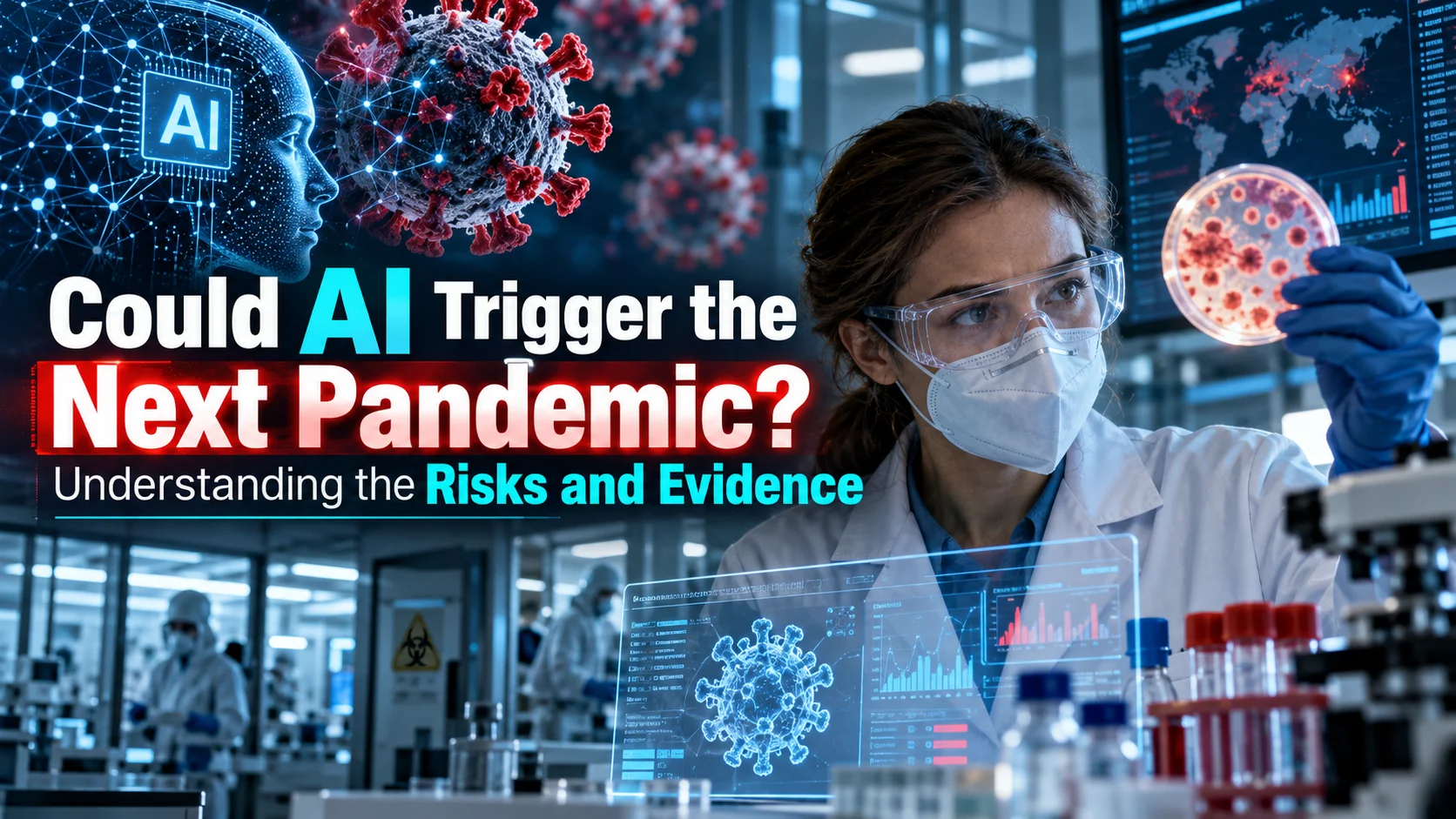
Imagine a scientist using artificial intelligence (AI) to discover a new medicine in days instead of months. Now imagine the same technology being misused to support dangerous biological research. This contrast raises an important question: Could AI trigger the next pandemic?
The short answer is that AI could increase certain biological risks, but there is no conclusive evidence that it will cause the next pandemic. Understanding the risks, scientific evidence, and available safeguards is essential for India and the rest of the world.
1. What Is AI-Enabled Biological Research?
AI-enabled biological research uses computer systems to analyse biological data, study proteins, support drug discovery, and help scientists understand diseases. These applications can improve healthcare, but some capabilities may also be misused.
2. Could AI Trigger the Next Pandemic?
AI could potentially make certain biological research tasks faster or easier for people with harmful intentions. However, designing a dangerous pathogen is far more complex than generating an answer on a computer. Biological feasibility, laboratory access, and real-world transmission all matter.
3. How Could AI Increase Biological Risks?
AI may contribute to biological risks in three broad ways:
- Knowledge assistance: Helping users understand complex scientific information.
- Research acceleration: Supporting biological design and analysis.
- Automation: Connecting AI systems with laboratory equipment or research workflows.
These capabilities do not automatically create a pandemic. The actual risk depends on how the technology is used and what safeguards are in place.
4. What Does Scientific Evidence Say?
A 2025 report from the US National Academies of Sciences, Engineering, and Medicine examined the benefits and biosecurity concerns of AI-enabled biological tools. It highlighted the need to understand how these technologies could be misused while preserving their scientific benefits.
Researchers continue to investigate how much AI changes real-world biological risk. Current evidence does not justify treating a future AI-driven pandemic as inevitable.
5. AI Risks Versus Natural Pandemic Risks
| Factor | AI-related biological risk | Natural outbreak risk |
|---|---|---|
| Potential source | Misuse of AI-assisted research | Pathogens circulating in nature |
| Human involvement | May involve deliberate misuse | May involve animal-to-human transmission |
| Prevention | AI safeguards and biosecurity | Surveillance and infection prevention |
| Main uncertainty | How much AI changes harmful capabilities | When and where new outbreaks emerge |
Both risks require scientific monitoring and effective public-health systems.
6. How Can AI Help Prevent Pandemics?
AI can also strengthen pandemic preparedness. It can help researchers analyse disease surveillance data, identify patterns, support drug discovery, and improve outbreak forecasting.
The World Health Organization recognises AI’s potential in disease surveillance and outbreak response while emphasising responsible development and oversight.
7. What Safeguards Are Needed?
Governments, researchers, and technology companies can reduce risks through:
- Testing advanced AI systems before release.
- Restricting assistance that could enable serious biological harm.
- Strengthening laboratory biosafety and biosecurity.
- Screening orders for synthetic genetic material.
- Supporting independent safety evaluations and international cooperation.
No single safeguard eliminates every risk, so multiple layers of protection are necessary.
8. What Should India Do?
India can strengthen pandemic preparedness by investing in disease surveillance, public-health laboratories, responsible AI research, and coordination between healthcare institutions and technology developers.
Hospitals, researchers, policymakers, and public-health agencies should establish clear procedures for evaluating AI tools and reporting potential safety concerns.
9. Frequently Asked Questions About AI and the Next Pandemic
Can AI create a new virus?
AI can assist biological research, but generating a model or prediction does not prove that a viable, transmissible virus can be created.
Is an AI-caused pandemic inevitable?
No. Current evidence does not establish that an AI-caused pandemic will occur.
Can AI help prevent pandemics?
Yes. AI can support disease surveillance, research, and outbreak response when properly evaluated and supervised.
Is AI in healthcare dangerous?
Not inherently. AI offers significant benefits, but high-risk applications require appropriate safeguards and human oversight.
10. Conclusion: Preparation Matters More Than Prediction
AI could change the biological risk landscape, but it can also help detect outbreaks and accelerate medical research. The priority is to develop useful technology responsibly, strengthen public-health systems, and monitor emerging risks.
For India and the global community, the goal should not be to fear every AI breakthrough. It should be to ensure that scientific progress is matched by strong safety measures.
The next pandemic is not predetermined by AI. Our preparedness, oversight, and responsible use of technology will help shape the risks ahead.