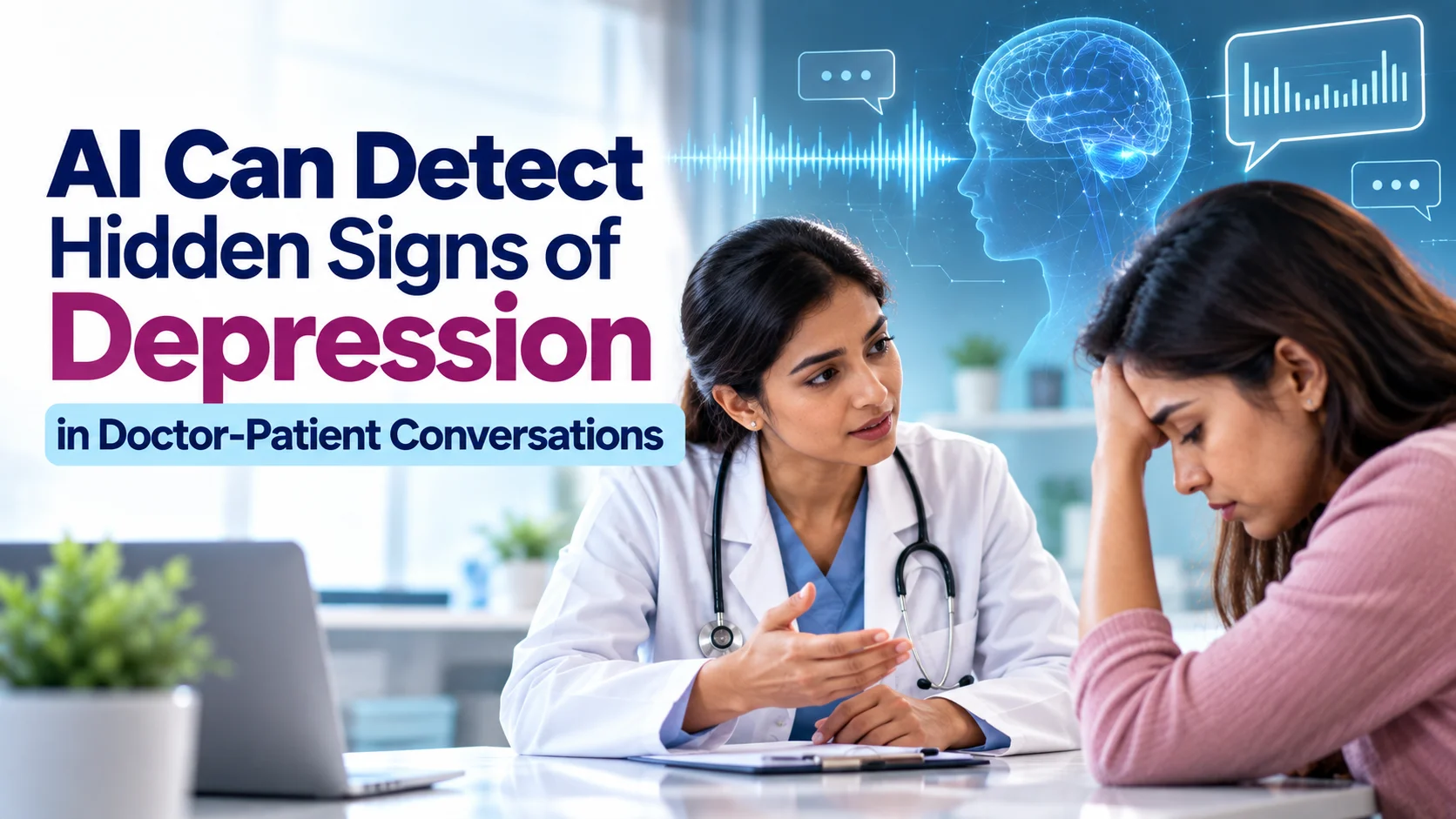
A patient may say, “I’m fine,” while their words, responses, or speech patterns suggest something more. Researchers are exploring whether artificial intelligence can identify depression-related signals hidden within doctor-patient conversations.
Recent studies show that machine-learning and large language models can analyze clinical dialogue, transcripts, and patient communications for patterns associated with depressive symptoms. However, these systems are still being evaluated and are not a replacement for professional diagnosis.
What Does AI Depression Detection Mean?
Quick answer: AI depression detection uses machine learning or natural language processing to identify patterns in spoken or written communication that may be associated with depression.
Instead of looking only for individual keywords, researchers can examine broader linguistic patterns, emotional cues, sentence-level information, and conversational features.
Can AI Analyze Doctor-Patient Conversations?
Quick answer: Yes. Research systems have been developed to analyze transcripts and recordings from clinical interviews and identify depression-related patterns.
A 2025 Scientific Reports study used machine learning to analyze clinical interview text and identify sentences containing depressive information. The researchers reported F1 scores of 0.88 and 0.86 on two research datasets.
What Hidden Signals Can AI Find?
Quick answer: AI may detect patterns involving emotional language, reduced motivation, negative sentiment, or other linguistic characteristics associated with depression.
A 2025 study involving 1,160 psychiatric outpatients found that an LLM-based system could identify clinical symptoms from psychiatrist-patient dialogues. Depression-related cases showed prominent markers involving anhedonia and decreased volition.
These are signals, not proof of depression.
How Does the Technology Work?
Quick answer: AI systems convert conversations into usable data and analyze linguistic or speech characteristics using trained models.
A simplified process looks like this:
- A clinical conversation is recorded or transcribed.
- The system processes the language or speech.
- Relevant linguistic features are extracted.
- A machine-learning model identifies patterns.
- The result may support further screening or clinical evaluation.
Some research focuses on text, while other studies examine speech characteristics such as how a person communicates. PubMed
What Does the Research Show?
Quick answer: Research is promising, but performance varies considerably between datasets, languages, conversation types, and AI models.
A recent systematic review and meta-analysis examined 123 studies of language-based depression detection. Across 43 studies included in the quantitative synthesis, pooled accuracy was about 80%, while substantial variation existed between approaches. The researchers emphasized the need for standardization and further validation before clinical use. PubMed Central (PMC)
| AI approach | What it analyzes | Research status |
|---|---|---|
| Text analysis | Words and language patterns | Actively researched |
| Speech analysis | Vocal and paralinguistic features | Under evaluation |
| Clinical dialogue analysis | Doctor-patient conversations | Promising research area |
| LLM analysis | Symptoms and conversational context | Emerging |
Why Could This Matter?
Quick answer: AI could potentially help clinicians notice patterns that deserve additional screening, particularly when consultation time is limited.
Depression can involve emotional, cognitive, behavioral and physical symptoms. Healthcare professionals typically assess symptoms, history and other aspects of a person’s life when evaluating depression.
AI could potentially function as an additional screening aid rather than another independent diagnostic authority.
Can AI Diagnose Depression?
Quick answer: AI research models should not be treated as a standalone diagnosis.
An algorithm may identify statistical patterns, but depression requires clinical assessment. Different conditions can produce overlapping symptoms, and individual communication styles vary significantly.
For example, one person may speak less because they are tired, while another may communicate differently because of anxiety, culture, language or personality.
What Are the Current Limitations?
Quick answer: Accuracy, dataset quality, language differences, privacy and real-world clinical validation remain important challenges.
Research performance can change depending on the source of the conversation and the population being studied. The recent meta-analysis found substantial heterogeneity across studies.
Privacy is another important consideration because clinical conversations contain highly sensitive health information.
Could This Technology Help in India?
Quick answer: Potentially, but Indian clinical deployment would require careful validation across languages, populations and healthcare settings.
India’s multilingual healthcare environment makes local validation particularly important. A model trained primarily on English-language datasets may not perform identically when applied to Hindi or other Indian languages and conversational styles.
This makes culturally and linguistically appropriate research essential before widespread implementation.
AI as a Clinical Support Tool
Quick answer: The most practical role for AI may be supporting screening, documentation and referral rather than replacing clinicians.
Researchers have specifically described AI-based depression detection as having potential for timely screening and referral, while noting that challenging cases still require further assessment.
The goal is not to let an algorithm decide whether someone has depression. It is to potentially give healthcare professionals another source of information.
What Should Patients Do?
Quick answer: Anyone experiencing persistent changes in mood, interest, sleep, energy, concentration or other concerning symptoms should discuss them with a qualified healthcare professional.
AI tools should not be used to self-diagnose depression. Professional assessment remains important, particularly when symptoms interfere with daily life.
The Future of AI and Mental Health
AI is opening a new research pathway: understanding what conversations may reveal beyond explicit answers.
Studies involving clinical interviews, patient messages and speech suggest that language-based AI could eventually support earlier identification of people who may need further mental-health assessment. But promising research results are not the same as proven clinical effectiveness.
The future may not be AI replacing the doctor. It may be AI helping the doctor notice more.
AI Can Detect Hidden Signs of Depression in Doctor-Patient Conversations: FAQs
Can AI detect depression from conversations?
Research suggests AI can identify language and conversational patterns associated with depression, but it cannot independently establish a clinical diagnosis.
What does AI look for in conversations?
Depending on the system, AI may analyze language, emotional patterns, symptoms, speech characteristics and other conversational features.
Can AI replace a mental-health professional?
No. AI-based detection is being researched as a potential screening or support tool, not a replacement for professional assessment.
Is AI depression detection accurate?
Performance varies by model, dataset, language and conversation type. Research shows potential but also substantial variation between studies.
Can AI detect depression from speech?
Researchers are studying speech characteristics as potential indicators of depression, but results require further clinical validation. +
Is AI depression detection available for patients in India?
AI-based mental-health technologies are developing, but availability, regulatory status and clinical validation can vary. Patients should rely on qualified healthcare professionals for diagnosis and treatment.