Introduction: What If Expert Healthcare Could Travel With You?
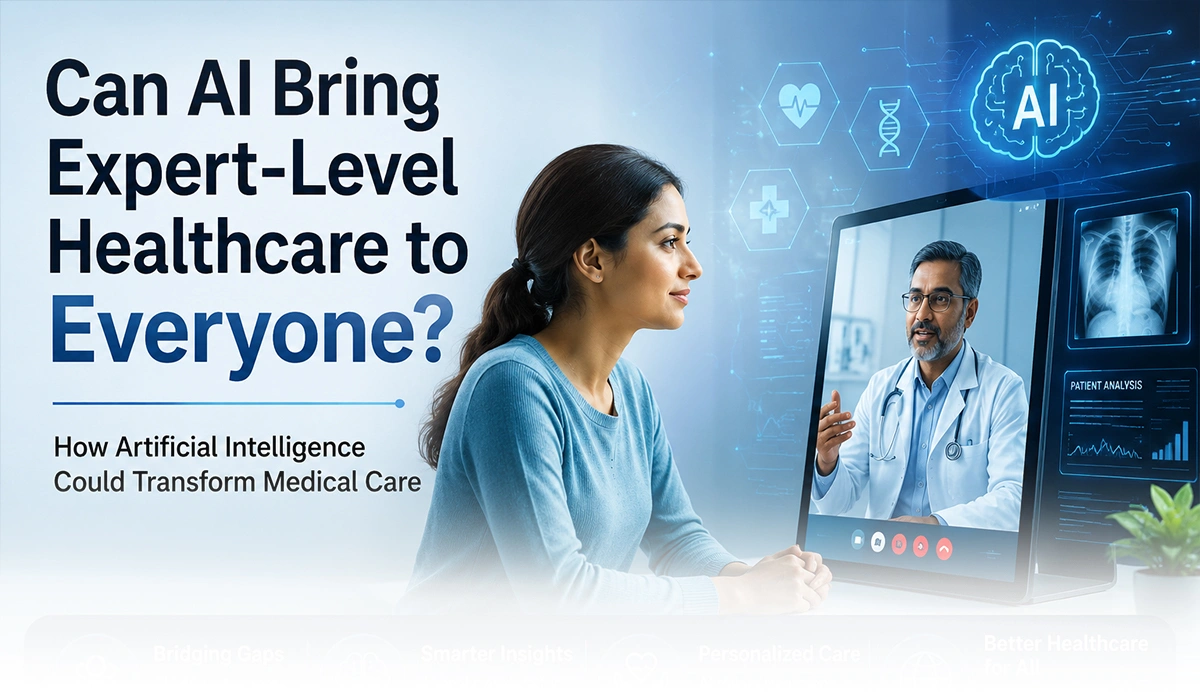
Imagine a patient in a small Indian town who has a health concern but cannot easily reach a specialist.
Today, that patient may have to travel to a larger city, wait for an appointment and potentially spend significant time and money accessing specialist care.
Now imagine a different system.
A healthcare professional has access to an AI system that can rapidly review medical information, identify patterns, summarize a patient’s history, flag possible risks and suggest questions that deserve further clinical investigation.
The patient still has a doctor.
But the doctor has a powerful digital assistant.
This is one of the most important possibilities behind AI in healthcare.
Artificial intelligence is already being used in areas such as diagnosis, clinical care, drug development, disease surveillance and health-system management. The World Health Organization says AI has significant potential to improve healthcare while warning that safety, equity, ethics and governance must develop alongside the technology.
So the real question isn’t:
“Will AI replace doctors?”
A more useful question is:
“Can AI help more people access the kind of support that was once available mainly through specialist expertise?”
The answer may be yes—but only if AI is developed and deployed responsibly.
What Is AI in Healthcare?
AI in healthcare refers to computer systems that analyze health-related information, recognize patterns, generate predictions or support clinical and administrative decisions. Applications include medical imaging, disease detection, risk assessment, personalized diagnostics, drug development and patient communication. AI is increasingly becoming a tool that supports healthcare professionals rather than simply replacing human work.
AI is not one single technology.
It includes:
- Machine learning
- Deep learning
- Natural language processing
- Computer vision
- Generative AI
- Large multimodal models
- Predictive analytics
These technologies can process different forms of information, including:
- Medical images
- Laboratory results
- Clinical notes
- Patient histories
- Genomic information
- Health records
- Text and voice
- Some forms of physiological data
The important point is that AI can process enormous amounts of information quickly.
But speed does not automatically equal medical accuracy.
Practical example
A radiologist may review hundreds of images.
An AI system can help flag images that require closer attention.
The AI does not necessarily replace the radiologist.
Instead:
AI finds patterns → clinician evaluates them → patient receives care.
Can AI Really Bring Expert-Level Healthcare to Everyone?
AI could expand access to expert-level healthcare support, but it cannot currently guarantee expert-level medical care for everyone. AI can help clinicians interpret information, identify patterns and support decisions, particularly where specialist resources are limited. However, medical judgment, physical examination, context and accountability remain essential.
This distinction is critical.
Healthcare is more than information processing.
A doctor may need to understand:
- A patient’s symptoms
- Family history
- Lifestyle
- Physical examination
- Emotional state
- Previous treatments
- Social circumstances
- Patient preferences
AI may help organize and analyze some of this information, but healthcare decisions exist within a much wider human context.
WHO describes AI as having potential to address workforce gaps and resource limitations, while emphasizing people-centered, equitable and sustainable healthcare systems.
The bigger opportunity
AI could help bring specialist-level decision support to places where specialists are scarce.
That is different from giving every person an AI doctor.
How AI Could Improve Medical Diagnosis
AI can support diagnosis by analyzing medical images, detecting patterns, assessing risks and helping clinicians identify findings that might otherwise require additional attention. The FDA identifies AI-enabled medical-device applications including image processing, early disease detection, diagnosis, prognosis and risk assessment.
Consider medical imaging.
A healthcare professional may need to examine:
- X-rays
- CT scans
- MRI images
- Ultrasound images
- Pathology images
AI can help analyze these images and identify patterns.
The potential advantage is not simply speed.
It is consistency and pattern recognition at scale.
Example
A doctor sees an unusual finding.
The AI system flags the same area.
The clinician then reviews it carefully.
This creates a second layer of support.
Practical tip
AI-assisted diagnosis should be treated as clinical decision support, not an automatic final diagnosis.
The FDA’s current AI-enabled medical-device framework emphasizes safety and effectiveness evaluation for authorized devices.
AI Could Help Where Doctors Are in Short Supply
One of AI’s biggest healthcare opportunities is supporting clinicians in areas with limited access to specialists. AI may help with screening, triage, documentation, information retrieval and decision support, allowing healthcare workers to spend more time on patients and complex cases. WHO specifically identifies workforce gaps and resource limitations as areas where AI could contribute.
This could be particularly relevant in countries such as India.
Healthcare access can vary significantly between:
Major metropolitan cities → smaller cities → rural communities.
A specialist may be concentrated in one location while patients are distributed across hundreds of communities.
AI cannot solve infrastructure problems by itself.
But it could help extend the capabilities of healthcare workers who are already serving those communities.
Example
A primary-care clinician in a smaller city could potentially use an approved AI tool to:
- Organize patient information.
- Highlight potential risk factors.
- Support interpretation of certain diagnostic information.
- Suggest evidence-based questions.
- Help determine whether specialist referral may be appropriate.
The doctor remains responsible for the clinical decision.
AI and Personalized Healthcare
AI could make healthcare more personalized by combining multiple types of patient information and identifying patterns that may not be obvious through manual review alone. Potential applications include risk assessment, personalized diagnostics and treatment-support tools. However, personalization depends on high-quality data, clinical validation and appropriate privacy protections.
Traditional healthcare often works with broad categories.
AI could help move toward:
“What works for people like this patient?”
rather than simply:
“What usually works for this condition?”
For example, future systems could potentially analyze combinations of:
- Medical history
- Laboratory results
- Imaging
- Medication history
- Lifestyle
- Genetic information
- Previous treatment response
The goal would be to provide more individualized insights.
But personalization has a major requirement:
better data.
Poor-quality data can produce poor-quality recommendations.
AI Could Make Healthcare More Preventive
AI could help shift healthcare from reacting to illness toward identifying risk earlier. By analyzing patterns in health data, AI systems may help identify people who require additional assessment or monitoring. However, predictions are not diagnoses, and risk alerts must be clinically validated before they are used for patient decisions.
Imagine healthcare working like this:
Today:
Patient becomes seriously unwell → seeks care.
Potential future:
AI identifies concerning pattern → healthcare professional reviews it → patient receives earlier assessment.
This could be especially valuable for conditions where early detection improves outcomes.
AI-enabled medical devices are already being developed and authorized for applications involving early disease detection and risk assessment.
Important distinction
Risk prediction ≠ disease diagnosis.
An AI system may say:
“This pattern deserves attention.”
It should not automatically mean:
“You definitely have this disease.”
AI in Drug Discovery and Pharmaceutical Research
AI is increasingly being explored across pharmaceutical development, including drug discovery, molecular analysis and other stages of research. WHO recognizes AI’s potential in pharmaceutical development and delivery, while also highlighting the need for appropriate governance and safety.
Drug development can take years and requires extensive research.
AI may help researchers:
- Analyze scientific literature
- Identify biological patterns
- Explore potential drug candidates
- Predict molecular properties
- Support clinical research
- Analyze complex datasets
The value is potentially enormous because researchers can use computational systems to explore possibilities much faster than manual approaches alone.
But a computer-generated candidate is not automatically a medicine.
It still needs:
Laboratory research → preclinical testing → clinical trials → regulatory review → manufacturing controls → monitoring
This is especially important for pharmaceutical companies and healthcare organizations adopting AI.
Can AI Help Patients Understand Their Health?
Yes, AI can help explain medical information in simpler language, summarize health documents and support patient education. However, AI-generated health information can be incomplete or incorrect, so patients should not treat general AI responses as a substitute for professional diagnosis or treatment.
One of the most powerful uses of generative AI may be surprisingly simple:
translation.
Not just language translation.
AI can translate:
medical language → understandable language.
For example:
Instead of a complicated medical report, a patient could receive a plain-language explanation of what certain terms mean and what questions to ask their healthcare professional.
That could improve health literacy.
But there is a boundary
AI should help people understand healthcare.
It should not encourage people to ignore qualified medical advice.
AI and Remote Healthcare in India
AI could strengthen telemedicine and remote healthcare by supporting clinical documentation, triage, translation, patient communication and decision support. In India, where healthcare access varies by geography, these tools could help connect healthcare workers and patients with additional digital capabilities.
Imagine a healthcare system where:
Patient → Local healthcare worker → Telemedicine → AI support → Specialist
This could create a connected care pathway.
AI may help with:
- Translating patient information
- Summarizing medical histories
- Organizing clinical notes
- Identifying potential risk
- Supporting referral decisions
- Patient education
But connectivity, affordability, digital literacy and data protection remain essential.
AI cannot improve healthcare access if people cannot access the underlying healthcare system.
What Are the Biggest Benefits of AI in Healthcare?
The major potential benefits include faster information analysis, improved decision support, earlier detection, greater access to specialist knowledge, personalized care, reduced administrative workload and faster medical research. WHO sees AI as a potentially important tool for more equitable and sustainable healthcare, provided safety and governance are built into implementation.
| Potential benefit | How AI may help |
|---|---|
| Faster analysis | Processes large datasets quickly |
| Diagnosis support | Identifies patterns |
| Early detection | Flags potential risks |
| Personalized care | Combines patient-specific information |
| Healthcare access | Supports clinicians in underserved areas |
| Research | Accelerates data analysis |
| Administration | Reduces repetitive documentation |
| Patient education | Simplifies complex information |
| Drug discovery | Helps explore research possibilities |
The important word is support.
AI should strengthen healthcare systems rather than become an uncontrolled replacement for them.
What Are the Risks of AI in Healthcare?
AI in healthcare can introduce risks involving incorrect outputs, biased data, privacy, cybersecurity, lack of transparency, unclear accountability and unequal access. WHO emphasizes human autonomy, safety, transparency, accountability and equity as core principles for responsible AI in health.
The technology may be powerful, but it is not infallible.
Key risks
1. Incorrect information
AI can generate inaccurate conclusions.
2. Bias
If training data does not adequately represent different populations, performance may vary.
3. Privacy
Health information is highly sensitive.
4. Accountability
Who is responsible if an AI-assisted decision causes harm?
5. Overreliance
Healthcare workers may become too dependent on automated recommendations.
6. Digital inequality
Advanced AI could benefit wealthy systems first while underserved communities remain behind.
WHO has warned that rapid AI adoption without appropriate legal and ethical safeguards could deepen inequities rather than reduce them.
AI vs Doctor: Who Is Better?
AI and doctors should not be treated as simple competitors. AI can process large amounts of information quickly and recognize patterns, while healthcare professionals bring clinical judgment, physical examination, communication, ethics and accountability. The strongest model is likely to combine AI capabilities with qualified human oversight.
| AI | Healthcare Professional |
|---|---|
| Processes data quickly | Understands patient context |
| Recognizes patterns | Applies clinical judgment |
| Works continuously | Communicates empathetically |
| Can summarize information | Performs physical examination |
| Can support prediction | Takes responsibility for care |
| Scales computational tasks | Understands human preferences |
The future may therefore be:
Doctor + AI > Doctor alone
rather than:
AI > Doctor
The exact balance will depend on the clinical task.
Can AI Replace Doctors?
AI is unlikely to replace the full role of doctors because healthcare involves physical examination, judgment, communication, ethics and responsibility. AI may automate or support specific tasks, but complete medical care involves far more than pattern recognition.
A doctor does not simply identify diseases.
A doctor also:
- Talks to patients
- Understands concerns
- Examines the body
- Explains choices
- Weighs risks
- Makes decisions under uncertainty
- Coordinates care
- Takes professional responsibility
AI can support many of these processes.
But it cannot simply replace the human relationship at the center of healthcare.
How Can Healthcare Organizations Adopt AI Responsibly?
Healthcare organizations should introduce AI gradually, validate tools for their intended clinical use, protect patient data, train healthcare workers and establish clear accountability. AI systems should be monitored after deployment rather than treated as permanently reliable once introduced.
A responsible implementation framework can follow six steps:
1. Define the problem
Don’t adopt AI simply because it is fashionable.
2. Choose the right use case
Start with a clear clinical or operational need.
3. Validate performance
Test the system with relevant populations and real-world conditions.
4. Protect patient information
Implement strong privacy and cybersecurity measures.
5. Train healthcare workers
Users need to understand both capabilities and limitations.
6. Monitor continuously
AI performance can change when data, workflows or populations change.
The FDA’s AI-enabled-device framework emphasizes safety and effectiveness, while its recent guidance work also addresses transparency, bias and lifecycle management.
What Does Responsible AI Healthcare Look Like?
A responsible healthcare AI system should be:
Safe
Patient safety comes first.
Transparent
Users should understand what the system is designed to do.
Fair
Performance should be assessed across relevant populations.
Private
Sensitive health information must be protected.
Accountable
There should be clear responsibility for decisions.
Human-centered
Patients and healthcare workers remain central.
WHO’s guidance emphasizes human autonomy, well-being and safety, transparency, accountability, inclusiveness and equity as fundamental principles for AI in health.
Why Human Expertise Still Matters
AI can provide powerful computational support, but human expertise remains essential because healthcare decisions involve uncertainty, context, values and responsibility. The best use of AI is therefore not to remove human expertise but to make qualified healthcare professionals more informed, efficient and capable.
Consider a difficult medical decision.
Two patients may have the same diagnosis but different:
- Ages
- Medical histories
- Allergies
- Medications
- Family circumstances
- Preferences
- Risk tolerance
A purely algorithmic answer may miss important context.
A trained healthcare professional can ask:
“What matters most to this patient?”
That question is at the heart of human-centered healthcare.
AI Healthcare in India: What Could the Future Look Like?
India could use AI to strengthen diagnostics, telemedicine, medical research, healthcare administration and access to specialist support. The greatest opportunity may be combining AI with India’s existing healthcare workforce and digital-health infrastructure rather than trying to replace healthcare professionals.
A future Indian healthcare journey could look like:
Patient
↓
Digital health information
↓
Primary healthcare professional
↓
AI-assisted analysis
↓
Specialist support
↓
Personalized care
This model could help reduce some geographic barriers.
But technology alone cannot solve every healthcare challenge.
India will also need:
- Reliable digital infrastructure
- Skilled healthcare professionals
- Data governance
- Cybersecurity
- Affordable access
- AI literacy
- Strong regulation
- Public trust
WHO’s global AI-for-health strategy similarly emphasizes country-level implementation, equity and responsible governance.
The Future: From AI Assistant to Healthcare Intelligence
The next stage of AI in healthcare may not be one giant system that “knows everything.”
Instead, healthcare could develop a network of specialized AI tools.
One might help analyze images.
Another might summarize medical records.
Another could support drug research.
Another might help identify population-level disease trends.
Another could help patients understand medical information.
The healthcare professional could become the human decision-maker working with multiple intelligent tools.
This could create a new model:
Human expertise + AI intelligence + better data + stronger healthcare systems
The goal should not be technology for technology’s sake.
The goal should be:
better care, earlier action, wider access and better outcomes.
AI Healthcare: Benefits vs Risks
| Area | Opportunity | Risk |
|---|---|---|
| Diagnosis | Faster pattern recognition | False positives/negatives |
| Patient education | Easier explanations | Incorrect information |
| Research | Faster analysis | Poor-quality data |
| Personalized care | Patient-specific insights | Privacy concerns |
| Rural healthcare | Expanded decision support | Digital access gaps |
| Administration | Less repetitive work | Automation errors |
| Drug discovery | Faster candidate exploration | Validation challenges |
| Public health | Disease surveillance | Data governance |
| Medical devices | New diagnostic capabilities | Safety concerns |
The lesson is simple:
Every AI benefit requires an equally serious approach to risk management.
Frequently Asked Questions: AI in Healthcare
1. Can AI bring expert-level healthcare to everyone?
AI could expand access to expert-level support, particularly where specialists are limited. However, it cannot currently guarantee expert-level healthcare for everyone and should work alongside qualified healthcare professionals.
2. How is AI used in healthcare?
AI is used or being developed for medical imaging, diagnosis support, risk assessment, personalized diagnostics, drug development, patient communication, administrative tasks and disease surveillance.
3. Can AI diagnose diseases?
Some AI-enabled medical devices are designed for specific diagnostic or screening applications. However, an AI output should not automatically be treated as a final diagnosis. Clinical context and professional assessment remain important.
4. Will AI replace doctors?
AI is more likely to automate or support specific healthcare tasks than replace the complete role of doctors. Human judgment, communication, examination and accountability remain essential.
5. Can AI improve healthcare in India?
Yes, potentially. AI could support diagnostics, telemedicine, healthcare administration, medical research and specialist decision support, particularly when combined with India’s healthcare workforce and digital infrastructure.
6. Is AI safe for healthcare?
AI can be useful when properly validated and regulated, but it also introduces risks involving bias, privacy, incorrect outputs and accountability. WHO recommends strong governance and ethical safeguards for AI in health.
7. Can AI help with medical imaging?
Yes. AI-enabled medical devices are being used for applications involving image processing and early disease detection, among other uses.
8. Can AI personalize medical treatment?
AI can potentially support personalized diagnostics and risk assessment by analyzing patient-specific information. However, personalized medical decisions require clinical validation and professional oversight.
9. Can AI help discover new medicines?
AI can support pharmaceutical research and drug development by analyzing complex biological and chemical data. However, AI-generated candidates still require laboratory, preclinical and clinical validation.
10. Should patients use AI instead of seeing a doctor?
No. AI can help people understand health information, but it should not replace professional evaluation, particularly for serious, persistent or worsening symptoms.
11. How can healthcare organizations use AI responsibly?
Organizations should define clear use cases, validate systems, protect patient data, train users, establish accountability and continuously monitor performance.
12. What is the future of AI in healthcare?
The future is likely to involve closer collaboration between healthcare professionals and AI systems, with AI handling more data-intensive tasks while humans retain clinical judgment, patient communication and accountability.
Conclusion: AI Could Expand Healthcare—If We Keep People at the Center
The most exciting possibility of AI in healthcare is not that a computer could become a doctor.
It is that AI could help make high-quality healthcare knowledge and decision support more widely available.
A healthcare professional in a smaller Indian city could potentially have access to tools that help analyze complex information. A patient could receive clearer explanations of medical terminology. Researchers could analyze enormous datasets faster. Pharmaceutical scientists could explore new research possibilities. Healthcare systems could identify patterns earlier and reduce some administrative burdens.
But these possibilities come with responsibilities.
AI can make mistakes.
Data can be biased.
Privacy can be compromised.
Technology can become inaccessible to the people who need it most.
And when healthcare decisions affect real human lives, someone must remain accountable.
That is why the future should not be:
AI instead of healthcare professionals.
It should be:
AI empowering healthcare professionals.
The World Health Organization’s vision is similarly centered on using AI to enhance health while preventing technology from becoming another source of inequality.
For India and the rest of the world, the opportunity is enormous.
The real promise of AI in healthcare is not replacing human expertise—it is helping more people benefit from it.