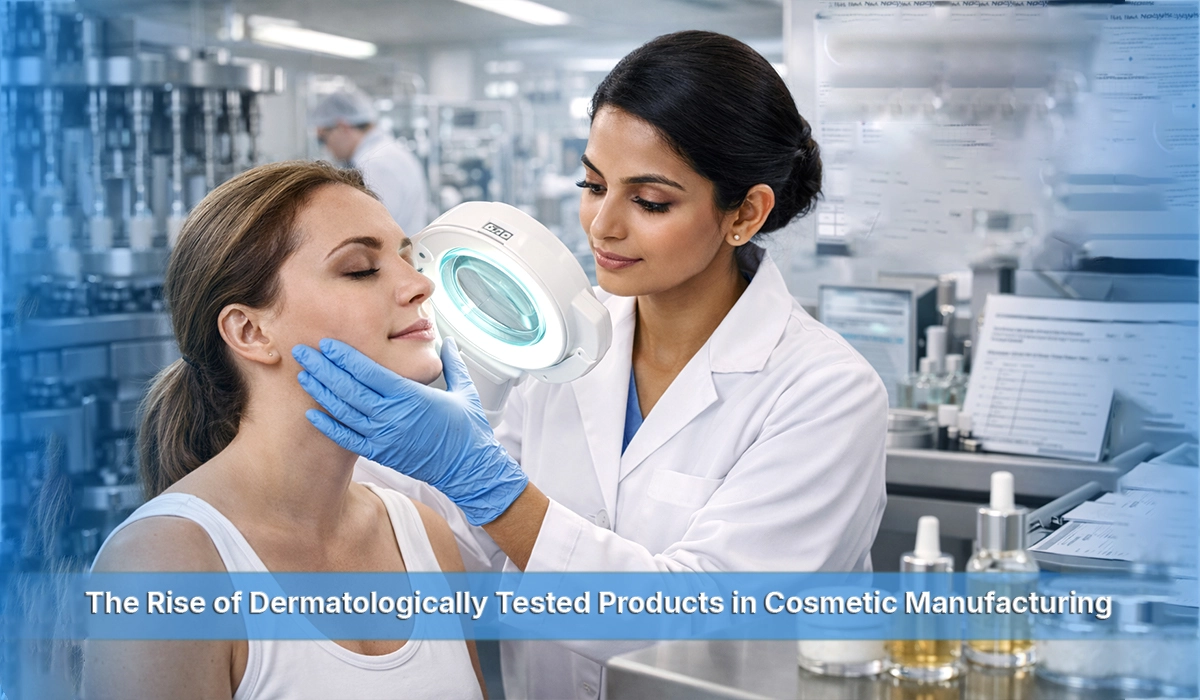
Introduction: A Simple Label That Changed Consumer Trust
Have you ever turned a skincare bottle around just to check one phrase — “dermatologically tested”?
For many consumers today, that small label means safety, credibility, and reassurance. In a world where sensitive skin issues, allergies, and product recalls make headlines, buyers are becoming more cautious. They want products that are not only effective but also safe and clinically evaluated.
This growing demand has fueled The Rise of Dermatologically Tested Products in Cosmetic Manufacturing, reshaping how cosmetic brands formulate, test, and market their products. What started as a niche requirement is now becoming an industry expectation.
Across the United States and global markets, dermatological testing has evolved from a competitive advantage to a core standard. But what does it really mean? And why is it transforming cosmetic manufacturing?
What Is The Rise of Dermatologically Tested Products in Cosmetic Manufacturing?
At its core, The Rise of Dermatologically Tested Products in Cosmetic Manufacturing refers to the growing industry shift toward clinical skin safety testing before products reach consumers.
“Dermatologically tested” means that a product has been evaluated under the supervision of a dermatologist to assess its skin compatibility.
It does not automatically mean:
- Hypoallergenic
- 100% irritation-free
- Suitable for all skin types
Instead, it indicates structured safety testing conducted on human volunteers under controlled conditions.
In cosmetic manufacturing, this rise signals a broader commitment to:
- Consumer safety
- Regulatory compliance
- Scientific validation
- Transparency
Manufacturers are no longer relying solely on ingredient safety data. They are conducting real-world testing to validate finished formulations.
Why Consumers Are Driving This Shift
The cosmetic industry has changed because consumers have changed.
Today’s buyer:
- Reads ingredient labels
- Checks certifications
- Searches product reviews
- Follows dermatologists online
- Questions brand claims
In the U.S., sensitive skin concerns are increasingly common. Pollution, stress, diet, and overuse of cosmetic actives contribute to irritation, breakouts, and inflammation.
As a result, consumers look for reassurance. “Dermatologically tested” offers that confidence.
This demand has accelerated The Rise of Dermatologically Tested Products in Cosmetic Manufacturing, forcing brands to invest in stronger safety protocols.
The Role of Clinical Testing in Modern Cosmetic Manufacturing
Dermatological testing is not just marketing. It involves structured evaluation processes such as:
Patch Testing
Small amounts of product are applied to the skin under controlled conditions to check for irritation.
Repeat Insult Patch Testing (RIPT)
Assesses long-term sensitivity after repeated exposure.
Safety Assessment Protocols
Monitoring redness, itching, inflammation, and allergic reactions.
Cosmetic manufacturers now integrate these protocols during product development rather than after launch.
This proactive approach reduces:
- Product recalls
- Consumer complaints
- Legal risks
- Brand damage
Regulatory Influence in the United States and Global Markets
Regulatory frameworks are also fueling The Rise of Dermatologically Tested Products in Cosmetic Manufacturing.
In the U.S., cosmetic regulations are evolving toward greater transparency and safety requirements.
While dermatological testing is not always legally mandatory, it strengthens compliance readiness and reduces risk exposure.
International markets such as:
- European Union
- Canada
- Australia
often require stricter safety documentation. Manufacturers aiming for global distribution are adopting dermatological testing as a standard practice.
Sensitive Skin Awareness and Ingredient Scrutiny
Consumers today are more informed about ingredients like:
- Parabens
- Sulfates
- Fragrances
- Retinoids
- Acids
This ingredient awareness has increased anxiety around skin reactions.
Dermatologically tested products help bridge the gap between active performance and skin tolerance.
Cosmetic manufacturers now balance:
- Efficacy
- Stability
- Skin compatibility
This balance is central to the rise in dermatological testing practices.
The Marketing Value of Dermatological Testing
Beyond safety, there is a strategic advantage.
When brands label products as dermatologically tested, they signal:
- Professional validation
- Scientific credibility
- Responsibility
- Premium positioning
In competitive retail environments, that label influences buying decisions quickly.
This explains why The Rise of Dermatologically Tested Products in Cosmetic Manufacturing is also a branding shift.
Innovation in Cosmetic Formulation
Dermatological testing has reshaped how products are formulated.
Manufacturers now prioritize:
- Non-comedogenic bases
- Fragrance-free options
- Barrier-support ingredients
- Lower irritation profiles
Testing data informs reformulation when irritation thresholds exceed acceptable limits.
This cycle of test, analyze, adjust, and retest strengthens final product quality.
Dermatologists as Industry Partners
Modern cosmetic manufacturing increasingly collaborates with dermatologists during:
- Product development
- Testing phases
- Marketing validation
- Consumer education
Dermatologist endorsements build authority and trust.
This partnership model has become central to The Rise of Dermatologically Tested Products in Cosmetic Manufacturing.
Practical Example: How a Brand Adapts
Consider a skincare brand launching an acne serum.
Previously, it may have relied on ingredient studies alone.
Today, to meet market expectations, it:
- Conducts clinical patch testing.
- Documents irritation rates.
- Adjusts concentration if reactions exceed acceptable thresholds.
- Includes dermatologist-supervised claims.
The result?
Lower consumer risk and higher brand credibility.
Misunderstandings About Dermatologically Tested Products
Some common myths include:
- It guarantees zero irritation.
- It means dermatologist-approved.
- It ensures suitability for all skin types.
These misunderstandings highlight the need for consumer education.
The rise of dermatological testing also increases demand for transparent communication.
Economic Impact on Cosmetic Manufacturers
Dermatological testing increases production costs due to:
- Clinical study expenses
- Testing facilities
- Volunteer compensation
- Documentation compliance
However, it reduces long-term risks.
Brands that invest in dermatological testing often experience:
- Lower return rates
- Higher customer retention
- Improved brand trust
- Better global expansion opportunities
Sustainability and Ethical Considerations
Consumers also care about:
- Cruelty-free testing
- Ethical human testing practices
- Transparency in clinical methods
Modern dermatological testing avoids animal testing and prioritizes ethical human trials.
This alignment supports both safety and sustainability.
The Future of Dermatologically Tested Products
Looking ahead, The Rise of Dermatologically Tested Products in Cosmetic Manufacturing is likely to expand into:
- AI-assisted skin analysis
- Personalized dermatology-backed skincare
- Biometric skin tolerance tracking
- Data-driven formulation adjustments
As consumer expectations grow, dermatological testing may become a universal baseline standard rather than a premium feature.
Conclusion
The cosmetic industry is no longer driven only by beauty trends. It is shaped by safety, transparency, and scientific validation. The Rise of Dermatologically Tested Products in Cosmetic Manufacturing reflects a deeper shift — from marketing promises to measurable skin compatibility standards. Consumers want proof. Brands want credibility. Regulators demand responsibility. Dermatological testing connects all three. As awareness grows, dermatologically tested products will likely become the new normal — not just a label, but a sign of accountable manufacturing.